The astronomical jungle won’t have any more secrets for you after reading this ALMA Astronomical Glossary, in which you will find a collection of frequently used terms in astronomy, ALMA publications and Press Releases.
| A | B | C | D | E | F | G | H | I | J | K | L | M | N | O | P | Q | R | S | T | U | V | W | X | Y | Z |
Angular
size
Angular
size is the apparent width of an object as seen by an observer and can be
expressed in degrees, arcminutes, or arcseconds. As a reference, the angular
size of the Full Moon is 30 arcminutes, or 0.5 degree. The same angular units
are also often used to describe the separation of objects in the sky, as seen
from Earth.
An
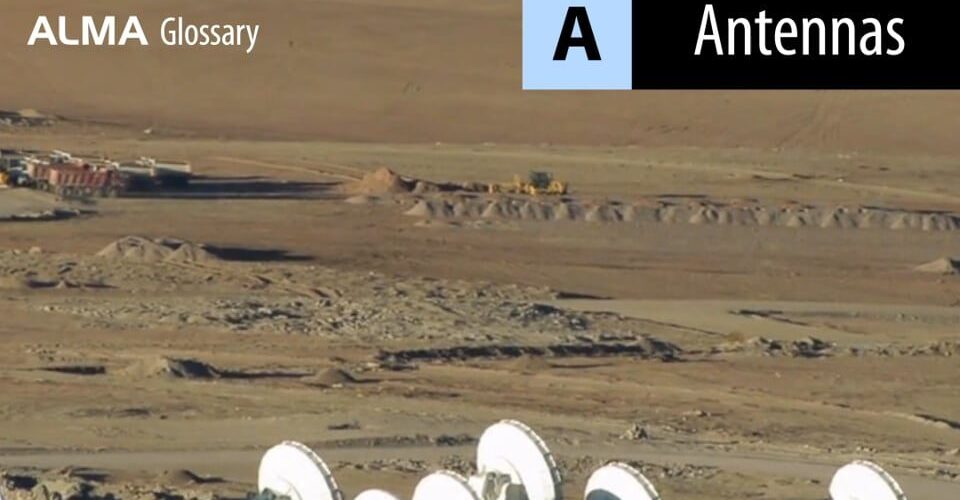
antenna is a conductor that can transmit or receive radio waves. Radio telescopes are antennas or a series of
antennas, and function in a similar way to ordinary household radio aerials.
Arcminute
/ Arcsecond
Arcminutes
and arcseconds are units used to measure angular size or distances. A 1
kilometer long line painted on the surface of the Moon would measure
approximatey 1 arcsecond as seen from Earth. There are 60 arcminutes to a
degree and 60 arcseconds to one arcminute, i.e.3600 arcseconds to one degree.
Astronomical
unit (AU)
The
astronomical unit is a unit of length used by astronomers, usually to describe
distances within planetary systems such as our Solar system. One AU is equal to 149,597,871 km, and
corresponds to the average distance from the Earth to the Sun.
An
asteroid is a small, rocky body that orbits a star. The solar system is estimated to contain 1 to 2
million asteroids, some 130,000 of which have an official number.
A
relatively new area of research in astronomy, astrobiology is concerned with
the origin, distribution and evolution of life in the Universe. It encompasses aspects of biology and geology as
well as astronomy. It is sometimes called “exobiology”.
Atmosphere
An
atmosphere is a layer of gas retained around an astronomical body (for instance
a planet) by its gravitational attraction. The Earth has an atmosphere that separates
us from outer space, as do other bodies in the solar system, such as Jupiter or
Venus. The outer gas layers of a star
are also known as its atmosphere.
Big Bang
The Big
Bang theory describes how the Universe
emerged from a small, dense, hot region in a single giant explosion (a 'big
bang'). The theory was first suggested to explain why the Universe appears to be expanding; while other theories about
the origins of the Universe do
exist, the Big Bang theory is the most widely supported by models and
observations.
A black
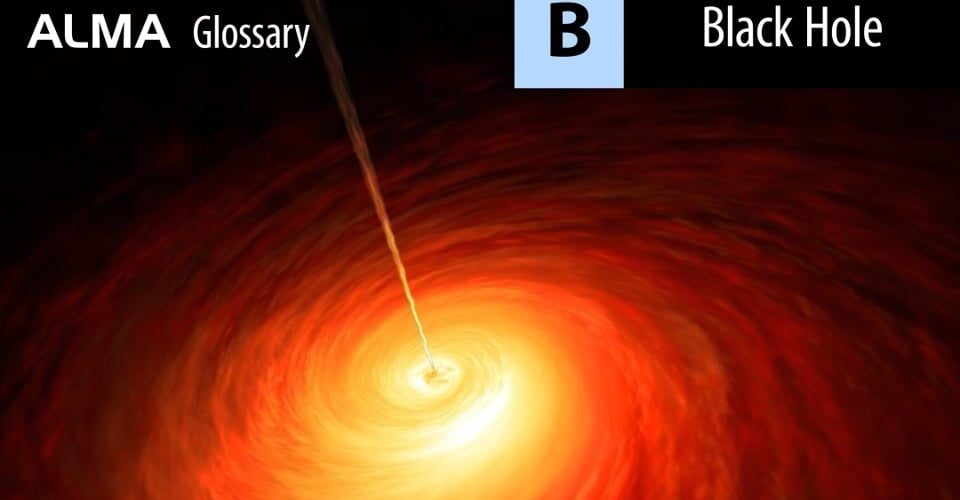
hole is a massive object or region in space that is so dense that, within a
certain radius, its gravitational force is so strong that not even light can
escape from it. Black holes do not emit radiation for us to detect, but material
falling towards them can emit large amounts of energy. They can form either
from the death of very massive stars
following a supernova
explosion, or from the collapse of large amounts of gas in the centre of galaxies.
See
Doppler Effect.
Comets
are icy rocks originating from the very outer regions of the solar system, where the gravity
of the massive planets can cause them to 'fall' into the inner solar system and pass through at
high speeds. Thus, they are often called the 'voyagers' of the solar system. The nucleus starts to emit gases and dust as it interacts with the
Sun's radiation on its path, giving rise to the characteristic 'tails'. Some comets
return at regular intervals, while others are seen just once.
A
constellation is a group of stars
that, when seen from Earth, form a pattern. Their names date back to the
ancient Greeks. The entire sky is divided up into 88 constellations, including
the constellations of the Zodiac
and many others.
Cosmology
Cosmology
is the branch of science concerned with the large-scale structure and evolution
of the Universe.
Dark
energy
Dark
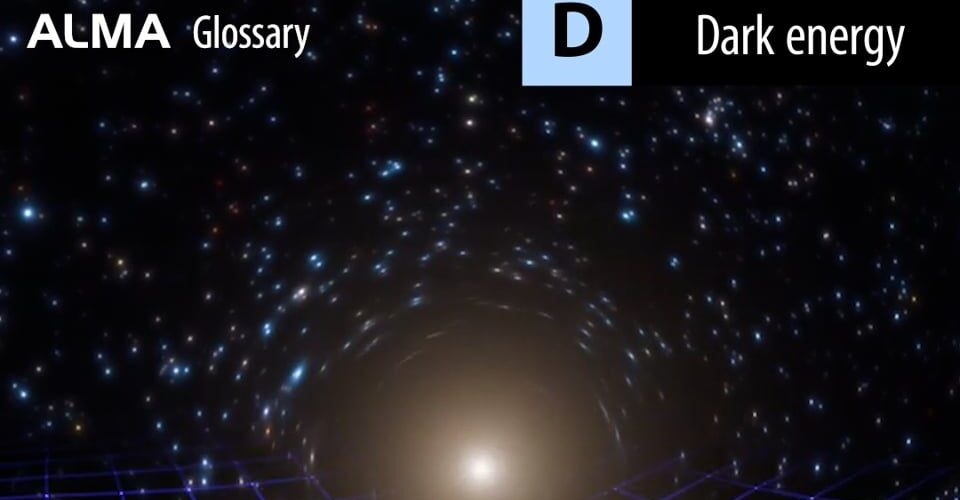
energy is a type of "negative gravity" that seems to play a role in
the acceleration of the expansion of the Universe.
Current models predict that dark energy makes up 70% of the Universe, but its nature is still
unknown.
Dark
matter
Dark
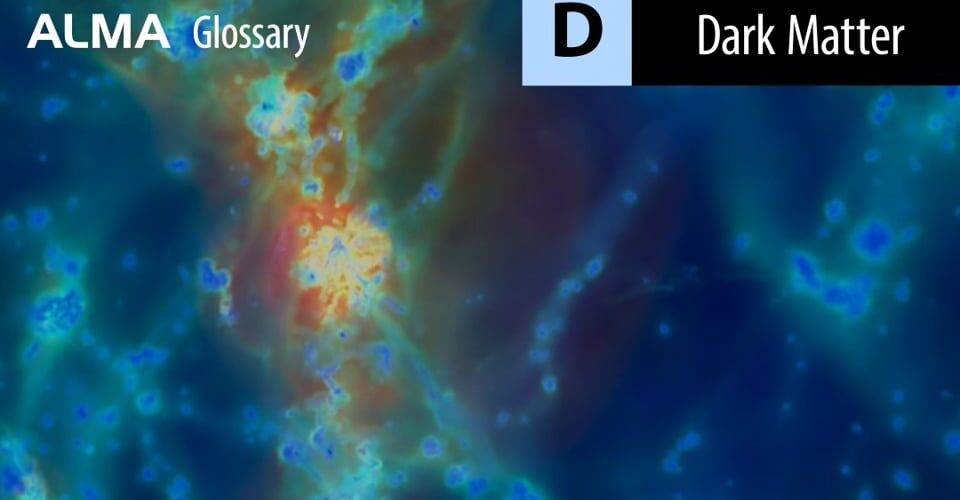
matter is material that exerts gravitational force but does not emit any
detectable light or radiation. Dark matter is thought to make up around 25% of
the content of the Universe
but its exact nature remains unknown.
Doppler
effect
The
Doppler effect (or Doppler shift) is an increase or decrease in the wavelength
of the radiation emitted by an object as it moves relative to the observer, as
observed from Earth. The wavelength is shortened, or the radiation appears
'bluer', when the source is moving towards the observer (blueshift) and
lengthened, appearing 'reddened' when moving away from them (redshift, often
denoted by the symbol 'z'). Most objects in the Universe are seen to recede from each other, and thus appear
'redshifted'. From the shift, the object's speed and distance can be
calculated. Studying objects with high redshift can give us information on
conditions in the early Universe.
Very
different from our common household dust, 'cosmic' dust is found in many parts
of the Universe: around stars, between galaxies, and throughout the solar system. It is composed of
microscopic particles (in the range of a micron
to a millimetre in size) of carbon and/or silicates. Once thought to be an
annoyance, as it obscures our view of interesting objects, dust is now known to
play an important role in many astrophysical processes, and is now a field of
study in astronomy in its own right.
Eclipse
An eclipse
occurs when the moon blocks the light from the Sun (solar eclipse) or the
Earth's shadow falls on the moon (lunar eclipse). Eclipses also occur in binary
star systems, when one of the stars passes in front of the
other.
Electromagnetic
radiation
Electromagnetic
radiation is a form of energy in the form of waves. Visible light is the most
familiar form on Earth, but the radiation is seen over a very wide range of
energies, called the electromagnetic
spectrum.
Electromagnetic
spectrum
The
electromagnetic spectrum is the name of the full range of energies electromagnetic radiation is
observed at. Many of these types of radiation are used in everyday life, such
as radio waves, microwaves,
and X-rays. In astronomy, the wavelength of radiation is often used to refer to
the wave's energy: the longer the wavelength, the lower the energy.
Radio waves form a very broad category, which includes the important submillimeter (0.3 - 1 mm) and microwave regions (1 mm - several cm).

Galaxy
Galaxies
are large structures of gas and dust,
held together by gravity, where stars
reside. They are classified according to their size and shape and contain
varying amounts of gas and dust,
from which new stars can be
born.
Galaxy cluster
Galaxy clusters are large assemblies of
galaxies that are bound together by gravity. They typically contain 50 to 1000
galaxies of all shapes and sizes and a large amount of dark matter according to models.
Gamma
rays
Gamma
rays are a high-energy form of electromagnetic
radiation produced only in the most violent events in the Universe. They are at the
shortest-wavelength end of the electromagnetic
spectrum with energies higher than X-rays. They can only be detected
from space.
Gamma-ray
burst (GRB)
Gamma ray
bursts are short and intense flashes of gamma rays, lasting from milliseconds
up to several minutes, followed by a longer lasting afterglow. As gamma rays
can only be detected from space, dedicated satellites are used to track the sky
for GRBs; ground-based telescopes then provide further observations at other
wavelengths.
Interferometer
An
interferometer is a system of two or more separate telescopes that achieves the
image quality of a much larger telescope, equivalent to the size of the
distance between the telescopes. In interferometry, the data from more than one
telescope are used simultaneously to improve the resolution.
Interstellar
medium
The
interstellar medium is made of very low density dust and gas (mostly hydrogen) located between stars in a galaxy.
Light
year
A light
year, often abbreviated 'ly', is a unit to measure distance and corresponds to
the distance light travels in a vacuum in one year, equivalent to approximately
9.46053 x 10¹² kilometers (9.5 thousand billion km).
Luminosity
Luminosity
is the total brightness of a star
or other astronomical object. It is expressed in Watts (symbol 'W') and
represents the total amount of energy that the object radiates each second over
all wavelength regions of the electromagnetic
spectrum. Luminosity is a physical property of the object and does not
depend on the distance it is being observed from.
Magellanic
Clouds
The Large
Magellanic Cloud and Small Magellanic Cloud are a pair of dwarf galaxies that orbit the Milky Way galaxy at a distance of
around 160,000 and 200,000 light years,
respectively. They are two of our most prominent galactic neighbors.
Magnitude:
Absolute Magnitude
Apparent Magnitude
The apparent magnitude of an astronomical
object (usually denoted by the symbol 'm') is a measure of its brightness as seen by an observer on Earth. The
lower the value, the brighter the object appears. The Sun, for example, has an
apparent magnitude of -26.8 whilst Venus at its brightest has an apparent
magnitude of -4.7.
Metallicity
The
metallicity of an object is the proportion of its material that is made up of
metals. In astronomy, the term 'metals' is used for any element heavier than
hydrogen or helium. The early Universe
contained predominantly hydrogen, helium and lithium, and heavier elements were
only formed when stars started
to fuse these elements into heavier ones, such as carbon and oxygen. Therefore
studying the metallicity of stars
in galaxies and clusters can
give astronomers information on their stellar history.
Meteor
A meteor
is a flash of light that occurs when a meteoroid burns up in the Earth's
atmosphere; also popularly known as a 'shooting star'.
Meteoroids
are tiny stones or pieces of metal that travel through space.
A
meteorite is a rock from space that survives the passage through Earth's atmosphere and falls to the
ground.
A micron
or micrometer is one-millionth of a meter. Although 'micron' is an outdated
term, the correct form being 'micrometer', it is still often used in astronomy.
The Milky
Way galaxy is a spiral galaxy, of which our Sun and solar system are a small part.
All of the stars that we can
see with the unaided eye are in the Milky Way Galaxy. The plane of the Milky Way looks like a faint band
of white in the night sky - hence the name 'milky'. The Milky Way measures
about 100,000 light-years in
diameter and contains around 200 billion stars.
The galaxy is the second
largest in the local galactic neighbourhood, called the Local Group.
A nebula
is a diffuse cloud of gas and dust
in intergalactic space. Nebulae can broadly be classified into mission nebulae
and reflection nebulae. In emission nebulae, the gas in the clouds is heated
and ionised by nearby stars,
causing it to 'glow'. Reflection nebulae are only visible because the dust contained within them
reflects light from nearby stars.
The term
orbit denotes the path an object follows around a more massive object or common
center of mass. For astronomical objects orbits are usually elliptical in
shape, but cases of circular (close binary stars),
parabolic or hyperbolic (comets) orbits are known.
A parsec
is a unit of distance commonly used in astronomy and cosmology, the parsec is
equal to about 3.262 light years, or 3.09 x 10¹⁶ meters. The name 'parsec'
arises from the definition of the unit, the distance at which an object is seen
to move by 1 arcsecond because of the Earth's orbit around the Sun (an effect
called 'parallax').
Photometry
is the measurement of light intensities from astronomical objects. It is a
highly important tool in astronomy.
Photons
are the carriers of individual 'packets' of electromagnetic
radiation.
A planet
is a large celestial body consisting of rocks and gas that orbits a star. It does not shine on its
own but reflects the star's
light. As an additional condition in our solar system, the body has to be large
enough to clear a free path on its orbit. There are eight planets orbiting the
Sun in the solar system.
Stars are composed of plasma, an extremely hot,
ionized gas composed of free-floating ions (positively charged) and electrons
(negatively charged).
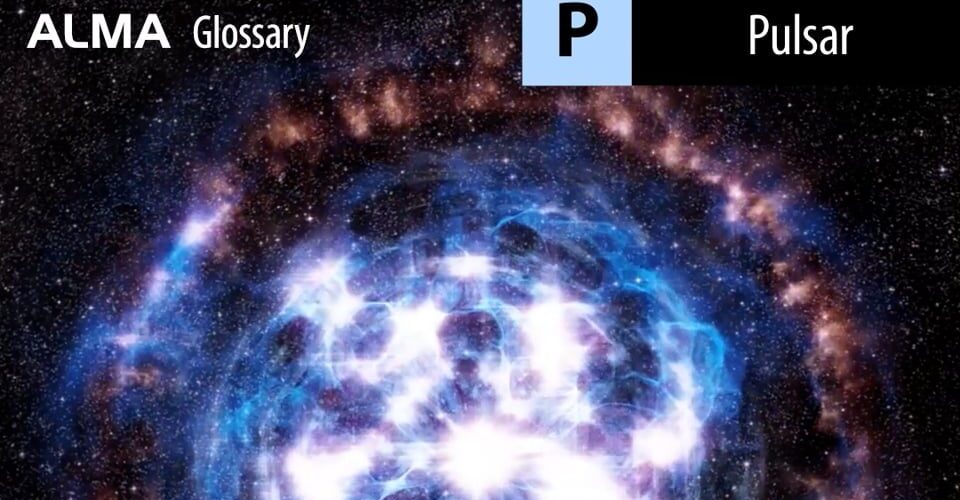
A pulsar
is a rapidly spinning neutron star
that emits strong pulses of radiation as they rotate, because of their strong
magnetic fields. A neutron star is the remnant of a massive star that died in a
supernova explosion, composed
mostly of tightly-packed neutrons. Neutron stars measure just 10-20 km in
diameter but have the same mass as the Sun.
Quasars,
named after 'quasi-stellar radio object', are highly energetic active galactic
nuclei and represent some of the most luminous objects in the Universe. Quasars were first
detected in 1963 by astronomers Maarten Schmidt and Allen R. Sandage. They are
also known as 'quasi-stellar objects' or QSOs. Because of their distance from
us they appear as point sources, which led to the name 'quasi-stellar'.
Radio
astronomy
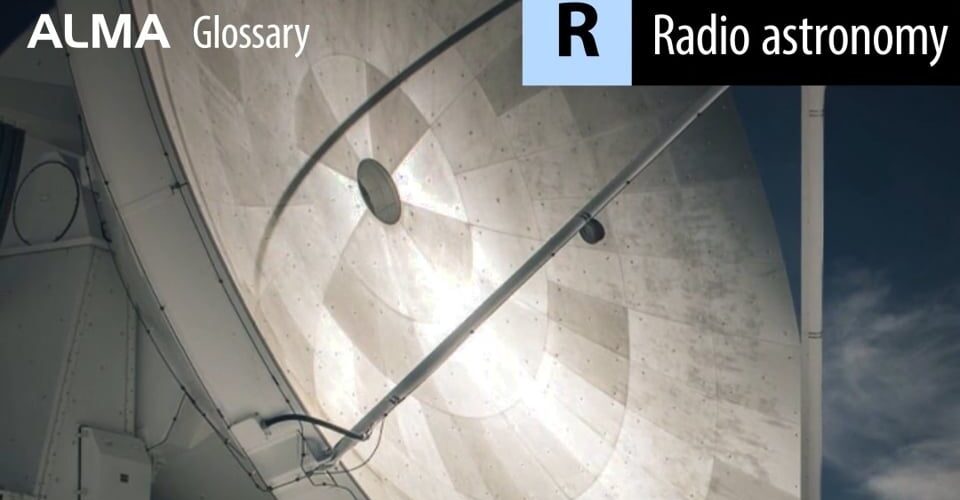
Radio
astronomy is the branch of astronomy that studies radio waves from astronomical
sources. Radio waves are
detected using special receivers, or 'antenna'.
Radio
waves are a type of electromagnetic
radiation with the longest wavelengths (and lowest energies), ranging
from 0.3 mm to several kilometers. They form a very broad category, which includes
the important submillimeter (with a wavelength of 0.3 - 1 mm) and microwave
regions (1 mm - several cm).
See
Doppler effect.
Satellite
Satellites
are objects that orbit a planet or other solar system body. Many man-made
satellites and one natural satellite (the Moon) orbit the Earth.
The term
seeing in astronomy is used to describe the disturbing effect of turbulence in
the Earth's atmosphere on incoming starlight. The study and characterization of
seeing at a given location is an important part of the site selection process for
astronomical observatories.
Solar
mass
A solar
mass is the amount of mass in our Sun; it is also the unit in which the masses
of other stars, galaxies, and other large
celestial bodies are expressed. The solar mass is 1.99 x 1030 kg, which is
about 330,000 times the Earth's mass.
Solar
system
The solar
system is the collective name for the Sun and the bodies that orbit it; this
includes eight planets and their satellites,
dwarf planets, and many small bodies.
Southern
Cross
A small
but very distinctive constellation, the Southern Cross inspired many ancient
cultures because of it prominence in the night sky. It is represented on the
ALMA logo.
Spectrograph
(spectrometer)
Spectrometers
and spectrographs are instruments that disperse the light from astronomical
sources into its spectrum and
images it for analysis. See also spectroscopy.
Spectroscopy
Spectroscopy
is the study of spectra of
astronomical objects.
In
astronomy, the spectrum of an astronomical object is the rainbow of electromagnetic radiation emitted
by the object, separated into its constituent wavelengths. The study of
astronomical spectra can give astronomers information on the chemical
composition of the source, as well as their redshift,
magnetic field, and many other properties. The study of spectra is known as
spectroscopy.
The speed
of light, usually denoted 'c', is the fastest possible speed in a vacuum,
equivalent to 300,000 km per second.
Star
A star is
a self-luminous sphere of hot gas, predominantly hydrogen, held together by
gravity; ordinary stars generate energy by nuclear fusion reactions in their
dense cores, which lead to the production of helium and heavier elements. Stars
are formed and reside in galaxies.
They are generally classified according to their temperature and luminosity.
Submillimeter
astronomy is the branch of astronomy that studies radiation in the
submillimeter part of the electromagnetic spectrum. The Atacama Large
Millimeter/submillimeter Array (ALMA) will be the world's biggest submillimeter
observatory on its completion in 2013.
Submillimeter
radiation
Submillimeter
radiation is electromagnetic radiation
with wavelengths longer than infrared radiation but shorter than microwave
radiation. It is the most energetic type of radio
waves.
Supernova
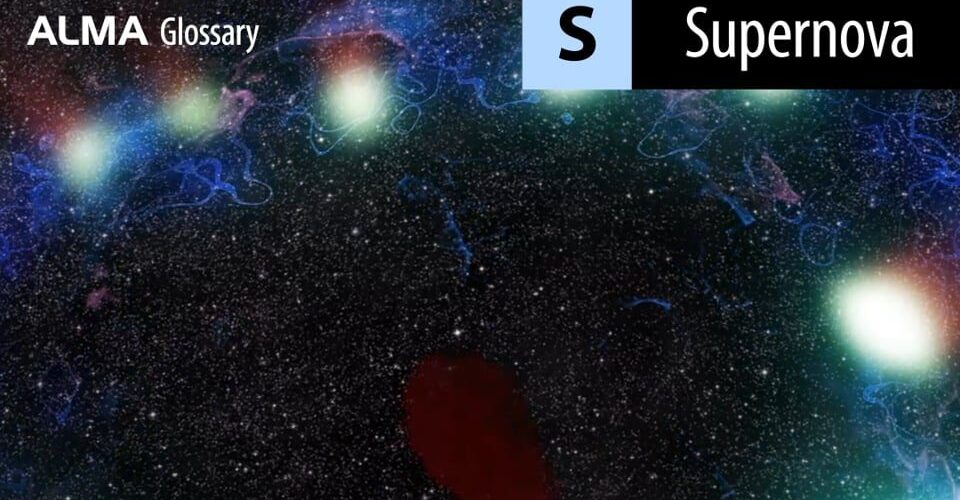
A supernova
is a huge explosion that occurs at the end of a heavy star's life. A supernova releases a tremendous amount of
energy, expelling the outer layers of the star
and momentarily becoming brighter than the entire galaxy it resides in. Alternatively a supernova explosion is
thought to occur when a white dwarf has accreted sufficient material from a
companion (see cataclysmic variable).
The
Universe is the collective term for all matter and space that exists in which
events occur or can occur. The Universe is often referred to in terms of the
'known Universe', which is all matter and space that we can observe from Earth.
The study of the Universe in its totality, its history and evolution, is called
cosmology.
Visible
light
Visible
light refers to the portion of the electromagnetic
spectrum visible to the human eye. It covers the range of wavelengths
from 400 to 750 nm.
Zodiac
The
zodiac is the region of the sky along which the Sun, Moon and planets move, as
well as a sequence of 12 constellations.
It coincides with the plane of the Earth's orbit around the Sun. The
constellations in the zodiac are: Capricorn (The Goat), Aquarius (The Water
Bearer), Pisces (The Fish), Aries (The Ram), Taurus (The Bull), Gemini (The
Twins), Cancer (The Crab), Leo (The Lion), Virgo (The Virgin), Libra (The
Balance), Scorpio (The Scorpion), and Sagittarius (The Archer).