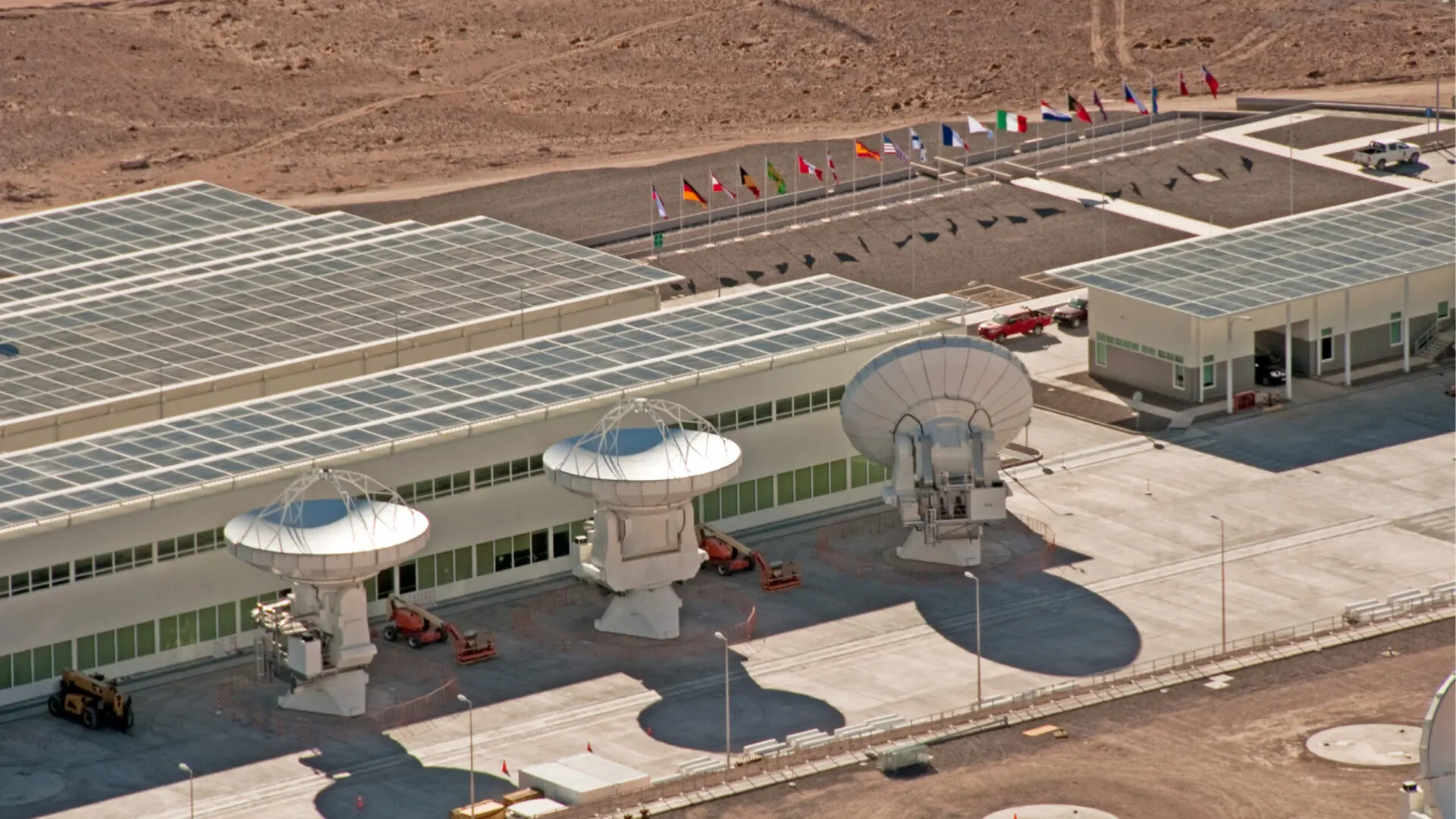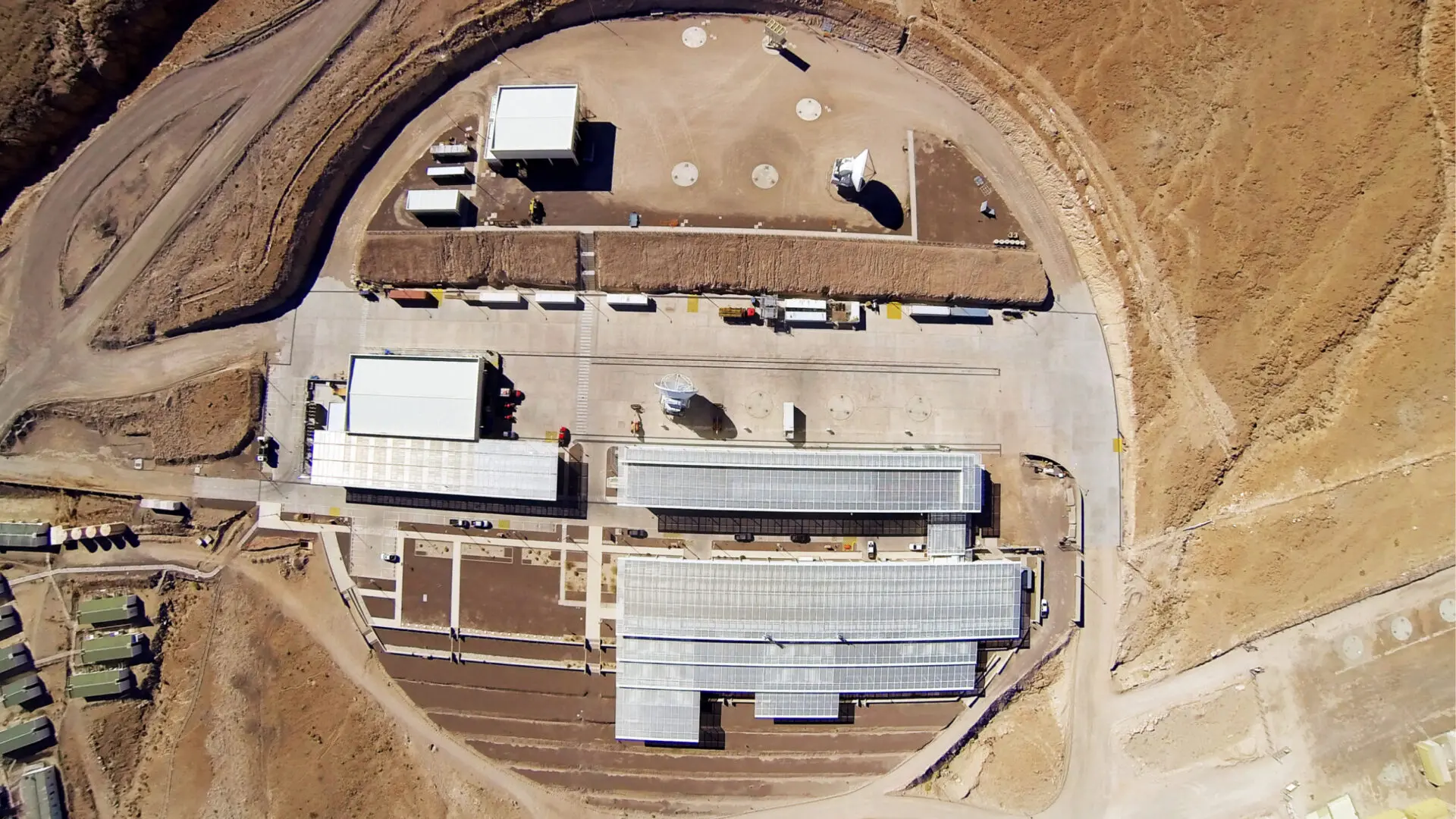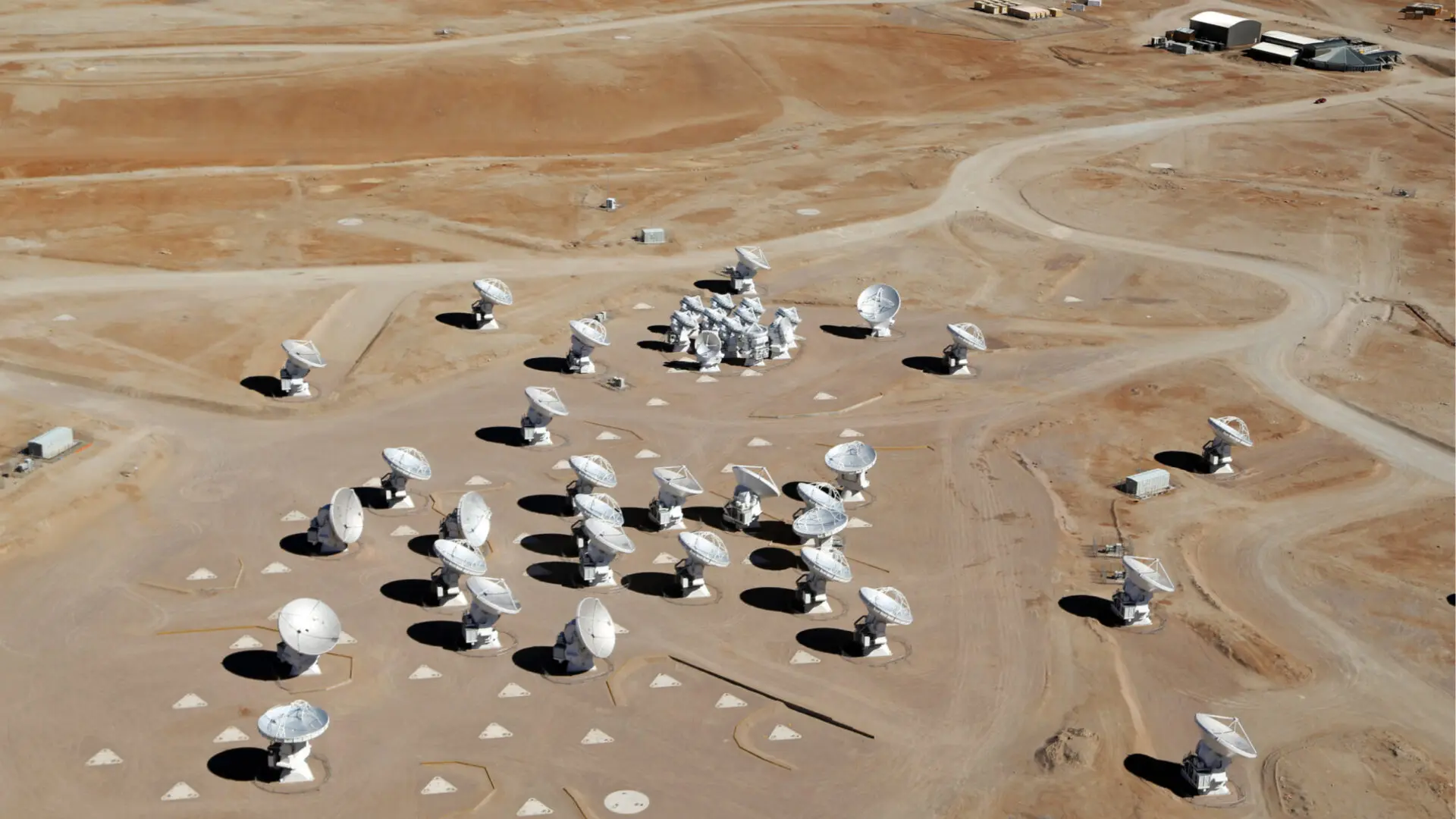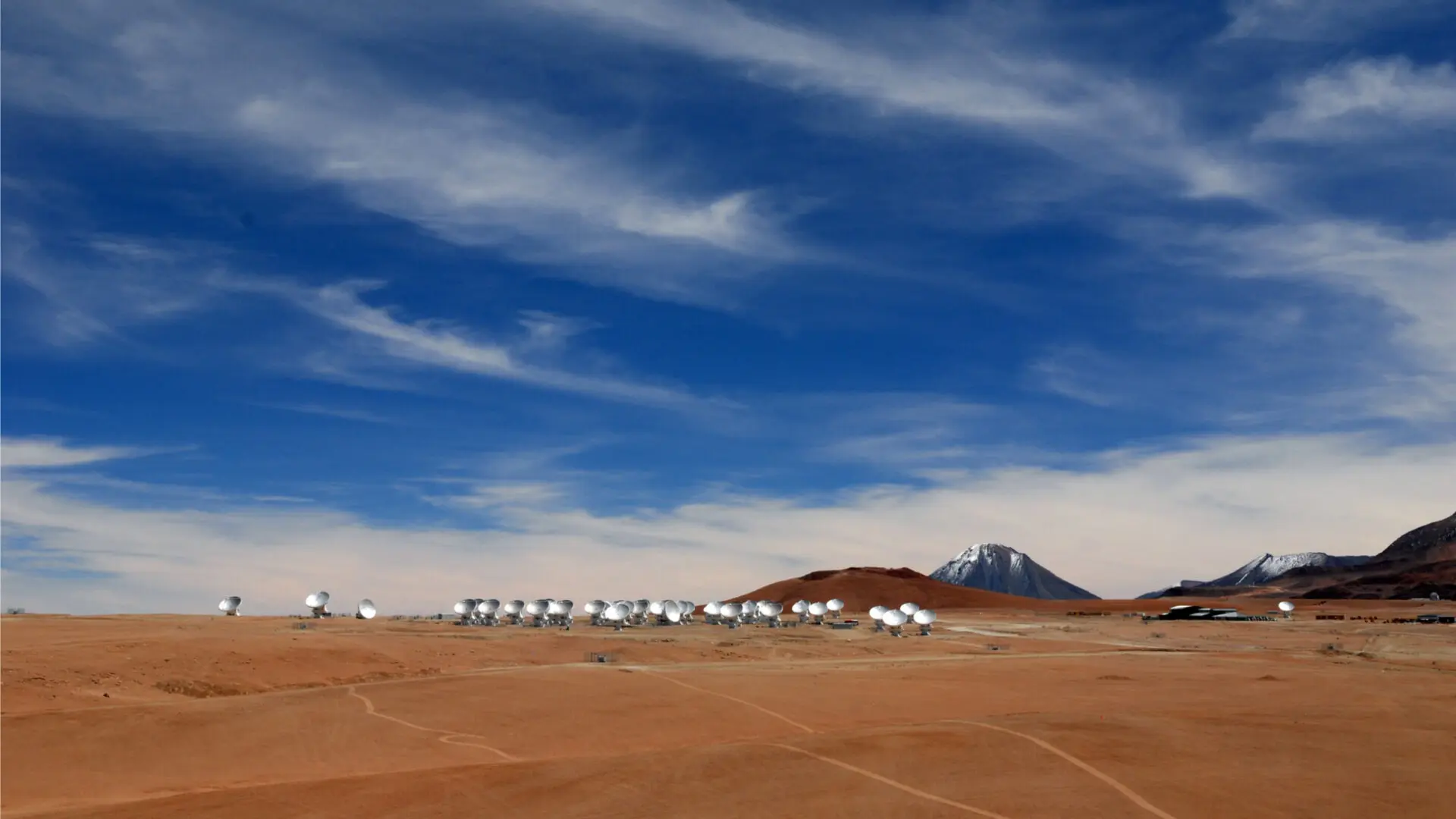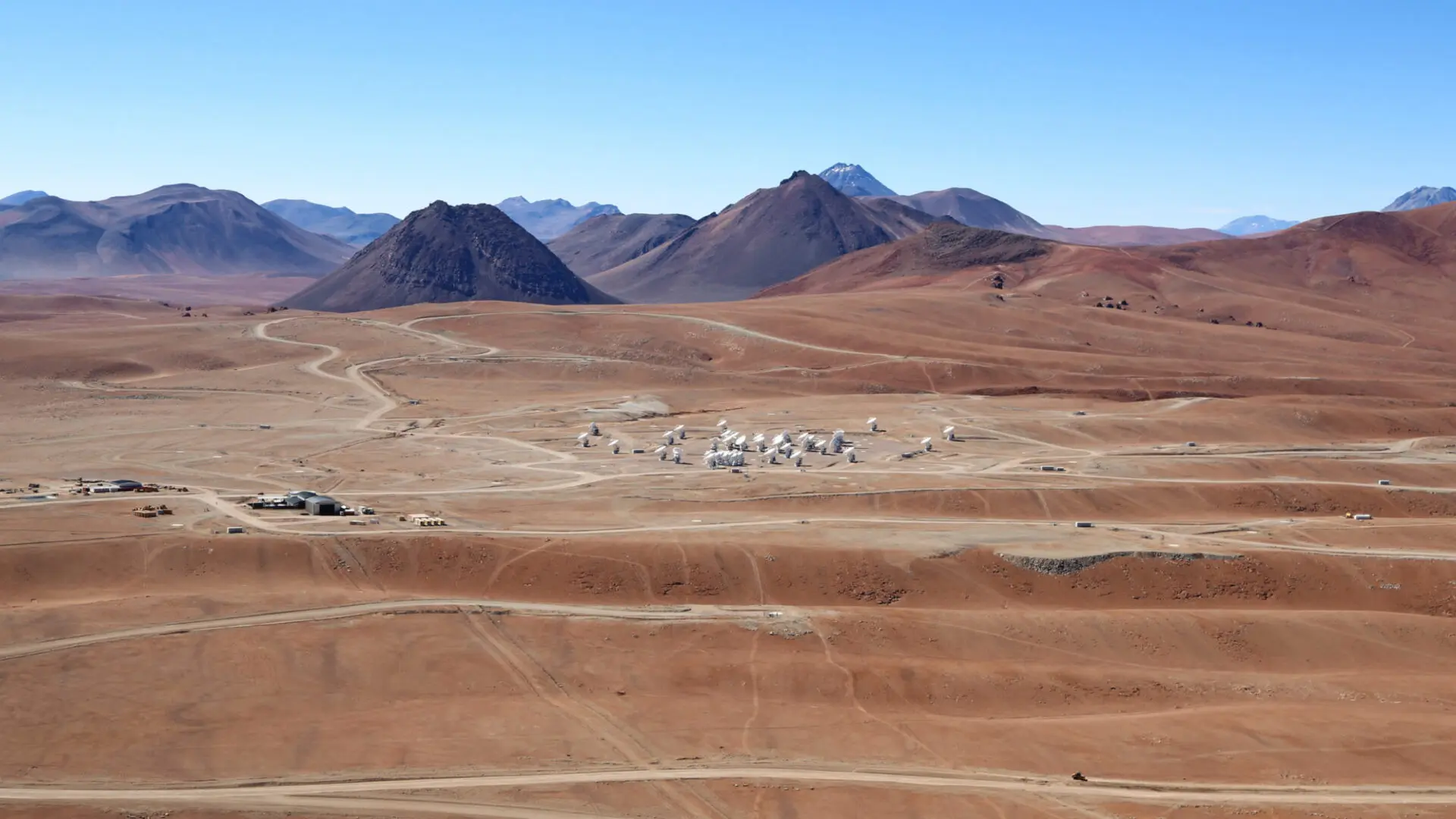
The Atacama Large Millimeter/submillimeter Array (ALMA), an international partnership of Europe, North America and East Asia in cooperation with the Republic of Chile, is the largest astronomical project in existence. ALMA will be a single telescope of revolutionary design, composed initially of 66 high precision antennas located on the Chajnantor plateau, 5000 meters altitude in northern Chile.
A panoramic view of the Chajnantor plateau showing the antennas of the Atacama Large Millimeter/submillimeter Array (ALMA) ranged across the unearthly landscape.
Credit: ALMA (ESO/NAOJ/NRAO), Tafreshi (ESO/twanight.org)
The most powerful millimeter/submillimeter-wavelength telescope in the world opens for business and reveals its first image.
This picture of the ALMA antennas on the Chajnantor Plateau, 5000 m above sea level, was taken a few days before the start of ALMA Early Science.
Credit: ALMA (ESO/NAOJ/NRAO), W. Garnier (ALMA).
On August 16th, the first 7-meter diameter ALMA antennas was transported to the 5,000-meter altitude Chajnantor plateau, where the Atacama Large Millimeter/submillimeter Array (ALMA) is under construction.
Credit: ALMA(ESO/NAOJ/NRAO), W. Garnier(ALMA)
The first European antenna for the Atacama Large Millimeter/submillimeter Array (ALMA) reaches new heights, having been transported to the observatory's Array Operations Site (AOS).
Credit: ALMA(ESO/NAOJ/NRAO), S. Rossi (ESO)
The Front End Service Vehicle heads uphill from the ALMA Operations Support Facility along the long, salt-paved road to the Array Operations Site where the working telescopes are situated.
Credit:ALMA(ESO/NAOJ/NRAO), C. Padilla(NRAO/AUI/NSF)