ALMA Reveals 57 Faces of a Dying Star
Astronomers expose complex flows and chemistry in W Hydrae
Highlights
- ALMA reveals 57 high-resolution molecular views of the atmosphere of the dying star W Hydrae.
- The star shows dramatically different appearances depending on which molecule is observed.
- ALMA and ESO’s VLT images taken only nine days apart reveal how gas molecules turn into dust.
- The observations expose a dynamic atmosphere with clumps, plumes, infall, and outflow.
- W Hydrae offers a glimpse into the future of the Sun and the origins of cosmic dust.
Astronomers using the Atacama Large Millimeter/submillimeter Array (ALMA) have obtained detailed radio images of a dying star’s atmosphere, revealing a remarkably complex and dynamic environment rich in chemical diversity. The new observations showcase W Hydrae (W Hya), an aging red giant located about 320 light-years from Earth, in an unprecedented way. By observing 57 different molecular spectral lines simultaneously, the team captured 57 distinct “faces” of the same star, each one revealing a different layer of its turbulent atmosphere.
With ALMA’s exceptional resolution, astronomers can now see the surface and surrounding layers of an AGB star in extraordinary detail. W Hydrae is enveloped in a shifting mix of clumps, arcs, plumes, and trailing structures that change depending on the molecule used to observe them. In some views, the atmosphere extends several times the size of the star itself — so large that, if W Hydrae were placed in the middle of our Solar System, its bloated outer layers would engulf Mercury, Venus, Earth, and Mars. These expanded regions form clouds sculpted by shocks, pulsations, convection, and chemistry. Each molecule paints a different picture: silicon monoxide (SiO) reveals one pattern, water vapor (H₂O) another, while sulfur dioxide (SO₂), sulfur monoxide (SO), hydrogen cyanide (HCN), aluminum monoxide (AlO), aluminum hydroxide (AlOH), titanium oxide (TiO), titanium dioxide (TiO₂), and hydroxyl (OH) uncover yet more layers of complexity.
Lead author Keiichi Ohnaka, from Universidad Andres Bello (Chile), emphasizes the significant advance these observations represent for understanding the final stages of stellar evolution: “With ALMA, we can now see the atmosphere of a dying star with a level of clarity in a similar way to what we do for the Sun, but through dozens of different molecular views. Each molecule reveals a different face of W Hydrae, revealing a surprisingly dynamic and complex environment. The combination of ALMA and VLT/SPHERE data lets us connect gas motions, molecular chemistry, and dust formation almost in real time — something that has been difficult until now.”
Because these lines form in different physical conditions, they trace different layers of the star’s extended atmosphere. ALMA’s extremely high resolution of about 17–20 milliarcseconds, equivalent to taking a detailed photo of a rice grain from a distance of 10 km, makes it possible to see absorption against the stellar disk and to identify shells of material flowing inward or outward. The data reveal a surprising mixture of motions: gas close to the star is pushed outward at speeds up to about 10 km/s, while material just above it is falling back inward at up to 13 km/s, creating a layered, constantly changing flow pattern. These alternating infall and outflow regions match predictions from state-of-the-art 3D models, in which large convective cells and pulsation-driven shocks shape the atmosphere.
One of the most remarkable aspects of the study is the direct connection between molecules and newly formed dust. The ALMA observations were compared with visible-light polarimetric images obtained from archival data taken with the ESO’s VLT’s SPHERE instrument, only nine days apart. This close timing allows astronomers to link gas chemistry and dust formation almost in real time. The results show that molecules such as silicon monoxide (SiO), water vapor (H₂O), and aluminum monoxide (AlO) appear precisely where clumpy dust clouds are seen in the VLT data, indicating that these species are directly involved in the formation of dust grains. Other molecules, such as sulfur monoxide (SO), sulfur dioxide (SO₂), titanium oxide (TiO), and possibly titanium dioxide (TiO₂), overlap with dust in some regions and may also contribute through shock-driven chemistry. In contrast, molecules like hydrogen cyanide (HCN) form close to the star but do not directly participate in dust formation.
The observations offer an exceptional laboratory for understanding how dying stars shed their material, enriching the interstellar medium with elements and compounds that later build new stars, planets, and ultimately the chemical ingredients for life. The mass-loss process in AGB stars remains one of the longest-standing unresolved problems in stellar astrophysics, and direct high-resolution imaging of the innermost regions, where the outflow begins and dust forms, is essential for solving it. W Hya’s proximity and ALMA’s longest baselines provide one of the best opportunities to witness these processes at work. Co-author Ka Tat Wong, from Uppsala University, highlights the importance of these observations: “Mass loss in AGB stars is one of the biggest unsolved challenges in stellar astrophysics. With ALMA, we can now directly observe the regions where this outflow begins, where shocks, chemistry, and dust formation all interact. W Hydrae gives us a rare opportunity to test and refine our models with real, spatially resolved data.”
These results also provide a preview of the Sun’s distant future. Stars like W Hya represent a stage the Sun will enter billions of years from now, when it expands and sheds much of its outer layers into space. Understanding how material escapes from such stars helps explain the origin of the dust and molecules that eventually become part of planets, asteroids, and comets, as well as the organic chemistry needed for life.
Additional Information
“High-angular-resolution ALMA imaging of the inhomogeneous dynamical atmosphere of the asymptotic giant branch star W Hya” by Keiichi Ohnaka et al. has been published in Astronomy & Astrophysics.
The Atacama Large Millimeter/submillimeter Array (ALMA), an international astronomy facility, is a partnership of the European Southern Observatory (ESO), the U.S. National Science Foundation (NSF), and the National Institutes of Natural Sciences (NINS) of Japan in cooperation with the Republic of Chile. ALMA is funded by ESO on behalf of its Member States, by NSF in cooperation with the National Research Council of Canada (NRC) and the National Science and Technology Council (NSTC) in Taiwan, and by NINS in cooperation with the Academia Sinica (AS) in Taiwan and the Korea Astronomy and Space Science Institute (KASI).
ALMA construction and operations are led by ESO on behalf of its Member States; by the National Radio Astronomy Observatory (NRAO), managed by Associated Universities, Inc. (AUI), on behalf of North America; and by the National Astronomical Observatory of Japan (NAOJ) on behalf of East Asia. The Joint ALMA Observatory (JAO) provides the unified leadership and management of ALMA's construction, commissioning, and operation.
Images
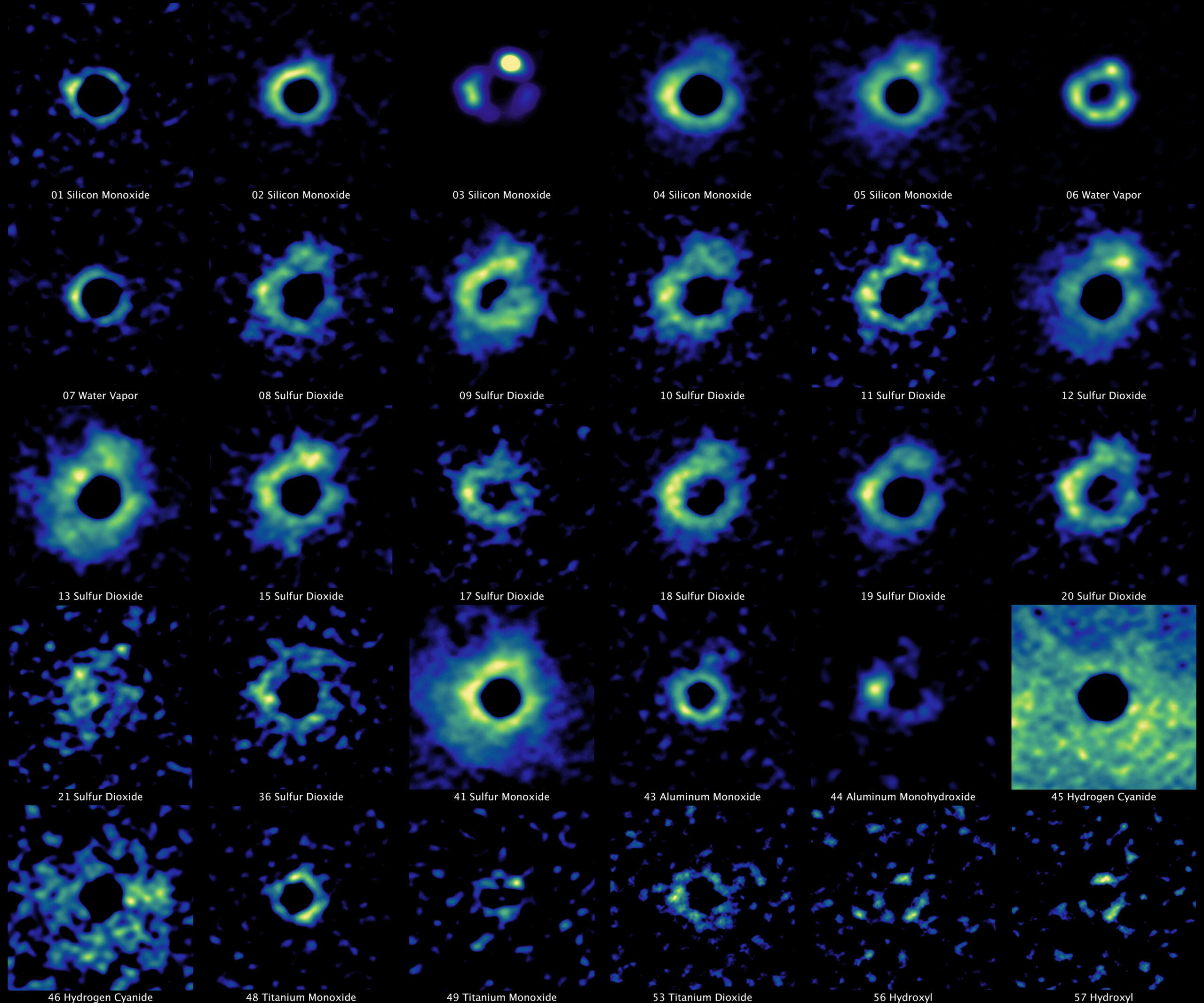

dust (solid particles), we study how dust particles condense from the gas. Credit: K. Ohnaka, ALMA (ESO/NAOJ/NRAO)

Contacts
-
Nicolás Lira
Education and Public Outreach OfficerJoint ALMA Observatory, Santiago - ChilePhone: +56 2 2467 6519Cel: +56 9 9445 7726Email: [email protected] -
Bárbara Ferreira
ESO Media Manager -
Jill Malusky
Public Information Officer -
Yuichi Matsuda
Education and Public Outreach OfficerNAOJEmail: [email protected]