ALMA and NSF VLA Reveal Time-Stamped History of Star Birth in a Dazzling Cosmic Jet
Decades of NSF VLA groundwork enable ALMA’s breakthrough images, uncovering rings in a stellar jet that record explosive outbursts from a young star
An international team of astronomers has uncovered the most unmistakable evidence yet that the powerful jets launched by newborn stars reliably record a star’s most violent growth episodes, confirming a long-standing model of how these jets propagate through their surroundings.
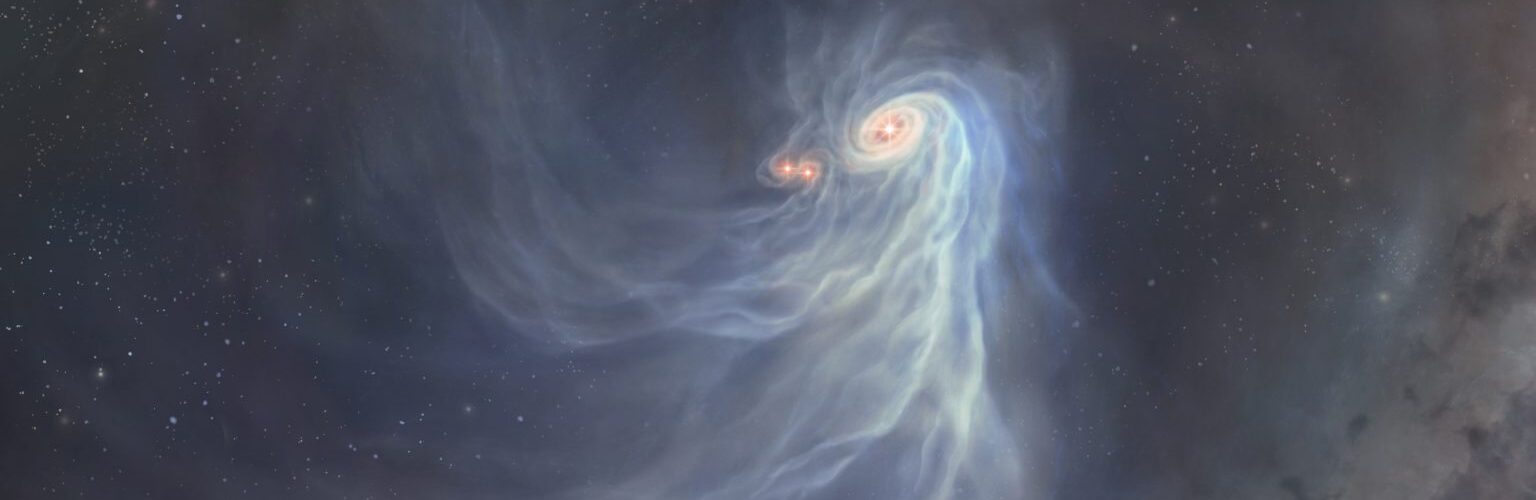
Early observations with the U.S. National Science Foundation Very Large Array (NSF VLA) identified SVS 13 as a remarkable binary protostellar system driving a chain of high-velocity “molecular bullets” and Herbig–Haro shocks in the NGC 1333 star-forming region, about 1,000 light-years from Earth. Those NSF VLA continuum images pinpointed the two radio protostars, VLA 4A and VLA 4B. They revealed the larger-scale outflow, which flagged this system as a prime target for deeper investigation into how young stars launch and collimate jets. This decades-long NSF VLA groundwork enabled the identification of the protostar powering the jet now seen in unprecedented detail.
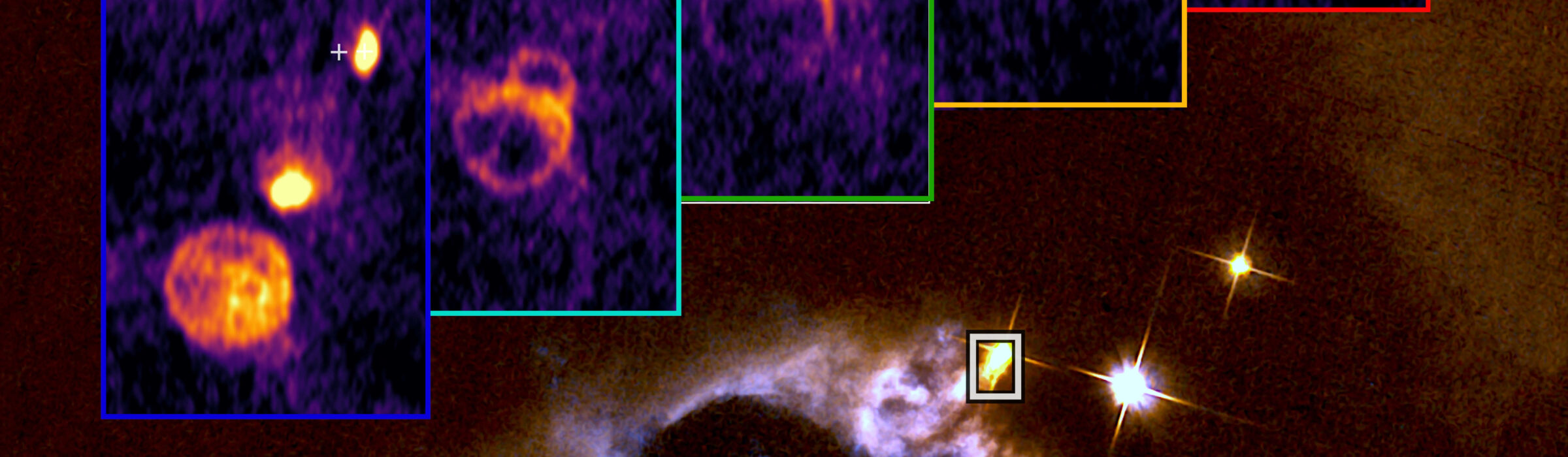
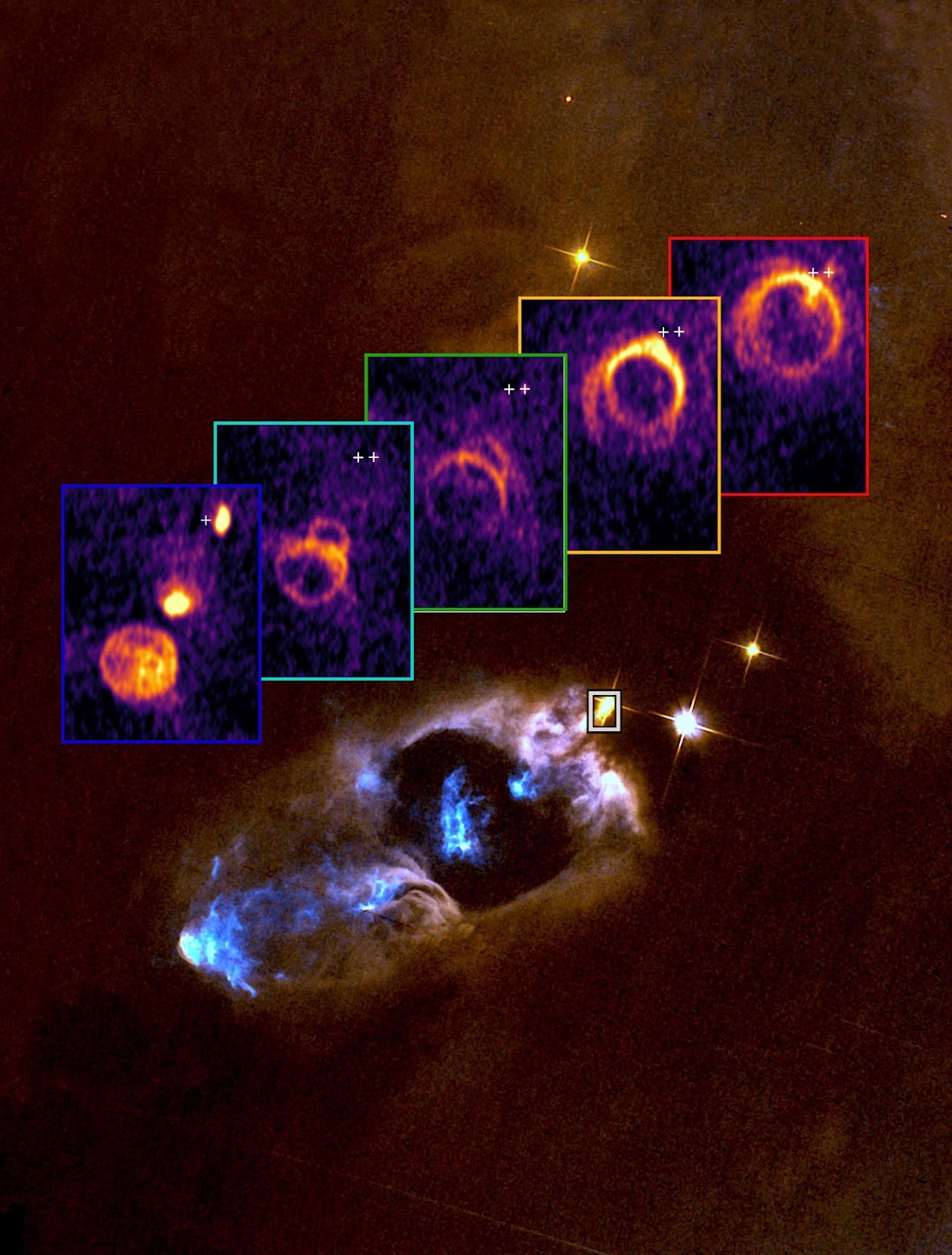
Building on that legacy, new observations with the Atacama Large Millimeter/submillimeter Array (ALMA) zoomed in on the brightest high-velocity “bullet” in the SVS 13 outflow. They revealed a striking sequence of nested molecular rings. As the observed velocity changes, each ring smoothly shrinks and shifts position, tracing ultra-thin, bow-shaped shells only a few dozen astronomical units thick and moving at speeds of up to about 100 kilometers per second. This tomographic view works much like a medical CT scan, allowing astronomers to reconstruct how the jet carves its way through surrounding gas.
“Our observations show that these jets are not just dramatic side effects of star birth—they are also faithful record-keepers,” said Guillermo Blázquez-Calero, co-lead author of the study and a researcher at the Instituto de Astrofísica de Andalucía, CSIC (IAA-CSIC). “Each sequence of rings in the jet carries a time-stamp of a past outburst, letting us read the history of how material fell onto the young star and was then violently ejected back into its environment.”
By fitting more than 400 individual rings, the team demonstrated that each shell matches a textbook momentum-conserving bow shock driven by a narrow jet whose speed changes over time. The age of the youngest shell aligns with a powerful optical and infrared outburst of SVS 13 VLA 4B in the early 1990s, providing the first direct link between bursts of material falling onto a young star and changes in the speed of its jet.
These results show that protostellar jets preserve a time-stamped record of past eruptions, offering new insight into how episodic outbursts shape the disks that eventually give rise to planets like Earth.
Additional Information
The full scientific results are published as "Bowshocks driven by the pole-on molecular jet of outbursting protostar SVS 132" in Nature Astronomy by G. Blázquez et al.
The complete list of authors is Guillermo Blázquez-Calero, Guillem Anglada, Sylvie Cabrit, Mayra Osorio, Alejandro C. Raga, Gary A. Fuller, José F. Gómez, Robert Estalella, Ana K. Díaz-Rodriguez, José M. Torrelles, Luis F. Rodríguez, Enrique Macías, Itziar de Gregorio-Monsalvo, Tom Megeath, Luis Zapata, and Paut T. P. Ho.
This article is based on a press release from the National Radio Astronomical Observatory (NRAO), an ALMA partner on behalf of North America.
The Atacama Large Millimeter/submillimeter Array (ALMA), an international astronomy facility, is a partnership of the European Southern Observatory (ESO), the U.S. National Science Foundation (NSF), and the National Institutes of Natural Sciences (NINS) of Japan in cooperation with the Republic of Chile. ALMA is funded by ESO on behalf of its Member States, by NSF in cooperation with the National Research Council of Canada (NRC) and the National Science and Technology Council (NSTC) in Taiwan, and by NINS in cooperation with the Academia Sinica (AS) in Taiwan and the Korea Astronomy and Space Science Institute (KASI).
ALMA construction and operations are led by ESO on behalf of its Member States; by the National Radio Astronomy Observatory (NRAO), managed by Associated Universities, Inc. (AUI), on behalf of North America; and by the National Astronomical Observatory of Japan (NAOJ) on behalf of East Asia. The Joint ALMA Observatory (JAO) provides the unified leadership and management of ALMA's construction, commissioning, and operation.
Images
Contacts
-
Nicolás Lira
Education and Public Outreach OfficerJoint ALMA Observatory, Santiago - ChilePhone: +56 2 2467 6519Cel: +56 9 9445 7726Email: [email protected] -
Corrina Jaramillo Feldman
Public Information Officer - New Mexico -
Bárbara Ferreira
ESO Media Manager -
Yuichi Matsuda
Education and Public Outreach OfficerNAOJEmail: [email protected]