Magnetic Superhighways Discovered in a Starburst Galaxy’s Winds
For the first time, ALMA traces polarized light to map magnetic fields in the high-speed winds of Arp 220, an ultraluminous infrared galaxy
Using the Atacama Large Millimeter/submillimeter Array (ALMA), an international team of astronomers has mapped a magnetic highway driving a powerful galactic wind into the nearby galaxy merger of Arp 220, revealing for the first time that its fast, molecular outflows are strongly magnetized and likely helping to drive metals, dust, and cosmic rays into the space around the galaxy. By watching how tiny dust grains and gas molecules line up with these fields, researchers have drawn the most detailed magnetic map yet of Arp 220’s buried, star‑forming cores and their outflows. The result is a new way to see how gravity, starbirth, black holes, and magnetic forces all work together in a chaotic cosmic environment.
Arp 220 is an ultraluminous infrared galaxy (ULIRG) made up of two spiral galaxies in the final stages of merging. Because Arp 220 is the nearest galaxy of its kind, it serves as a powerful time machine: what happens here today likely mirrors what happened in the first generations of massive, dusty galaxies more than 10 billion years ago.
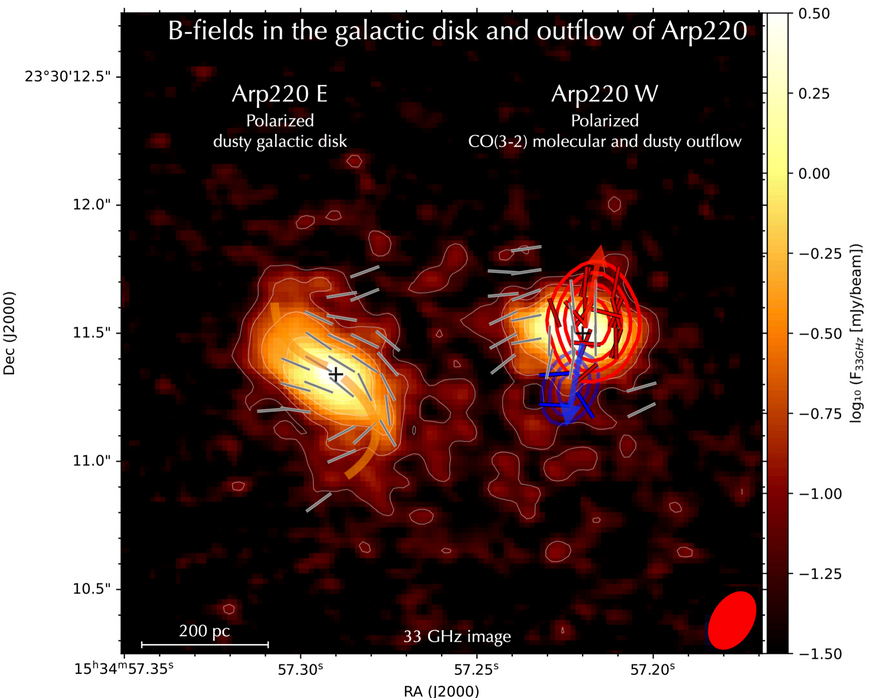
“We used ALMA to map the orientation and strength of magnetic fields in the twin galaxies,” shared Enrique Lopez-Rodriguez, the lead author of this research, and an Associate Professor with the University of South Carolina. “This revealed previously unseen details about Arp 220’s dust-enshrouded cores and molecular outflows, including the first detection of a polarized CO(3–2) molecular line emission,” adds Josep Miquel Girart, the lead in the observational work, and a researcher at the Institut de Ciències de l’Espai. This emission traced the galactic outflow in the external galaxy, showing that the outflowing gas itself carries a well-ordered magnetic field.
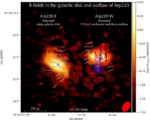
Observations of the west nucleus of Arp 220 revealed a nearly vertical magnetic field that runs alongside a bipolar molecular outflow moving at up to roughly 500 kilometers per second, driving a powerful, magnetic superhighway out of the galaxy. Galaxy mergers and starbursts are known to launch powerful winds that can shut down, or regulate, star formation by removing gas. However, these new results show that magnetic fields are a crucial, previously unknown driver in the force of these winds.
The team obtained full-polarization ALMA observations at 870 microns (Band 7), measuring both dust continuum polarization and CO(3–2) line polarization at a resolution of about 0.24 arcseconds (≈96 parsecs), fine enough to separate the two compact nuclei and their outflows. The dust polarization traces magnetically aligned grains in the cold, dense interstellar medium, while the Goldreich–Kylafis effect imprints linear polarization on the CO(3–2) emission line in the presence of anisotropic radiation and magnetic fields, together providing a three-dimensional view of the field geometry.
By combining the polarization geometry with measurements of gas mass, turbulence, and outflow speed, the authors applied and refined versions of the Davis–Chandrasekhar–Fermi method to estimate the magnetic field strengths in the blue- and redshifted outflow lobes. In the eastern nucleus, ALMA revealed a spiral-like magnetic pattern threading a compact, dust-enshrouded disk and arm, suggesting that ordered spiral fields can survive deep into the merger stage.
A highly polarized highway of dust between the two nuclei, with polarization fractions of about 3–5 percent, traces a magnetized ridge that may be funneling material and magnetic flux between the merging cores. Adds Lopez-Rodriguez, “When Arp 220 is observed as a whole, it’s one of the best places in the universe for astronomers to study how gravity, star formation, and powerful winds work together with strong magnetic fields to reshape a galaxy and seed its surroundings with magnetized gas and dust.”
The team estimates magnetic field strengths of roughly 1–10 milligauss in the molecular outflows—hundreds to thousands of times stronger than the average magnetic field in the Milky Way’s disk—implying that compressed and turbulence-amplified fields help steer material into the circumgalactic medium. Because Arp 220 is the closest analog to the extreme, dusty star-forming galaxies in the early universe, these results suggest that strong, organized magnetic fields may be common in high-redshift starbursts and could regulate star formation and feedback across cosmic time.
These ALMA observations show that magnetic fields are a major engine in driving material out of galaxies like Arp 220. The strong, ordered fields in its galactic winds act like invisible guardrails, guiding metals, dust, and cosmic rays into the vast cocoon of gas surrounding the system. That material will eventually help build and enrich future generations of stars and galaxies. As astronomers turn ALMA and future telescopes toward ever more distant galaxies, they expect to find similar magnetic superhighways at work across the cosmos. Studies like this transform Arp 220 from a single spectacular merger into a crucial blueprint for understanding how galaxies grow, shut down, and recycle their material over cosmic time—shaping the universe we see today.
Additional Information
This research appear as "The Magnetic Fields of the Dusty Nuclei and Molecular Outflows of Arp 220" by E. López-Rodriguez et al. in the Astrophysical Journal Letters.
The Atacama Large Millimeter/submillimeter Array (ALMA), an international astronomy facility, is a partnership of the European Southern Observatory (ESO), the U.S. National Science Foundation (NSF), and the National Institutes of Natural Sciences (NINS) of Japan in cooperation with the Republic of Chile. ALMA is funded by ESO on behalf of its Member States, by NSF in cooperation with the National Research Council of Canada (NRC) and the National Science and Technology Council (NSTC) in Taiwan, and by NINS in cooperation with the Academia Sinica (AS) in Taiwan and the Korea Astronomy and Space Science Institute (KASI).
ALMA construction and operations are led by ESO on behalf of its Member States; by the National Radio Astronomy Observatory (NRAO), managed by Associated Universities, Inc. (AUI), on behalf of North America; and by the National Astronomical Observatory of Japan (NAOJ) on behalf of East Asia. The Joint ALMA Observatory (JAO) provides the unified leadership and management of ALMA's construction, commissioning, and operation.
Images
Contacts
-
Nicolás Lira
Education and Public Outreach OfficerJoint ALMA Observatory, Santiago - ChilePhone: +56 2 2467 6519Cel: +56 9 9445 7726Email: [email protected] -
Jill Malusky
Public Information Officer -
Yuichi Matsuda
Education and Public Outreach OfficerNAOJEmail: [email protected] -
Bárbara Ferreira
ESO Media Manager