ALMA Witnesses Star Birth Beyond the Milky Way
Highlights
- ALMA has enabled the first measurement of the core mass function in a galaxy beyond the Milky Way
- Observations of the Large Magellanic Cloud show that star-forming cores follow similar patterns to those in our Galaxy
- The results suggest that the earliest stages of star formation may be universal across different galactic environments
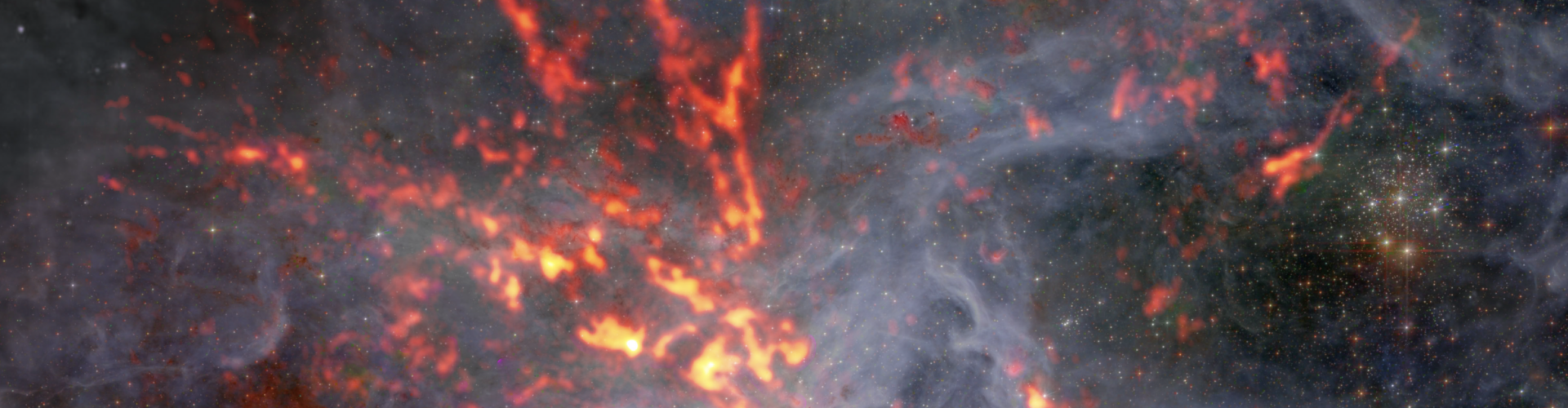
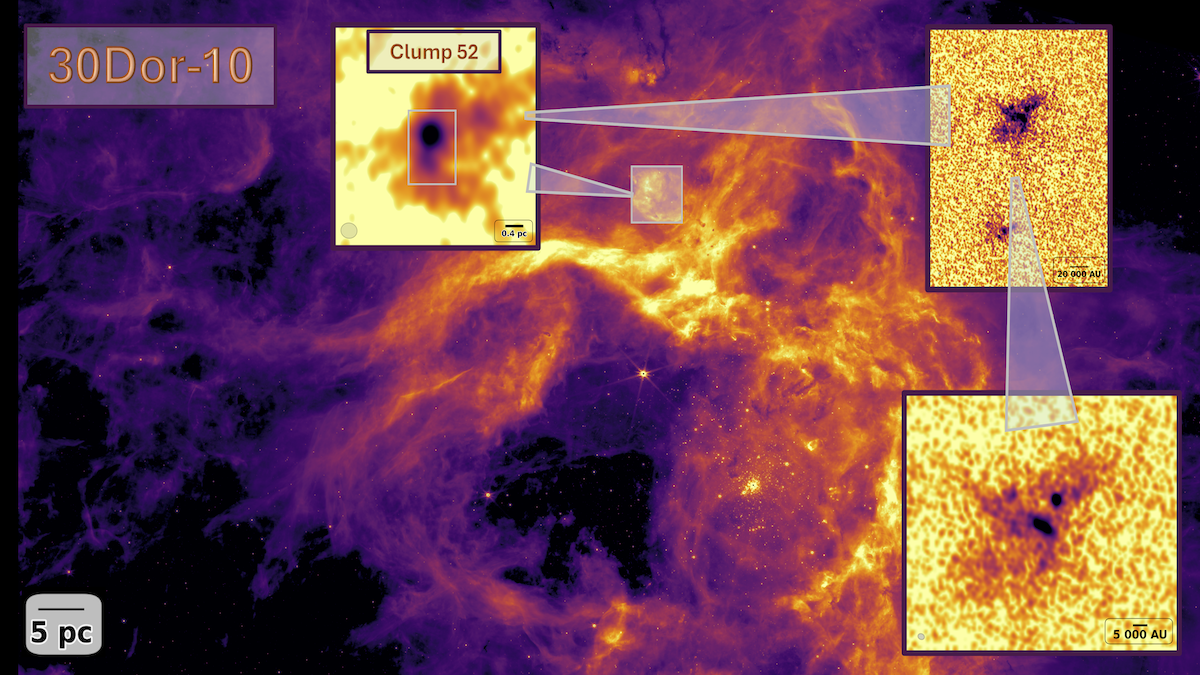
Astronomers have used the Atacama Large Millimeter/submillimeter Array (ALMA) to map, for the first time, the mass distribution of the gas and dust clumps from which new stars are born—the so-called core mass function (CMF)—in a star-forming region outside the Milky Way.
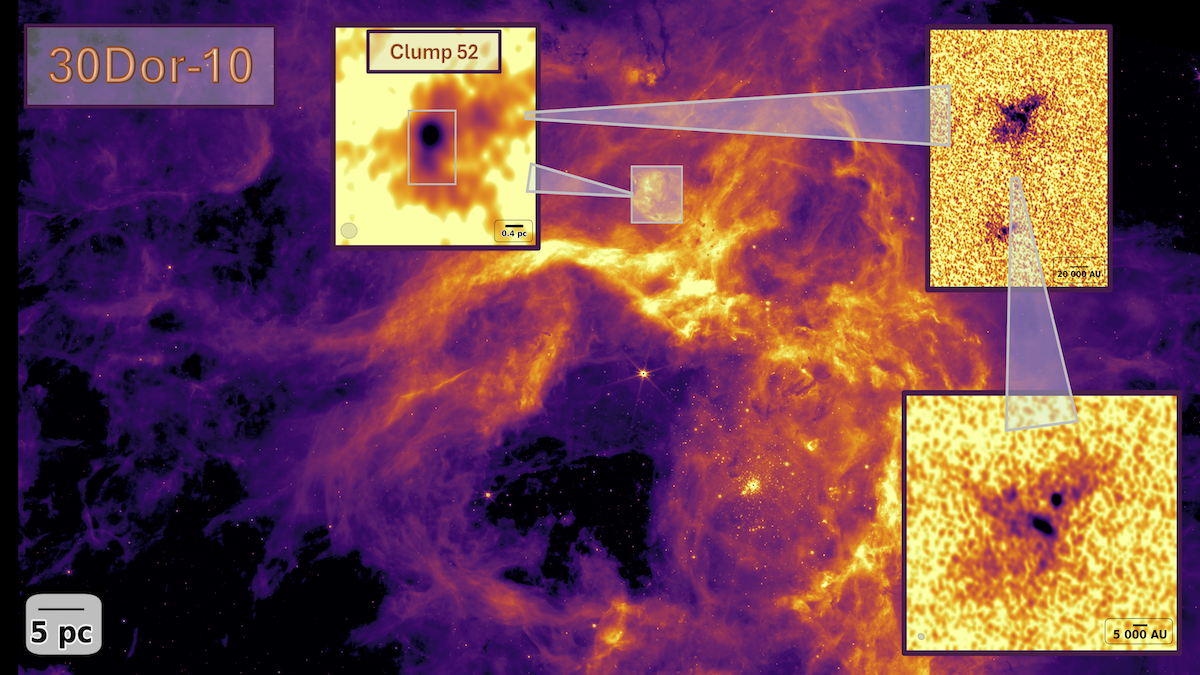
The study, led by the Italian National Institute for Astrophysics and published in Nature Communications, focuses on the 30 Dor-10 region in the Large Magellanic Cloud, a nearby galaxy located about 160,000 light-years from Earth. ALMA's combination of high sensitivity and angular resolution enables the resolution of the small-scale structure of star-forming regions even in nearby galaxies, opening a new window for studying the earliest stages of star formation beyond the Milky Way.
To achieve this result, the research team pushed ALMA to the limits of its capabilities for this type of study, reaching an angular resolution of 0.05 arcseconds—equivalent to distinguishing a one-euro coin from 100 kilometers away. This precision allowed them to resolve structures as small as 2,000 astronomical units, identifying 70 dense cores embedded within four protoclusters at a distance of 160,000 light-years. To confirm the nature of these structures and exclude contamination from ionized gas—a particular challenge in such active regions—the team combined ALMA observations with data from the Hubble Space Telescope and the James Webb Space Telescope, which also confirmed that the detected cores are still in an early phase of their evolution.
"We are truly excited about the results achieved with this study. Thanks to ALMA, studying core masses in our Galaxy is becoming almost 'routine,' suggesting in particular that the mass of our cores seems to evolve, especially in high-mass regions," says Alessio Traficante, lead author of the study. "Until now, no one had attempted to push this type of research into extra-galactic regions, which require significantly higher resolution and sensitivity than studies conducted within the Milky Way. The identification of more than 70 cores in 30Dor-10 was by no means guaranteed, considering we were observing an environment with an interstellar medium whose characteristics are profoundly different from those found in the main massive star-forming regions of our Galaxy. We had no idea what to expect before seeing the highly detailed images obtained by ALMA."
By comparing the mass distribution of these cores with those observed in the Milky Way, the researchers found that both follow a similar trend consistent with Salpeter's Law—a notable result given the markedly different conditions in the Large Magellanic Cloud, including lower metallicity, different turbulence regimes, and a more strongly ionized interstellar medium. Crucially, while the initial mass function of stars in such extreme environments can show an excess of massive stars, the earliest phase of core formation appears to follow the same patterns seen in our Galaxy, suggesting that these young cores continue to accrete mass over time regardless of their surroundings.
The findings suggest that the initial fragmentation of molecular clouds—the process that leads to the formation of dense cores—may be largely independent of the surrounding galactic environment. This work, connected to ALMA Large Programs such as ALMA-IMF and ALMAGAL, opens the door to a systematic study of star formation in other galaxies using techniques previously applied only within the Milky Way, and allows astronomers to begin testing whether the physical laws governing the birth of stars hold constant across the universe.
Additional Information
This research appears in Nature Communications as "The fragmentation properties of massive star-forming regions in 30Dor-10 at 2000 au resolution" by A. Traficante et al.
This article is an adaptation of the original press release by the Italian National Institute of Astrophysics (INAF).
The Atacama Large Millimeter/submillimeter Array (ALMA), an international astronomy facility, is a partnership of the European Southern Observatory (ESO), the U.S. National Science Foundation (NSF), and the National Institutes of Natural Sciences (NINS) of Japan in cooperation with the Republic of Chile. ALMA is funded by ESO on behalf of its Member States, by NSF in cooperation with the National Research Council of Canada (NRC) and the National Science and Technology Council (NSTC) in Taiwan, and by NINS in cooperation with the Academia Sinica (AS) in Taiwan and the Korea Astronomy and Space Science Institute (KASI).
ALMA construction and operations are led by ESO on behalf of its Member States; by the National Radio Astronomy Observatory (NRAO), managed by Associated Universities, Inc. (AUI), on behalf of North America; and by the National Astronomical Observatory of Japan (NAOJ) on behalf of East Asia. The Joint ALMA Observatory (JAO) provides the unified leadership and management of ALMA's construction, commissioning, and operation.
Image
Contacts
-
Nicolás Lira
Education and Public Outreach OfficerJoint ALMA Observatory, Santiago - ChilePhone: +56 2 2467 6519Cel: +56 9 9445 7726Email: [email protected] -
Bárbara Ferreira
ESO Media Manager -
Jill Malusky
Public Information Officer -
Seiichiro Naito
NAOJ EPO LeadEmail: [email protected]