ALMA Reveals How Planet-Forming Disks Take Shape
New study identifies a long-sought transition zone where infalling gas becomes a rotating disk.
Every planet — including everyone in the Solar System — was born inside a rotating disk of gas and dust swirling around a young star. Astronomers have long understood that these disks exist and that planets take shape within them. What they couldn't explain was how the raw material gets there in the first place. Now, a new study led by Indrani Das of the Academia Sinica Institute of Astronomy and Astrophysics (ASIAA) has found the missing piece: a distinct transition zone where chaotic, infalling gas gradually settles into the orderly rotation of a planet-forming disk. The team named it ENDTRANZ — the Envelope Disk Transition Zone — and detected it for the first time in an actual young stellar system using the Atacama Large Millimeter/submillimeter Array (ALMA).
From chaos to order
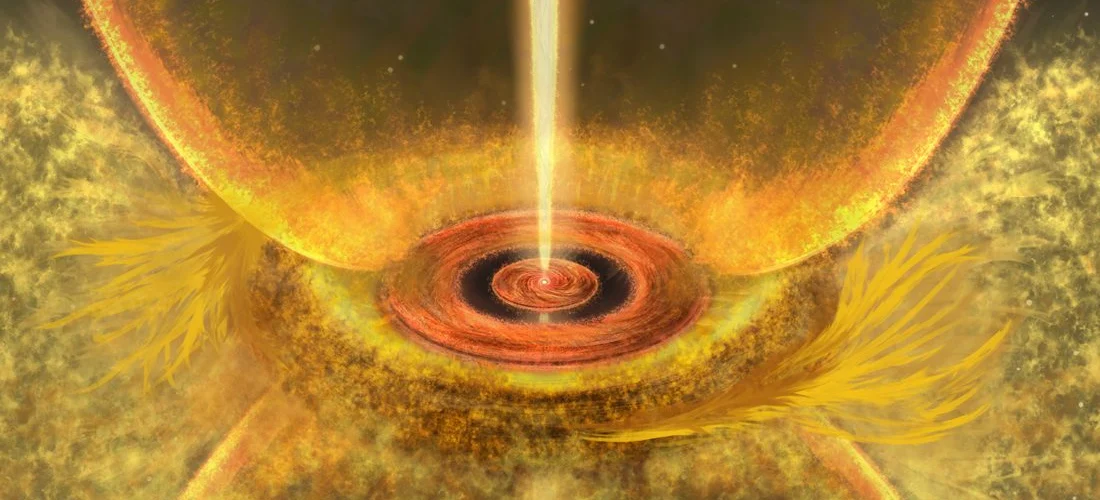
Young stars are surrounded by a vast shroud of gas and dust called an envelope. Gravity pulls this material inward, feeding both the growing star and the disk around it. But the infalling gas moves differently than the disk — more slowly and chaotically — and the point at which one becomes the other had never been clearly observed.
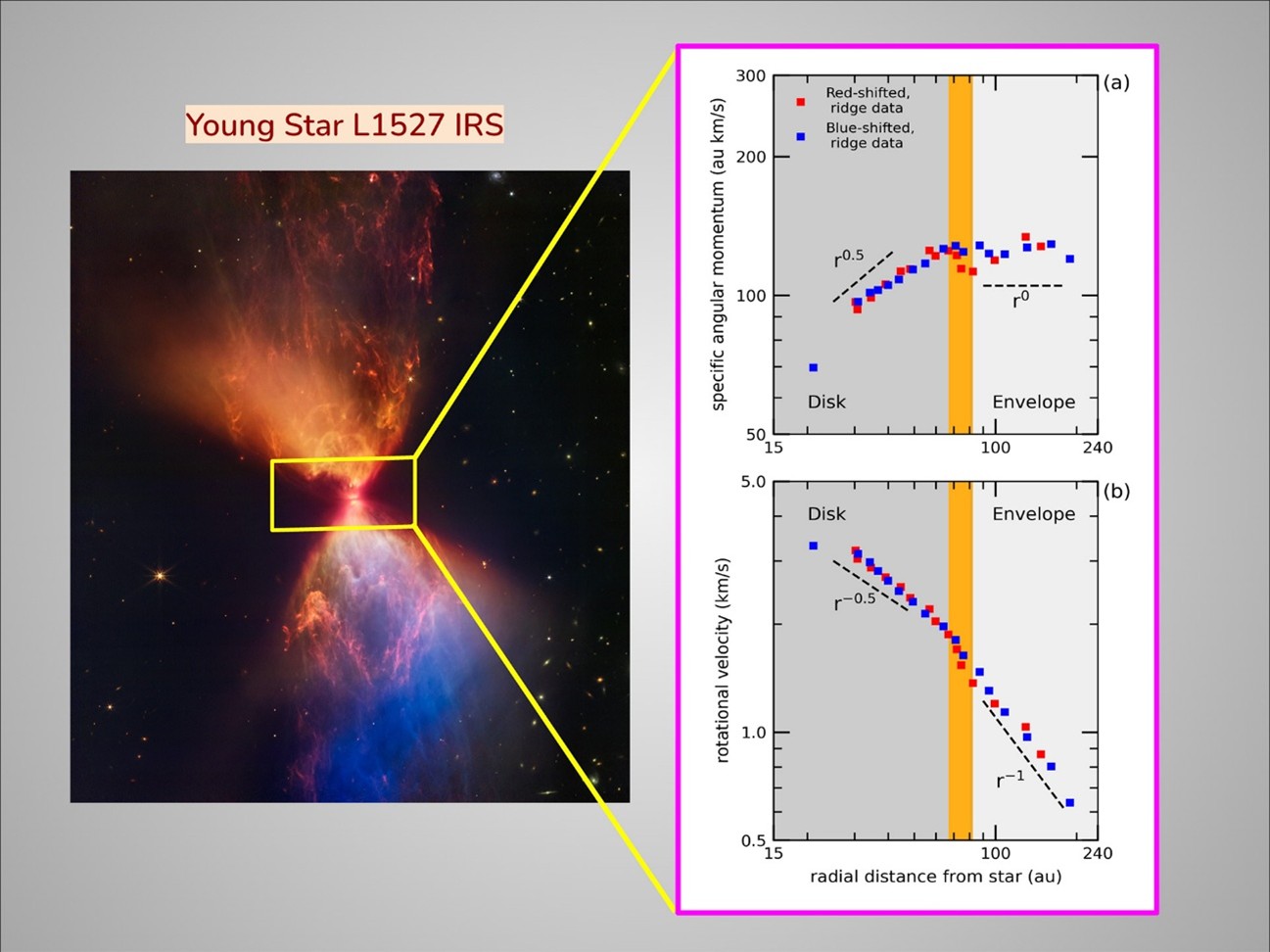
Earlier theoretical models assumed the switch was sharp, almost instantaneous. The new study shows it isn't. Using numerical simulations with the FEOSAD code, the team tracked how a collapsing cloud core evolves into a star-disk system — and found that the transition unfolds gradually across a finite region, leaving a tell-tale signature: a characteristic "jump" in the distribution of specific angular momentum, a measure of how gas rotates as a function of its distance from the star.
"The existence of ENDTRANZ naturally results from the redistribution of mass and angular momentum during the formation of disks around young stars. This process ultimately governs how infalling material from the envelope, which rotates more slowly than the Keplerian speed, spreads out to form the disk and gradually settles into ordered Keplerian rotation," explained Das.
ALMA finds the fingerprint
To test whether ENDTRANZ exists in nature, the team turned to L1527 IRS, a young protostar about 450 light-years away in the Taurus molecular cloud. Using data from the ALMA Large Program eDisk (Embedded Disks in Planet Formation), they found exactly the same angular momentum signature that the simulations had predicted — spanning a zone roughly 16 astronomical units wide, or about 16 times the distance from Earth to the Sun.
"This ENDTRANZ tracer essentially manifests from the gradual transition in the rotational velocity, which offers a diagnostic framework for understanding the physical processes at play that drive the disk evolution," said Shantanu Basu, Interim Director of the Canadian Institute for Theoretical Astrophysics and co-author of the study.
ALMA's extraordinary resolution was essential to making this detection possible, resolving the structure at the precise interface between the envelope and the disk — a regime that had previously been beyond reach.
"A careful inspection and comparison of the radial dependence of specific angular momentum between the observational data and the simulations helped identify the evidence of ENDTRANZ in L1527 IRS," said Nagayoshi Ohashi, principal investigator of the ALMA eDisk Large Program and co-author of the study.
A new window on planet formation
The discovery establishes ENDTRANZ as a fundamental feature of how stars and planetary systems assemble — and opens the door to searching for the same signature in other young systems across the galaxy.
"In many ways, we believe this is just the beginning!" Das said.
Additional Information
The study appears as “Modeling the Break in the Specific Angular Momentum within the Envelope-Disk Transition Zone” by I. Das et al. in the Astrophysical Journal.
This article is based on the original press release by the National Astronomical Observatory of Japan (NAOJ), an ALMA partner on behalf of East Asia.
The Atacama Large Millimeter/submillimeter Array (ALMA), an international astronomy facility, is a partnership of the European Southern Observatory (ESO), the U.S. National Science Foundation (NSF), and the National Institutes of Natural Sciences (NINS) of Japan in cooperation with the Republic of Chile. ALMA is funded by ESO on behalf of its Member States, by NSF in cooperation with the National Research Council of Canada (NRC) and the National Science and Technology Council (NSTC) in Taiwan, and by NINS in cooperation with the Academia Sinica (AS) in Taiwan and the Korea Astronomy and Space Science Institute (KASI).
ALMA construction and operations are led by ESO on behalf of its Member States; by the National Radio Astronomy Observatory (NRAO), managed by Associated Universities, Inc. (AUI), on behalf of North America; and by the National Astronomical Observatory of Japan (NAOJ) on behalf of East Asia. The Joint ALMA Observatory (JAO) provides the unified leadership and management of ALMA's construction, commissioning, and operation.
Images

Contacts
-
Nicolás Lira
Education and Public Outreach OfficerJoint ALMA Observatory, Santiago - ChilePhone: +56 2 2467 6519Cel: +56 9 9445 7726Email: [email protected] -
Seiichiro Naito
NAOJ EPO LeadEmail: [email protected] -
Jill Malusky
Public Information Officer -
Bárbara Ferreira
ESO Media Manager