ALMA Reveals Turbulence May Dominate Magnetic Fields in the Seeds of Massive Star Clusters
Highlights
- The largest ALMA dust-polarization survey of high-mass star-forming regions has examined magnetic-field structures associated with hundreds of compact stellar “seeds.”
- ALMA found that these dense gas condensations tend to be elongated parallel to their local magnetic fields—opposite to the pattern commonly observed on larger scales.
- Comparisons with numerical simulations suggest that turbulence plays a more important role than magnetic fields in shaping these condensations.
- The observations also reveal a possible turbulence-driven misalignment between magnetic fields and the condensations’ rotation axes, which could facilitate the formation of large protostellar disks.
Massive stars profoundly influence their surroundings. Through their intense ultraviolet radiation, powerful stellar winds, production of heavy elements, and eventual explosions as supernovae, stars more than eight times the mass of the Sun help shape the structure and evolution of galaxies. Yet astronomers are still working to understand how these stars form within crowded stellar nurseries.
New observations with the Atacama Large Millimeter/submillimeter Array (ALMA) now suggest that, at the small scales where the immediate precursors of stars take shape, turbulent gas motions may be more influential than magnetic fields.
Massive stars form in protoclusters that arise from the hierarchical collapse and fragmentation of molecular clouds. Large clouds break into smaller clumps, cores, and eventually compact structures known as condensations, typically about 0.01 parsec across. These condensations are the immediate parental structures of protostellar disks and may collapse to form an individual star or a close multiple-star system.
Magnetic fields have long been considered an important regulator of this process. On the scales of clouds and clumps, gas can collapse more easily along magnetic-field lines than across them, producing structures that tend to be elongated perpendicular to the field. Observations have frequently detected this perpendicular arrangement at scales larger than approximately 0.1 parsec.
Whether magnetic fields retain this dominant role at the much smaller scales of individual condensations, however, has remained uncertain.
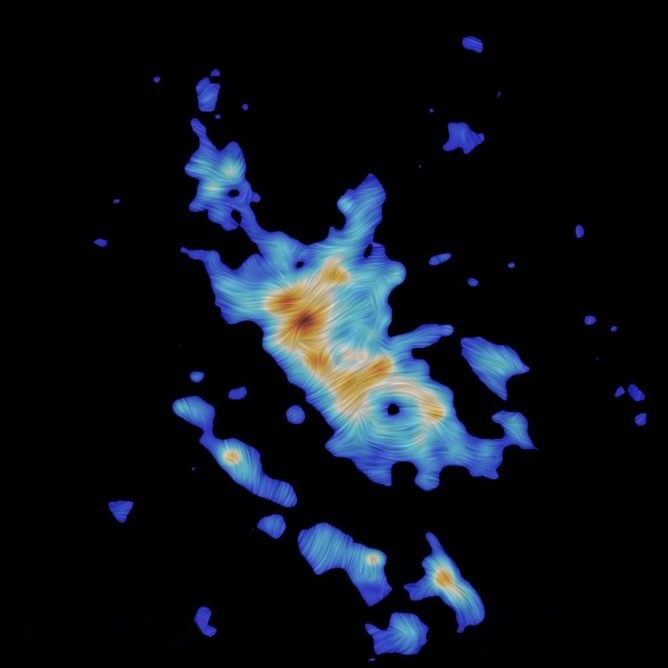
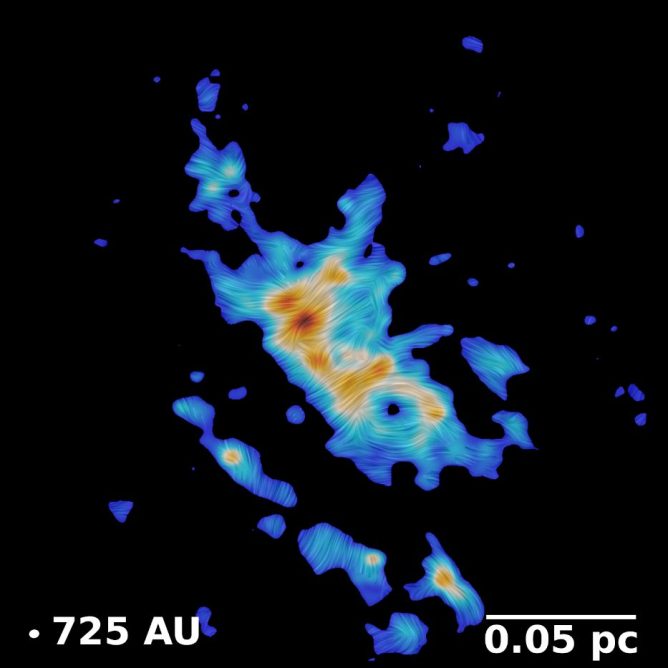
To investigate, an international team led by Junhao Liu of Nanjing University analyzed observations from the Magnetic Fields in Massive Star-forming Regions, or MagMaR, survey. The survey used ALMA to map polarized dust emission in 30 high-mass star-forming regions in the Milky Way, making it the largest ALMA dust-polarization survey to date.
Dust grains tend to align relative to the local magnetic field, causing their millimeter-wavelength emission to become polarized. By measuring this polarization, astronomers can infer the orientation of the magnetic field projected onto the sky.
ALMA’s combination of sensitivity and angular resolution allowed the researchers to trace magnetic-field structures at physical resolutions of approximately 500 to 2,000 astronomical units. The team then compared the orientation of the magnetic field with the elongated shapes of hundreds of compact condensations detected in ALMA’s dust-continuum images.
The results revealed a clear statistical preference: at these small scales, the condensations tend to be elongated parallel—not perpendicular—to their local magnetic fields. This is the opposite of the relationship widely observed in larger clouds and clumps.
“Magnetic fields or turbulence? It is a cosmic battle between order and chaos. While orderly magnetic fields clearly structure giant molecular clouds and clumps on large scales, our results show they lose the battle against chaotic turbulence when it comes to forming individual stars and clusters,” said Junhao Liu, lead author of the paper and a former researcher at the National Astronomical Observatory of Japan who recently joined Nanjing University as an Assistant Professor.
“This discovery shifts our understanding of massive star cluster formation from a magnetically regulated, orderly process to one driven by cosmic chaos. I expect this study not only solves an observational puzzle but will also stimulate future theoretical and simulation work to understand the detailed physical processes that form and feed these stellar seeds.”
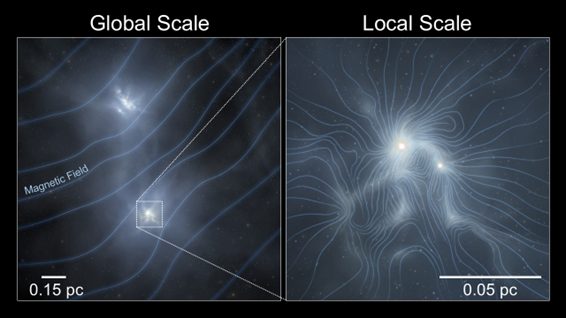
To determine what physical conditions could produce the observed alignment, the researchers compared the ALMA results with synthetic observations derived from 11 three-dimensional magnetohydrodynamic simulations of clustered massive-star formation.
In simulations where magnetic fields initially dominated turbulence, the condensations tended to be elongated perpendicular to their local magnetic fields, as expected in classical magnetically regulated models. By contrast, simulations in which turbulence initially dominated the magnetic field produced the preferentially parallel alignment seen by ALMA.
Turbulent flows can converge and compress gas into flattened condensations. The same compression can amplify magnetic-field components along the condensations’ elongated direction, potentially producing the parallel arrangement observed.
The close correspondence between the observations and the turbulence-dominated simulations suggests that turbulence, rather than magnetic regulation, is the prevailing influence shaping these condensations.
“This work challenges classical magnetically-regulated star formation models. The breakthrough was made possible by ALMA’s unique combination of high resolution and sensitivity,” said Patricio Sanhueza, Associate Professor at the University of Tokyo and Principal Investigator of the ALMA survey. “Years of dedicated data analysis and hard work were necessary to produce these novel results. Finally, we have been able to systematically uncover the small-scale physics in massive star-forming regions.
What is particularly exciting is that the small-scale behaviors of magnetic fields and turbulence are distinctly different from those observed on larger scales.”
The findings do not mean that magnetic fields are unimportant throughout massive-star formation. Magnetic fields may still strongly influence the formation of clouds and large molecular clumps, helping create the reservoirs from which smaller structures subsequently form and grow. They may also dominate the formation of some individual condensations. The results instead indicate that magnetic regulation is unlikely to be the prevailing mechanism shaping condensations across the clustered environments studied.
The team also examined how magnetic fields are oriented relative to the rotation axes of a subset of condensations. Using emission from methyl cyanide, a molecule that traces warm, dense gas, to map internal motions, the researchers found statistical evidence that the magnetic fields tend to be misaligned with the inferred rotation axes.
The simulations suggest that turbulence could plausibly generate this misalignment, although the researchers note that other physical processes may also contribute. A misalignment between the magnetic field and rotation axis can reduce the efficiency of magnetic braking—the process through which magnetic fields remove angular momentum from rotating gas. Reduced braking could make it easier for large, massive protostellar disks to form, supporting the continued accretion of material onto growing high-mass stars and potentially encouraging the formation of multiple-star systems.
Together, the observations and simulations indicate that the relative influence of turbulence and magnetism may change with physical scale. Magnetic fields may help organize the large clouds in which massive stars are born, while turbulence becomes increasingly important in shaping the compact condensations that directly precede stars and stellar systems.
Additional Information
This research is presented in the paper “The dominance of turbulence over magnetism in the formation of massive star cluster seeds” by Junhao Liu et al., published in Nature Astronomy on May 22, 2026.
The observations were obtained as part of the MagMaR survey under ALMA projects 2017.1.00101.S and 2018.1.00105.S.
The research team used ALMA observations of 30 massive star-forming regions, together with three-dimensional magnetohydrodynamic simulations and radiative-transfer modeling.
This article is based on a press release by the National Astronomical Observatory of Japan (NAOJ), an ALMA partner on behalf of East Asia.
The Atacama Large Millimeter/submillimeter Array (ALMA), an international astronomy facility, is a partnership of the European Southern Observatory (ESO), the U.S. National Science Foundation (NSF) and the National Institutes of Natural Sciences (NINS) of Japan in cooperation with the Republic of Chile. ALMA is funded by ESO on behalf of its Member States, by NSF in cooperation with the National Research Council of Canada (NRC) and the National Science and Technology Council (NSTC) in Taiwan and by NINS in cooperation with the Academia Sinica (AS) in Taiwan and the Korea Astronomy and Space Science Institute (KASI).
ALMA construction and operations are led by ESO on behalf of its Member States; by the National Radio Astronomy Observatory (NRAO), managed by Associated Universities, Inc. (AUI), on behalf of North America; and by the National Astronomical Observatory of Japan (NAOJ) on behalf of East Asia. The Joint ALMA Observatory (JAO) provides the unified leadership and management of the construction, commissioning and operation of ALMA.
Images
Contacts
-
Nicolás Lira
Education and Public Outreach OfficerJoint ALMA Observatory, Santiago - ChilePhone: +56 2 2467 6519Cel: +56 9 9445 7726Email: [email protected] -
Seiichiro Naito
NAOJ EPO LeadEmail: [email protected] -
Jill Malusky
Public Information Officer -
Bárbara Ferreira
ESO Media Manager