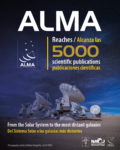
ALMA Reaches 5,000 Refereed Scientific Publications
From the Solar System to the most distant galaxies, 5,000 papers demonstrate the breadth, impact, and lasting scientific value of ALMA observations
Highlights
• ALMA has reached 5,000 refereed scientific publications, covering science from the Solar System to the most distant galaxies.
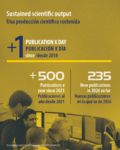
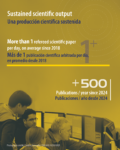
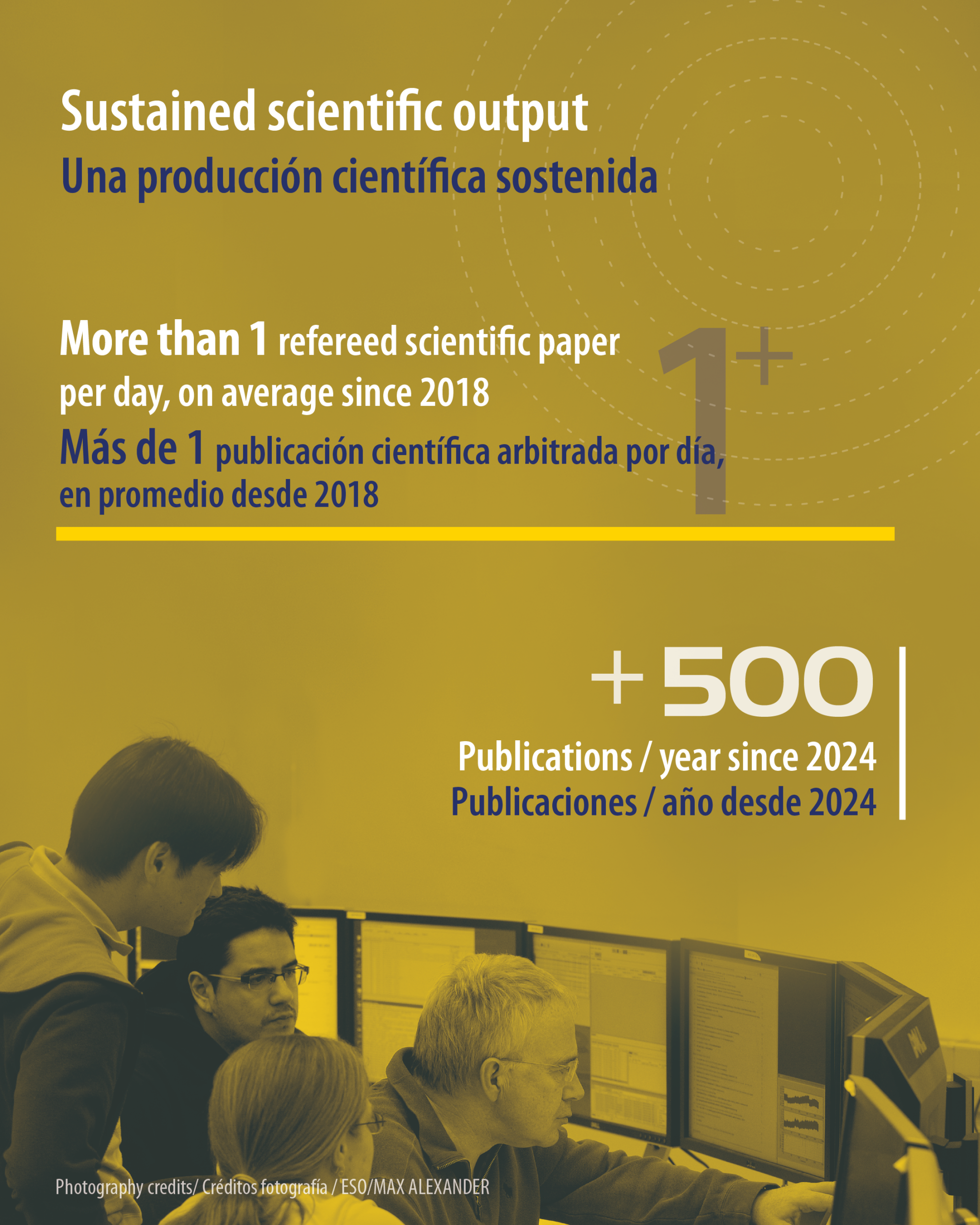
• ALMA has produced, on average, more than one refereed scientific paper per day every year since 2018, with annual output reaching a record 575 papers in 2025.
• A total of 1,514 papers—around 30% of the corpus—used at least some archival ALMA data, with the share of archive-based publications growing from 21% in 2018 to 35% in 2025.
• The first 5,000 ALMA publications had accumulated more than 217,000 citations as of July 2026, while about four in ten ALMA papers explicitly used data from at least one additional telescope or space mission.
The Atacama Large Millimeter/submillimeter Array (ALMA) has reached a major scientific milestone: 5,000 refereed publications based on observations obtained with the observatory.
Since the first ALMA scientific papers were published in 2012, researchers have used the observatory to investigate an extraordinary range of phenomena—from the Sun, planets, moons, comets, and the disks where planets form, to stellar nurseries, evolved stars, nearby galaxies, growing supermassive black holes, and some of the most distant galaxies known.
ALMA’s publication output has grown rapidly alongside the observatory’s scientific capabilities. From only a few papers in 2012, annual output rose to a record 575 refereed publications in 2025. Since 2018, research based on ALMA observations has produced more than one scientific paper per day.
“This milestone reflects not only the extraordinary capabilities of ALMA, but also the creativity and commitment of the international scientific community that continues to push the observatory in new scientific directions,” said John Carpenter, ALMA Observatory Scientist. “Each publication adds to a scientific legacy that will remain valuable for decades.”
Science across the universe
The underlying ALMA projects cover the observatory’s full scientific scope.
ALMA is an exceptionally versatile observatory rather than a single-purpose instrument. Its observations address questions across nearly every area of modern astronomy, and many studies cross traditional scientific boundaries. Research on galaxies, for example, can connect the study of molecular gas and dust to questions about star formation, chemical enrichment, black hole growth, and galaxy evolution. This ability to explore many different phenomena–and connect them within a single study–is one of ALMA’s defining scientific strengths.
Together, the projects behind these 5,000 publications include approximately 96,000 science observations and about 2.7 petabytes of data. These observations cover an extraordinary range of targets, from the Solar System and the Milky Way to nearby galaxies and the distant universe.
A central part of multi-observatory and multi-messenger astronomy
ALMA’s scientific value is frequently amplified by observations made at other wavelengths.
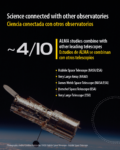
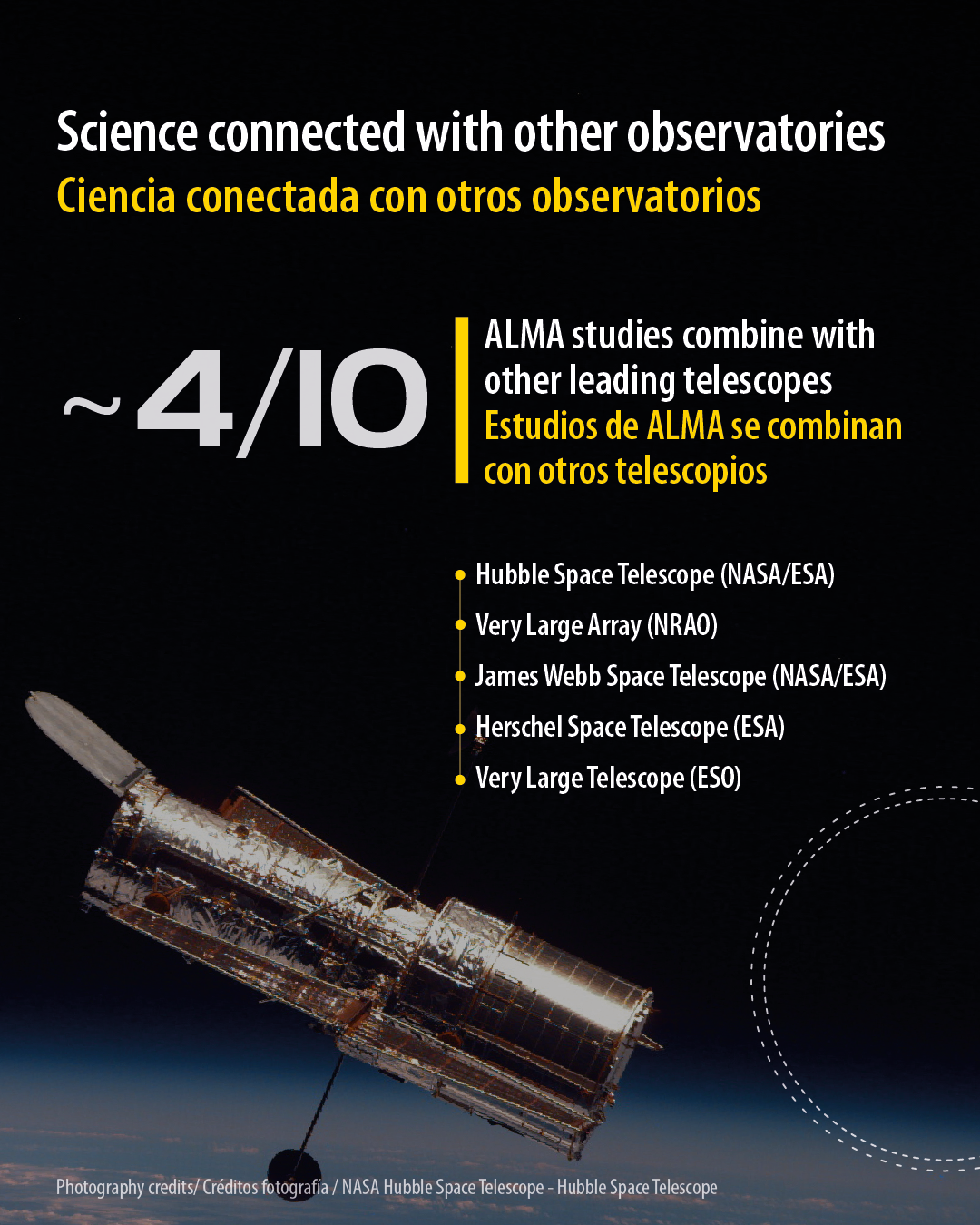
An analysis of the publication corpus found that about four out of ten ALMA papers use data from at least one additional telescope or space mission. The observatories most frequently combined with ALMA include the NASA/ESA Hubble Space Telescope, the U.S. National Science Foundation Very Large Array, the NASA/ESA/CSA James Webb Space Telescope, the ESA Herschel Space Observatory, and ESO’s Very Large Telescope.
These combinations connect ALMA’s view of the millimeter and submillimeter universe with observations at other wavelengths and physical phenomena such as gravitational waves. Together, they allow astronomers to study different components and physical processes within the same cosmic objects and events.
“ALMA does not work in isolation,” added Carpenter. “Its observations become even more powerful when combined with measurements from other facilities, across the electromagnetic spectrum and through multi-messenger astronomy. These collaborations provide a more complete view of the universe than any single observatory could achieve alone.”
An archive that continues producing discoveries
The milestone also demonstrates the long-term scientific value of the ALMA Science Archive.
Of ALMA’s first 5,000 refereed publications, 1,514–around 30%–used at least some archival ALMA data. This includes 790 papers based entirely on archival data and 724 that combined archival data with data from projects involving members of the author team. The use of the ALMA Science Archive has grown substantially over time. In 2018, 82 papers –about 21% of that year’s total–used archival data. By 2025, the number had risen to 201 papers, representing about 35% of all ALMA publications that year.
“Maintaining ALMA’s publication record allows us to see not only how scientific output has grown, but also how the observatory’s data continue to generate new results long after the original observations were made,” said Felix Stoehr, Subsystem Scientist of the ALMA Science Archive. “The increasing use of archival data shows how ALMA’s scientific legacy continues to expand with every new observation.”
This means that ALMA observations frequently lead to discoveries beyond the original goals of the teams that proposed them. Data collected for one scientific question can later be reused to address another, test new methods, compare large samples, or explore questions that had not yet emerged when the observations were made.
Large Programs, which address major scientific questions through extensive and coordinated observing campaigns, have contributed to more than 560 refereed publications. Director’s Discretionary Time observations—used for urgent, rapidly evolving, or especially timely scientific opportunities—have contributed to more than 300.
Participation from Chile and around the world
ALMA’s publication record reflects the international community that operates and uses the observatory.
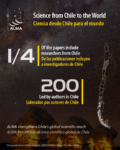
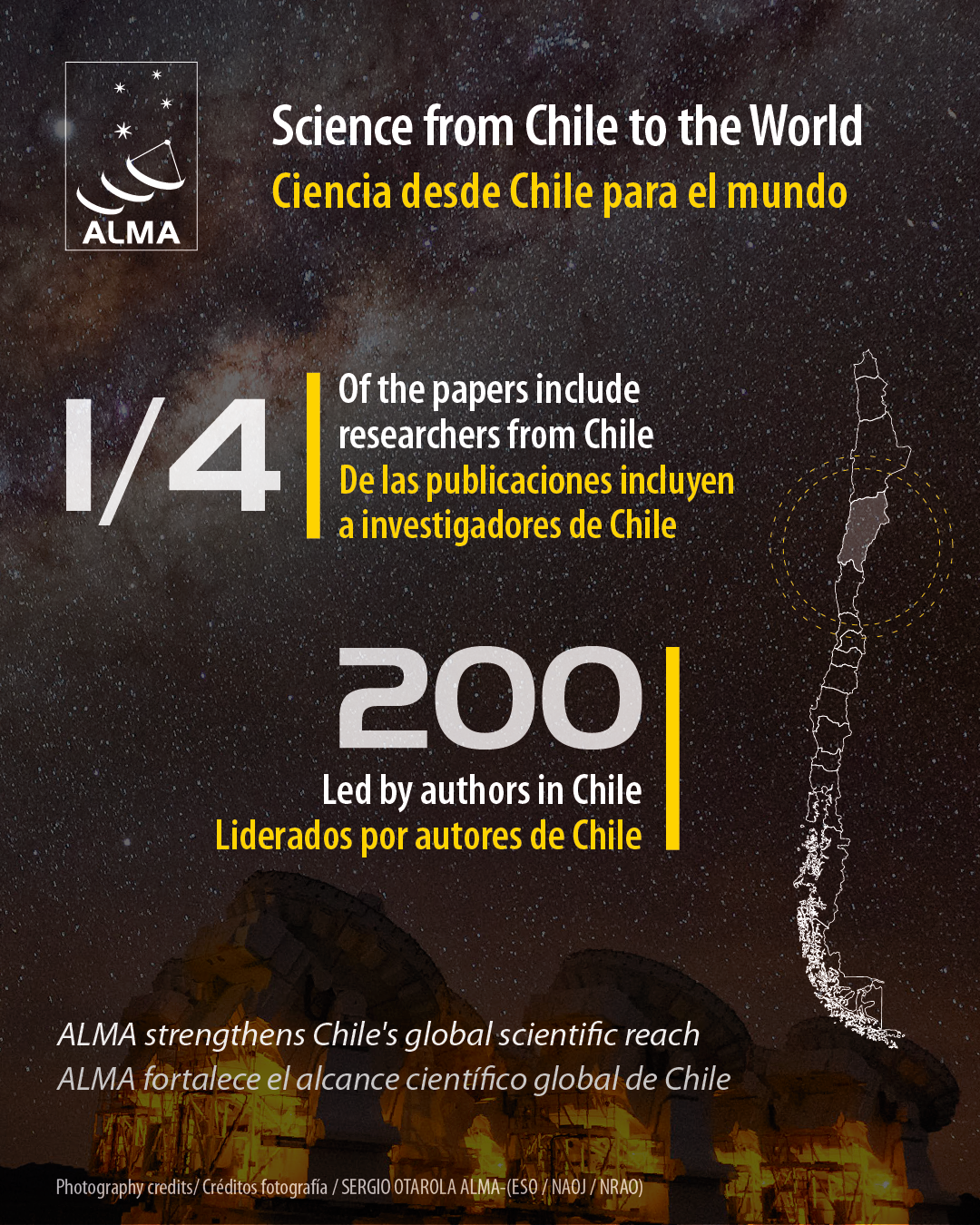
Researchers affiliated with institutions in Chile have contributed to nearly one-quarter of ALMA publications. About 200 papers have had a first author affiliated with an institution from Chile, ALMA’s host country.
Scientific influence
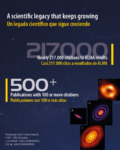
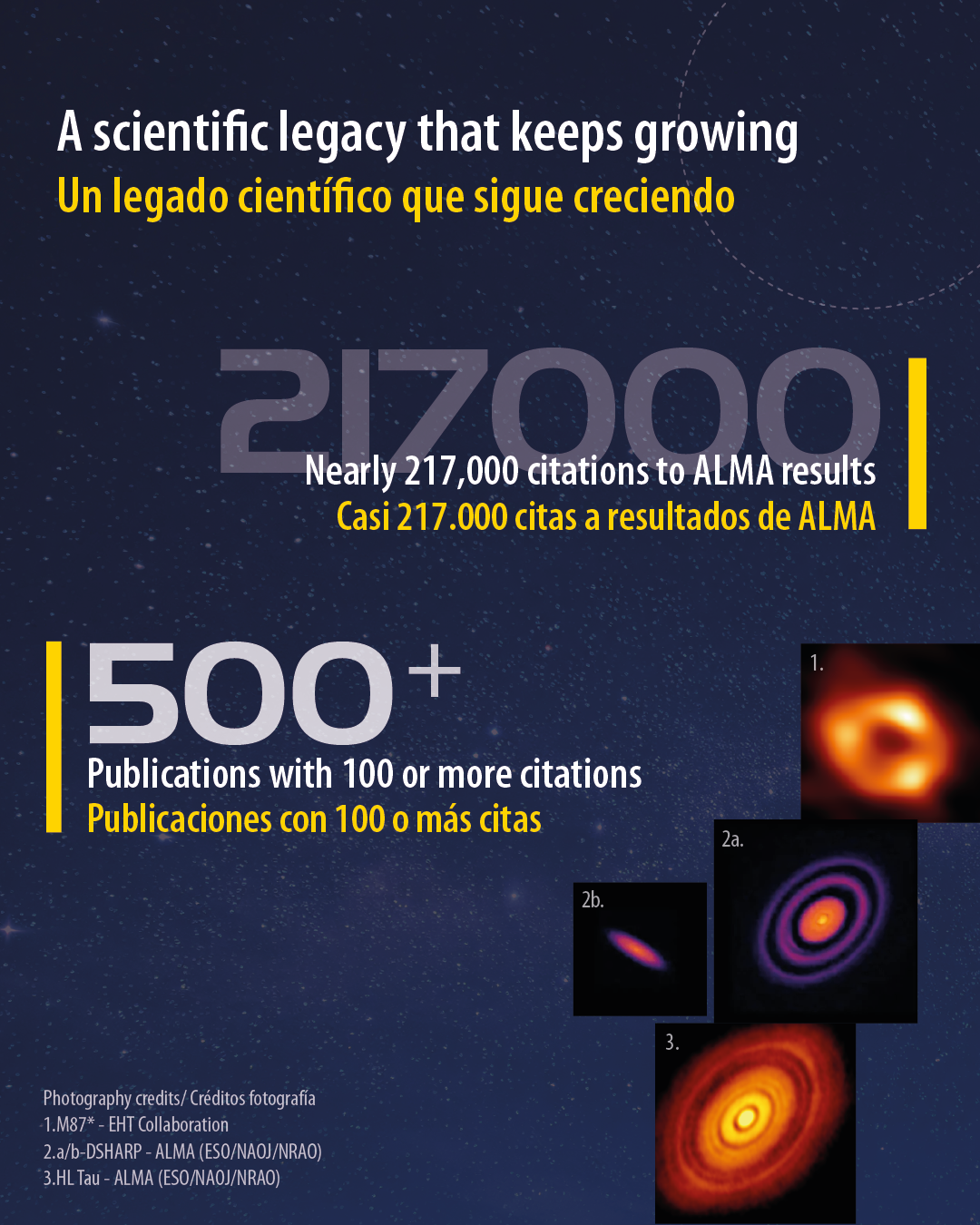
According to a July 2026 query of the NASA Astrophysics Data System, ALMA’s first 5,000 refereed publications had accumulated nearly 217,000 citations. The median ALMA publication has been cited 21 times, while nearly 500 papers have received at least 100 citations.
Among the most highly cited publications are the first Event Horizon Telescope results on the black holes in M87 and the center of the Milky Way, the first high-resolution ALMA observations of the planet-forming disk around HL Tau, and the Disk Substructures at High Angular Resolution Project, known as DSHARP.
These landmark results sit within a much broader body of work that has reshaped research on planet formation, astrochemistry, star formation, galaxy evolution, black hole environments, and the early universe.
A growing scientific legacy
Reaching 5,000 refereed publications is not an endpoint. ALMA is expected to continue observing for decades to come, while new observations, technical upgrades, increasingly sophisticated analysis methods, and the continued reuse of archival data expand the range of scientific questions the observatory can address.
The Wideband Sensitivity Upgrade will significantly expand the observatory’s instantaneous spectral coverage and improve its sensitivity, opening new opportunities for studies ranging from cold molecular gas and complex chemistry to planet formation and distant galaxies.
As ALMA enters its next phase, the observatory’s growing archive and global scientific community will continue to build on the discoveries represented by its first 5,000 publications.
“These five thousand publications demonstrate what becomes possible when advanced technology, international cooperation, and scientific curiosity come together,” Carpenter concluded. “The most exciting part of this milestone is knowing how much remains to be discovered.”
Additional Information
The publication statistics presented in this announcement are discussed in more detail in a refereed article published as “ALMA Publication Statistics,” by F. Stoehr et al., available through IOPscience.
ALMA is a partnership of ESO (representing its member states), NSF (USA), and NINS (Japan), together with NRC (Canada), NSTC and ASIAA (Taiwan), and KASI (Republic of Korea), in cooperation with the Republic of Chile. The Joint ALMA Observatory is operated by ESO, AUI/NRAO, and NAOJ.
Images
Contacts
-
Nicolás Lira
Education and Public Outreach OfficerJoint ALMA Observatory, Santiago - ChilePhone: +56 2 2467 6519Cel: +56 9 9445 7726Email: [email protected]