ALMA Watches a Massive Binary Assemble in Real Time
Using the Atacama Large Millimeter/submillimeter Array (ALMA), astronomers have captured one of the most detailed three-dimensional views yet of a massive binary star system while it is still being born. By tracking the motions of two young, massive stars over nearly eight years, the team found that the pair follows a highly stretched-out orbit and is surrounded by strongly tilted gas disks, both relative to each other and to the stars' orbit. The findings suggest the two stars didn't form together from a single spinning disk of material, as is often assumed, but instead formed independently and later came together in a close gravitational encounter, revealing a new way close massive binary star systems may form.
Most massive stars are born with stellar companions, and at least 90% are thought to exist in binary or higher-order multiple systems. These massive binaries go on to shape their surroundings dramatically, through supernova explosions and the production of heavy elements. But because most known massive binaries are only studied long after they've finished forming, astronomers have had few opportunities to catch the actual moment of assembly.
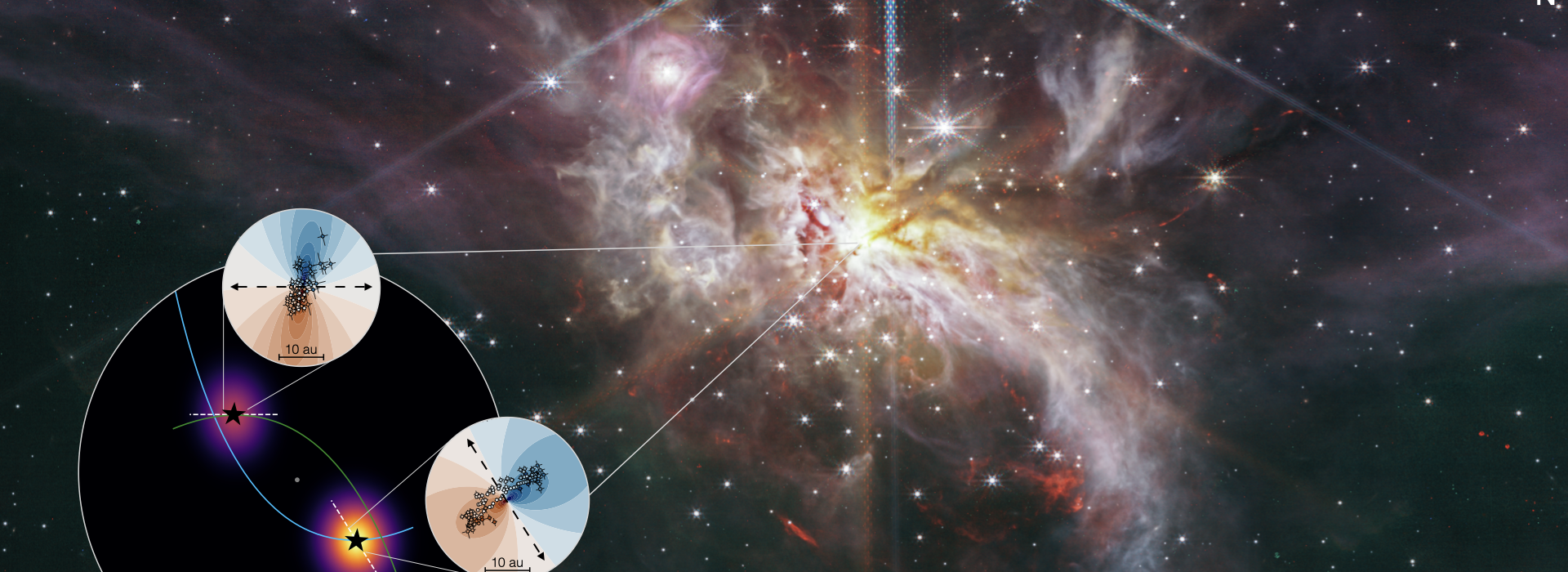
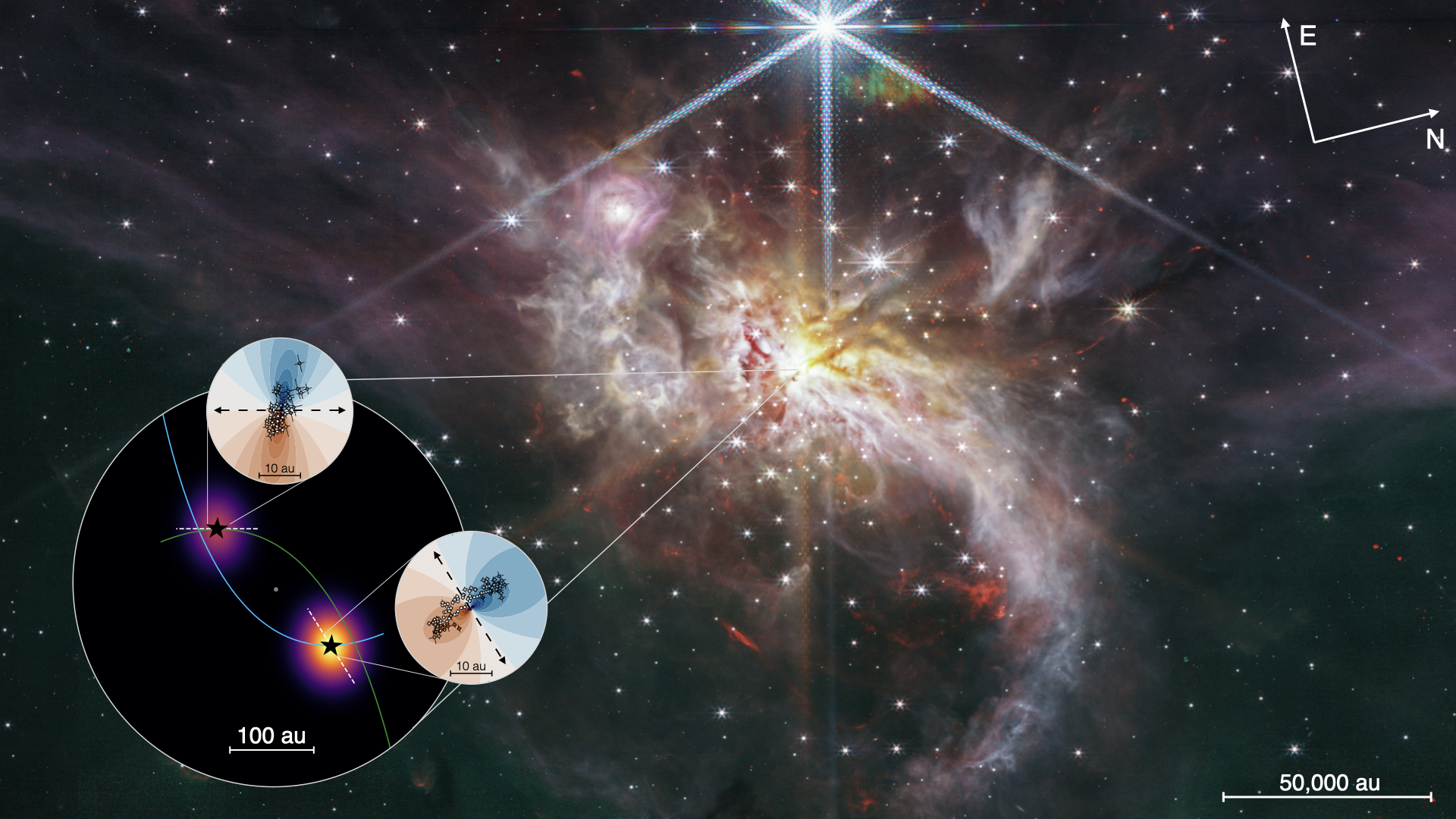
An international team led by Yichen Zhang of Shanghai Jiao Tong University set out to change that by studying IRAS 07299−1651, a system containing two massive protostars, stars still growing by pulling in surrounding gas and dust. The team had studied this system before, in 2019, when ALMA observations first provided direct dynamical constraints on the pair. At the time, the results seemed broadly consistent with the standard picture: two stars forming together from the fragmentation of one large disk. But one detail didn't quite fit: the disks around the two stars already looked oddly misaligned.
To dig deeper, the researchers spent nearly eight years measuring extremely subtle shifts in the two stars' positions on the sky, a technique that requires exceptional precision and is well within ALMA's capabilities. "For the first time, we were able to watch two massive stars move around one another while they were still being born," said Yichen Zhang, corresponding author of the study.
The team combined this long-term ALMA monitoring with data from the U.S. National Science Foundation's Very Large Array (VLA), as well as infrared images from the James Webb Space Telescope (JWST) and ESO's Very Large Telescope (VLT), which traced jets of material streaming away from the young stars. Together, these observations let the team reconstruct, for the first time, the system's full three-dimensional architecture, how the stars orbit each other, how their disks are tilted, and how their jets point into space.
"Each telescope revealed a different piece of the puzzle," said Rubén Fedriani, a co-author of the study. "The combination of radio and infrared observations provides the most exquisite detail on the formation of this massive protobinary system."
What they found surprised them. Instead of a neat, roughly circular orbit, the stars are following a highly eccentric trajectory, with the preferred orbital solutions lying close to a parabolic path. And rather than being aligned, as would be expected if the stars formed from the same disk, their surrounding disks are tilted at a sharp angle to each other and to the orbit itself. "It felt like solving a three-dimensional puzzle," said Yao Wang, the study's first author. "Each new observation added another piece, and eventually the orbit, disks, and jets all came together into a single, coherent picture."
This mismatched, chaotic-looking architecture is hard to explain if the two stars grew up together in the same disk — in that scenario, they'd be expected to inherit similar, well-aligned spins. Instead, the evidence points to a different origin story: the two stars likely began forming separately, in their own individual pockets of gas, before a chance close encounter brought them into their present configuration while they were still wrapped in their birth cloud. In representative orbital solutions, the stars passed closest to each other only about 60 years before the observations, practically an instant on cosmic timescales. The compact disks seen today appear to have survived the encounter, retaining well-defined rotational structures.
"This study demonstrates that the early lives of stars can be quite chaotic, with a chance encounter leading to this gravitational dance and stellar coupling," said Jonathan C. Tan, a co-author of the study.
It's still not certain whether the two stars will stay gravitationally bound to each other for good — their current motion sits close to the dividing line between a bound orbit and one that could eventually fly apart, and interactions with the surrounding gas may still nudge their fate one way or the other. Future observations will help pin that down.
More broadly, the study opens a new way of investigating how massive binary stars come together. By applying the same long-term monitoring approach to other young massive binaries, astronomers hope to learn how often close encounters like this one—rather than shared birth in a single disk—build the massive binary systems seen across our galaxy.
Additional Information
The results of this research appear in Nature Astronomy as "An eccentric massive protobinary assembled via a core-merger parabolic encounter" by Y. Wang et al.
This article is based on the original press release by the National Astronomical Observatory of Japan (NAOJ), an ALMA partner on behalf of East Asia.
The Atacama Large Millimeter/submillimeter Array (ALMA), an international astronomy facility, is a partnership of the European Southern Observatory (ESO), the U.S. National Science Foundation (NSF), and the National Institutes of Natural Sciences (NINS) of Japan in cooperation with the Republic of Chile. ALMA is funded by ESO on behalf of its Member States, by NSF in cooperation with the National Research Council of Canada (NRC) and the National Science and Technology Council (NSTC) in Taiwan, and by NINS in cooperation with the Academia Sinica (AS) in Taiwan and the Korea Astronomy and Space Science Institute (KASI).
ALMA construction and operations are led by ESO on behalf of its Member States; by the National Radio Astronomy Observatory (NRAO), managed by Associated Universities, Inc. (AUI), on behalf of North America; and by the National Astronomical Observatory of Japan (NAOJ) on behalf of East Asia. The Joint ALMA Observatory (JAO) provides the unified leadership and management of the construction, commissioning, and operation of ALMA.
Images
-2263x3000.jpg)
Contacts
-
Nicolás Lira
Education and Public Outreach OfficerJoint ALMA Observatory, Santiago - ChilePhone: +56 2 2467 6519Cel: +56 9 9445 7726Email: [email protected] -
Seiichiro Naito
NAOJ EPO LeadEmail: [email protected] -
Jill Malusky
Public Information Officer -
Bárbara Ferreira
ESO Media Manager
-113x150.jpg)