Cosmic Cocktail: ALMA Reveals Exotic Methanol Around Young Stars
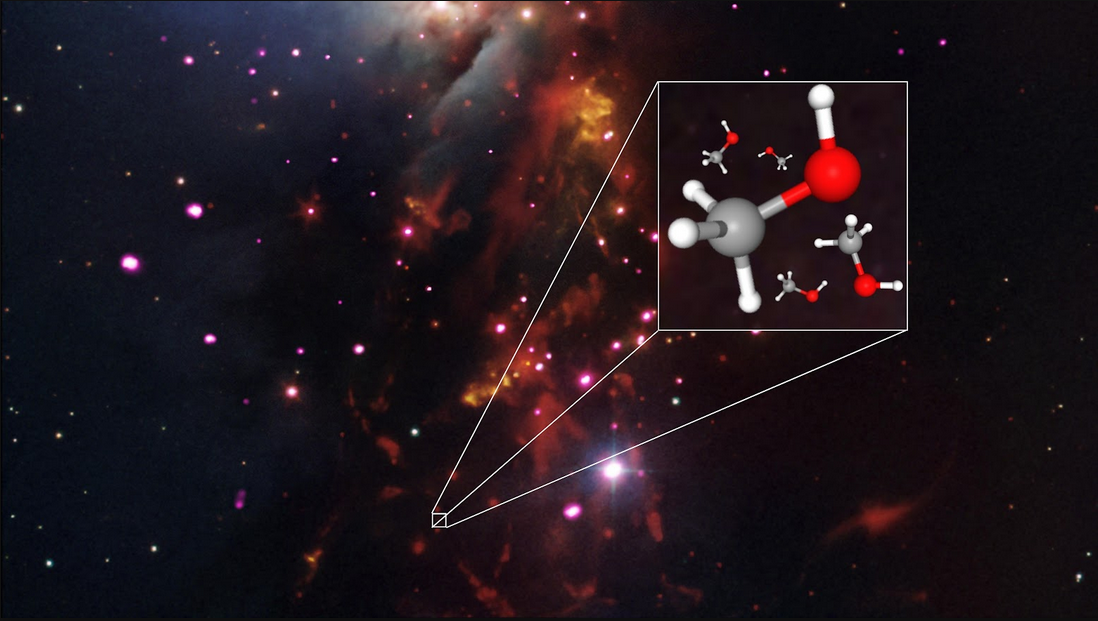
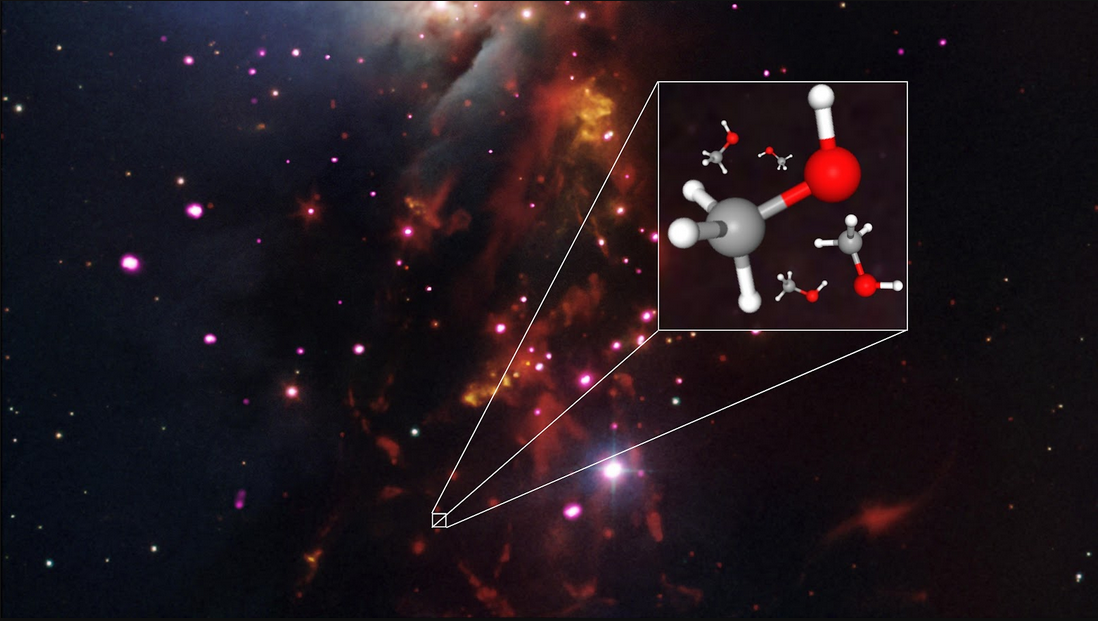
A major ALMA survey of young stars has uncovered widespread methanol masers and the first detection in space of fully deuterated methanol
An international team of astronomers using the Atacama Large Millimeter/submillimeter Array (ALMA) is opening a new window into how organic molecules develop around young stars and may eventually become part of emerging planetary systems.
New results from the ALMA COMPASS Large Program (Complex Organic Molecules in Protostars with ALMA Spectral Surveys) reveal that young stars still forming are surrounded by a surprisingly rich chemical environment. Among the molecules detected is methanol, a simple organic alcohol that plays an important role in forming more complex molecules in space.
“We are getting completely new insights into the complex chemistry occurring around the youngest protostars,” said Jes Jørgensen, Professor at the Niels Bohr Institute of the University of Copenhagen and PI of the program. “The interesting question is how these chemical ingredients may influence the conditions on planets and potentially the origin of life there.”
More Than 100 Hours of ALMA Observations
COMPASS is an international project using ALMA to study 11 nearby young, Sun-like stars in unprecedented detail. The program required more than 100 hours of telescope time to systematically investigate their chemical compositions.
Molecules in space emit radiation at characteristic frequencies, creating spectral fingerprints that astronomers can use to identify them. By combining signals from its antennas, ALMA can detect extremely faint molecular signatures and determine how different chemicals are distributed around young stars on scales comparable to our own Solar System.
The first results from COMPASS are presented in seven papers in Astronomy & Astrophysics, providing an initial look at the wealth of information contained in the survey.
“With COMPASS we can for the first time systematically compare protostars from different environments and in different evolutionary stages to begin to understand how chemical complexity develops during star formation,” said Dr. Adele Plunkett of the U.S. National Science Foundation National Radio Astronomy Observatory (NSF NRAO) and one of four co-PIs of the program together with Dr. Audrey Coutens of the University of Toulouse in France, Dr. Maria Drozdovskaya of the University of Bern in Switzerland and Prof. Jeong-Eun Lee of Seoul National University in South Korea.
Methanol Beacons Around Young Stars
Several of the first COMPASS results focus on methanol, the simplest alcohol and an important ingredient in the chemical pathways that produce larger organic molecules.
One study, led by Seoul National University graduate student Jae-Hong Jeong, found that methanol maser emission is far more widespread around low-mass protostars than previously thought.
Masers occur when molecules under particular physical conditions naturally amplify radiation at specific radio frequencies, creating bright signals that can act as cosmic beacons. The COMPASS observations detected methanol masers in more than half of the young stars studied, suggesting this emission may be common during the earliest stages of stellar evolution and becomes apparent only with sufficiently sensitive observations.
ALMA Detects Fully “Heavy” Methanol in Space for the First Time
In another major result, the COMPASS observations enabled the first detection in space of a fully “heavy” version of methanol.
The molecule, known as fully deuterated methanol, or CD₃OD, is a rare variant in which all of methanol’s hydrogen atoms have been replaced by deuterium, a heavier form of hydrogen.
Researchers made the discovery around the young protostar IRAS 4A2, located in the Perseus molecular cloud about 1,000 light-years from Earth. The result is reported in a study led by Dr. Arnaud Belloche of the Max Planck Institute for Radio Astronomy.
Detecting different forms of methanol lets astronomers investigate the physical and chemical conditions in which these molecules formed and better understand how chemistry develops during the earliest stages of star formation.
More Discoveries Ahead
These first results demonstrate ALMA’s ability to uncover rare and previously unseen chemical phenomena through sensitive spectral surveys. But they represent only the beginning of the scientific analysis of COMPASS.
The team will continue studying the full dataset, extending the analysis to the different molecular species detected across all 11 sources. One key goal is to determine whether differences in chemical composition among young stars originate in the environments where they were born or develop later as the stars evolve.
“We are just beginning to tap into the richness of this dataset”, said Prof. Jeong-Eun Lee. “As we expand the analysis, we expect to uncover entirely new aspects of how chemistry evolves on the path to planet formation.”
By systematically comparing the chemistry of young stellar systems, COMPASS is helping astronomers trace how molecular complexity evolves from interstellar clouds toward emerging planetary systems. Together with laboratory studies and chemical modeling, the observations provide new clues about the journey of material from the cold environments where stars are born to the disks in which planets may eventually form.
Additional Information
The first COMPASS results are presented in seven papers in Astronomy & Astrophysics:
- Jørgensen, Coutens, Drozdovskaya et al., “I. Overview of the ALMA Large Program”, 2026, A&A. DOI: 10.1051/0004-6361/202558725
- Plunkett, Maret, Harsono et al., “II. Approach to data reduction and products for line-rich broadband (sub-)millimeter spectra”, 2026, A&A. DOI: 10.1051/0004-6361/202558751
- Coutens, Cruz-Sáenz de Miera, Jørgensen et al., “III. CH3OH isotopic fractionation in the low-mass protostar BHR71-IRS1”, 2026, A&A. DOI: 10.1051/0004-6361/202558733
- Nazari, Coutens, Jørgensen et al., “Methyl cyanide isotopologues toward BHR71-IRS1”, 2026, A&A. DOI: 10.1051/0004-6361/202558748
- Yun, Lee, Jørgensen et al., “Tracing cavity walls and shocked knots with non-thermally desorbed CH3OH in BHR71-IRS1”, 2026, A&A. DOI: 10.1051/0004-6361/202558732
- Jeong, Lee, Jørgensen et al., “Discovery of a class I methanol maser transition and its association with acetaldehyde”, 2026, A&A. DOI: 10.1051/0004-6361/202558734
- Belloche, Spezzano, Coutens et al., “VII. First interstellar detection of fully deuterated methanol”, 2026, A&A. DOI: 10.1051/0004-6361/202659642
This article is based on the original press release by the National Radio Astronomical Observatory (NRAO), an ALMA partner on behalf of North America.
The Atacama Large Millimeter/submillimeter Array (ALMA), an international astronomy facility, is a partnership of the European Southern Observatory (ESO), the U.S. National Science Foundation (NSF), and the National Institutes of Natural Sciences (NINS) of Japan in cooperation with the Republic of Chile. ALMA is funded by ESO on behalf of its Member States, by NSF in cooperation with the National Research Council of Canada (NRC) and the National Science and Technology Council (NSTC) in Taiwan, and by NINS in cooperation with the Academia Sinica (AS) in Taiwan and the Korea Astronomy and Space Science Institute (KASI).
ALMA construction and operations are led by ESO on behalf of its Member States; by the National Radio Astronomy Observatory (NRAO), managed by Associated Universities, Inc. (AUI), on behalf of North America; and by the National Astronomical Observatory of Japan (NAOJ) on behalf of East Asia. The Joint ALMA Observatory (JAO) provides the unified leadership and management of the construction, commissioning, and operation of ALMA.
Image
Contacts
-
Nicolás Lira
Education and Public Outreach OfficerJoint ALMA Observatory, Santiago - ChilePhone: +56 2 2467 6519Cel: +56 9 9445 7726Email: [email protected] -
Jill Malusky
Public Information Officer -
Bárbara Ferreira
ESO Media Manager -
Seiichiro Naito
NAOJ EPO LeadEmail: [email protected]