ALMA Reveals Hidden Planet-Forming Structures in the Smallest Disks
Using ALMA’s exceptionally sharp vision, astronomers have uncovered rings, gaps, and cavities in extremely compact disks around young stars. The observations show that planet-formation structures extend into regions comparable in size to the inner Solar System, suggesting that many small disks may have looked smooth simply because their details were too small to resolve.
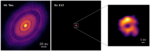
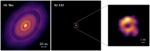
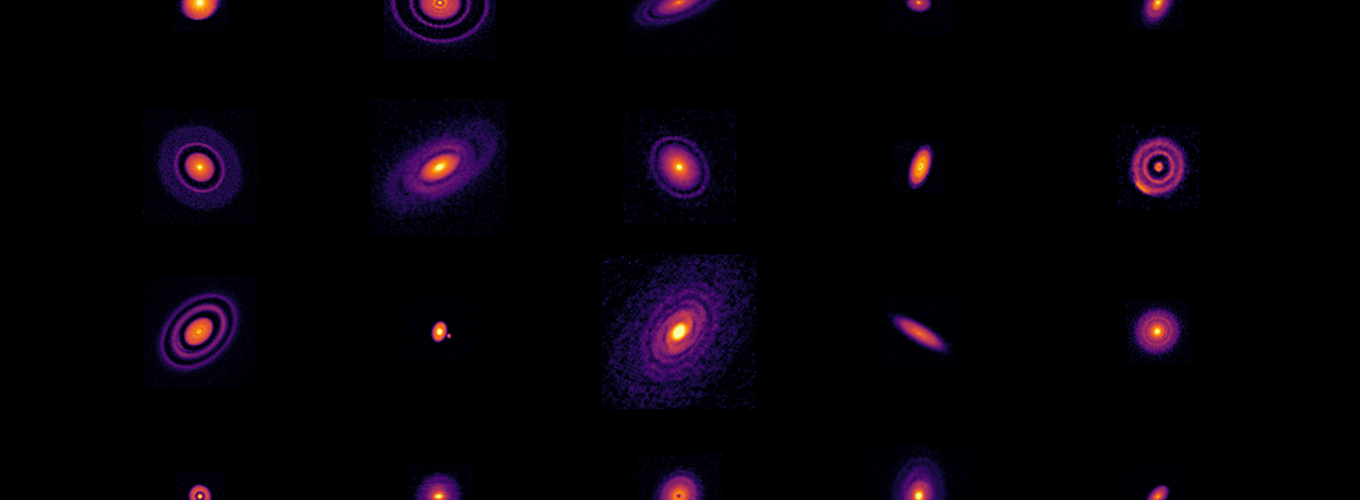
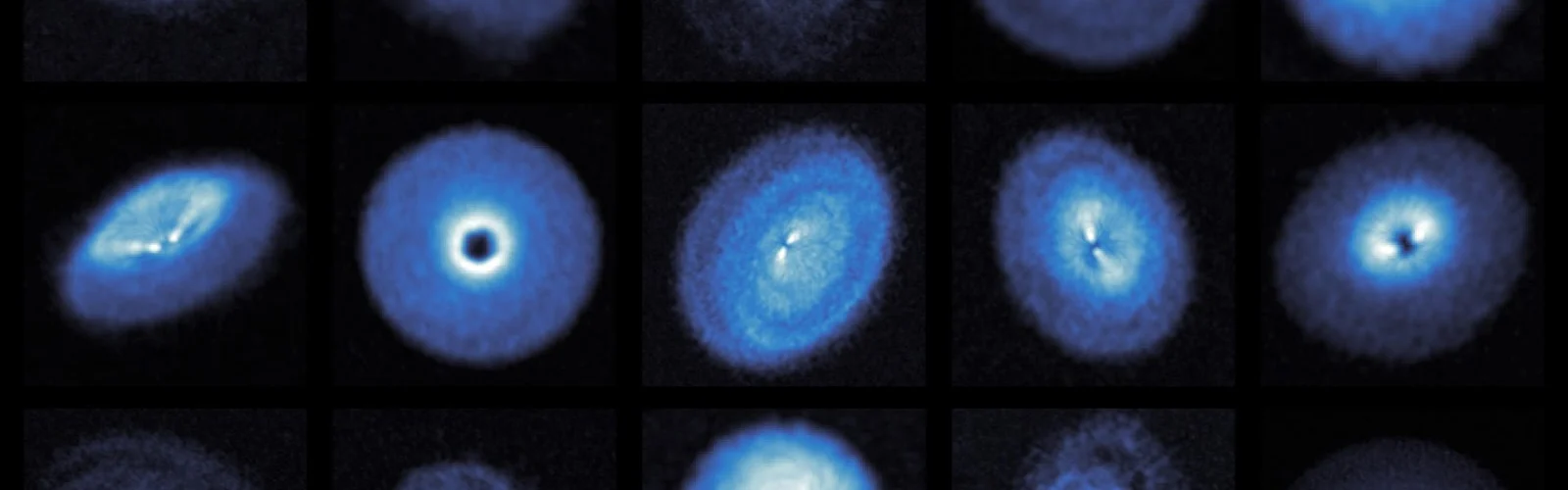
Some of the most striking images from the Atacama Large Millimeter/submillimeter Array (ALMA) show young stars surrounded by broad gas and dust disks divided into intricate rings and gaps. These structures can trap solid material and may mark places where planets are beginning to form.
But astronomers have mostly seen those spectacular structures in large, bright disks. Much smaller disks have often appeared smooth and relatively featureless, raising the question of whether they evolve differently — or whether their structures have simply been too small to see.
A team led by Pietro Curone of the CATA (Center for Astrophysics and Associated Technologies) and Universidad de Chile, with Gijs Mulders of Pontificia Universidad Católica de Chile, Nienke van der Marel of Leiden Observatory, and Laura Pérez of Universidad de Chile, has now taken a much closer look.
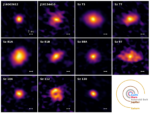
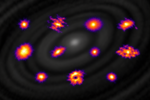
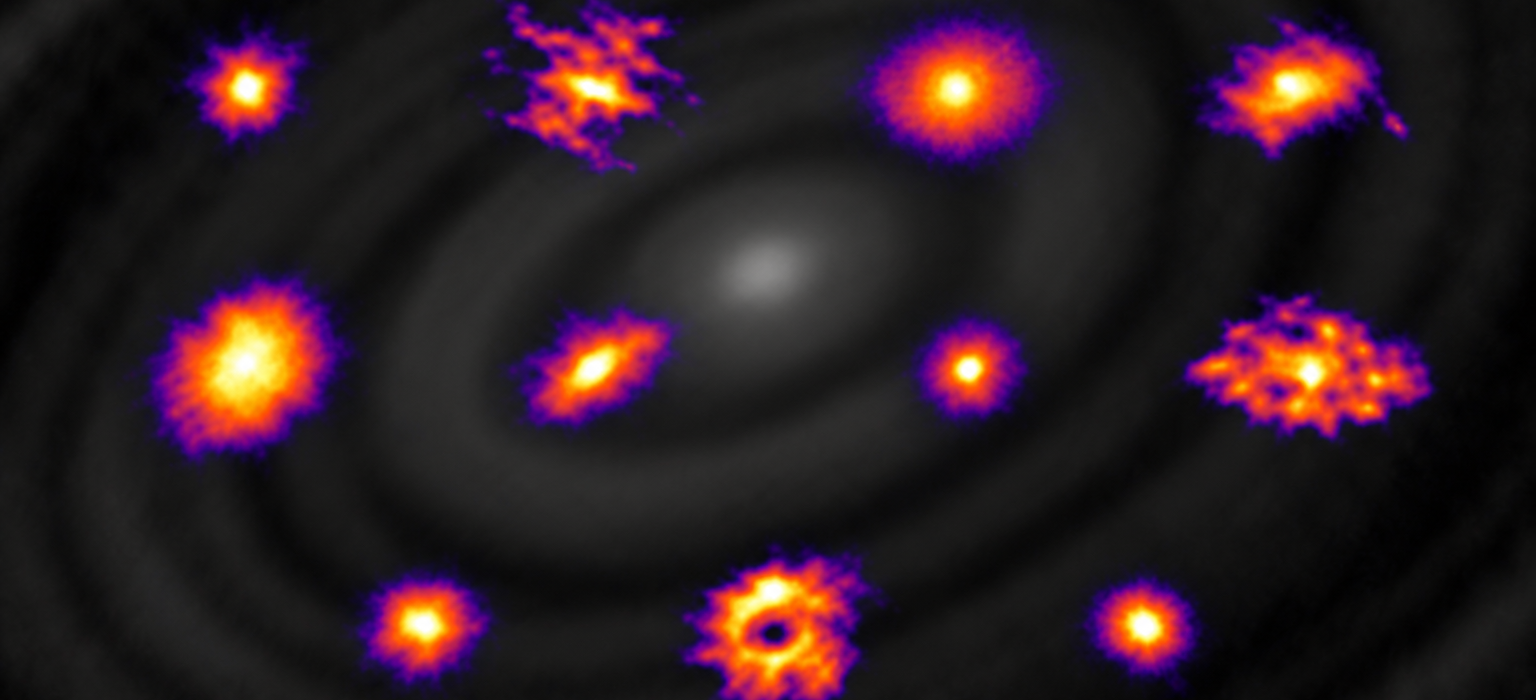
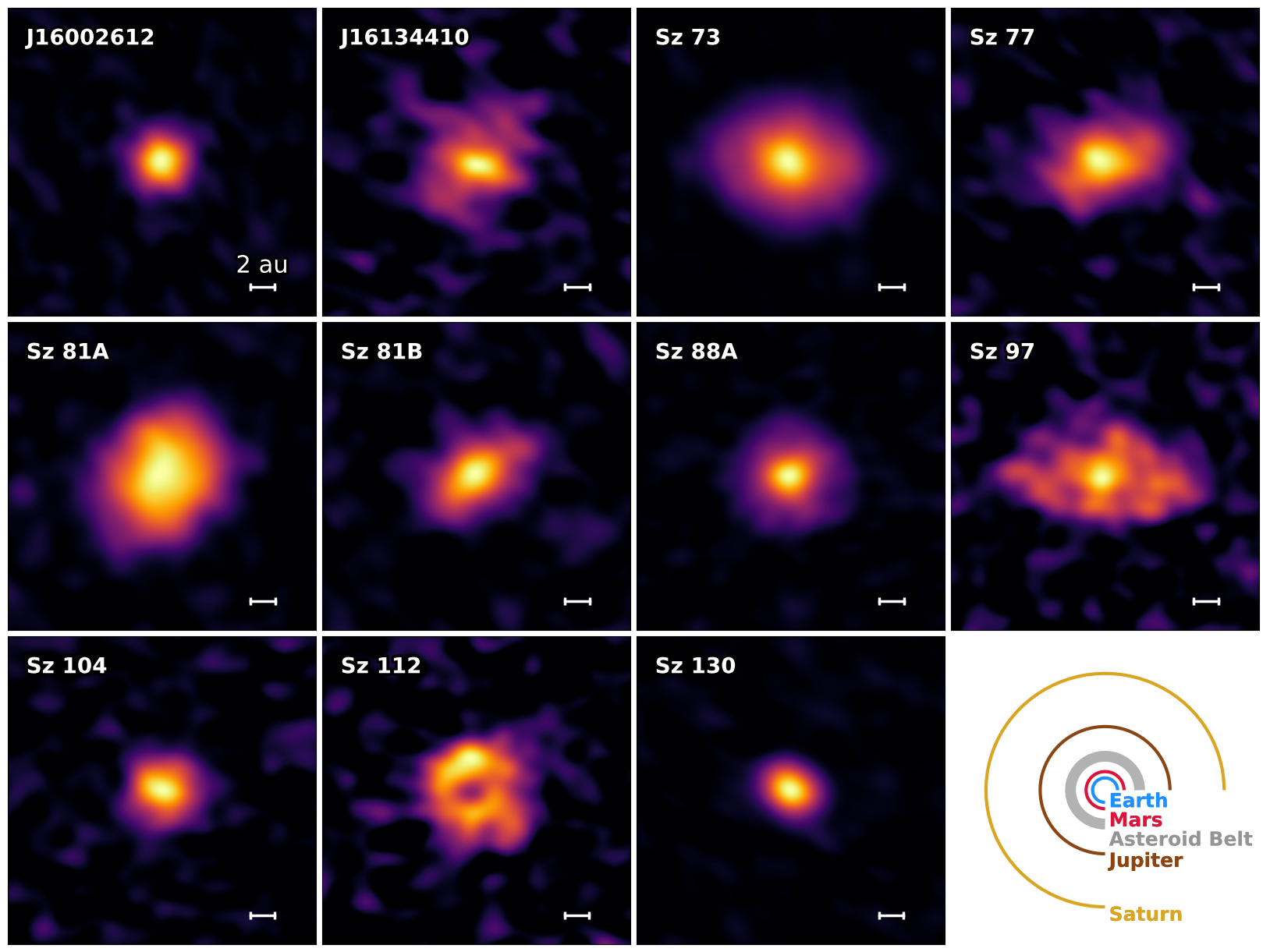
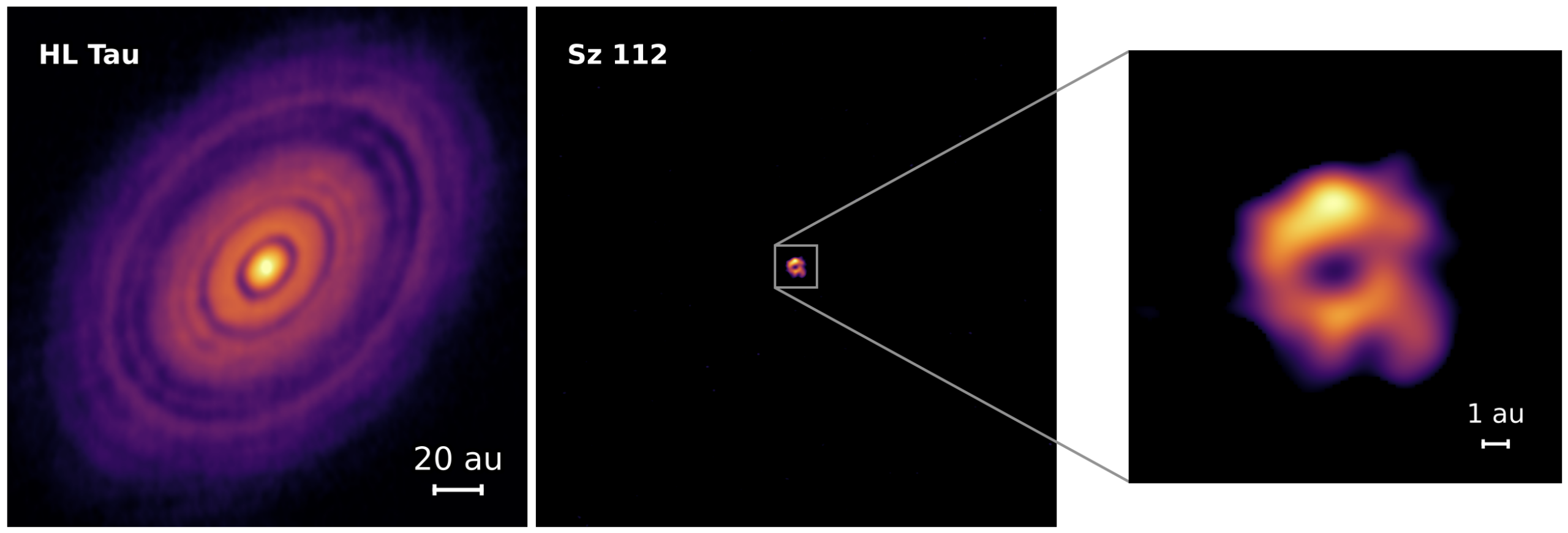
Using ALMA in its most extended antenna configuration, the astronomers observed 11 extremely compact protoplanetary disks in the Lupus star-forming region. The observations, made in ALMA Band 7 at a wavelength of about 0.9 millimeters, reached an angular resolution of roughly 0.02 arcseconds. At Lupus's distance, that corresponds to scales of about two astronomical units, or twice the average distance between Earth and the Sun. This is the highest angular resolution currently available with ALMA at this wavelength.
At that resolution, several disks that had appeared simple began to reveal hidden detail. The team detected clear substructures within 10 astronomical units of the central star in four of the 11 disks and found indications of similar features in another three. In one system, Sz 112, ALMA resolved a central cavity extending to only 1.6 astronomical units from the star.
“For a long time, the smallest disks looked much simpler than the large, spectacular disks that ALMA made famous. What we find is that at least part of that difference was an illusion caused by resolution,” explains Curone. “When we zoom in far enough, rings, gaps and cavities begin to appear, even in these tiny systems.”
The result suggests that compact disks may not represent a fundamentally different kind of planet-forming environment. Instead, many may contain the same kinds of structures found in larger disks but compressed into regions only a few astronomical units across.
That is particularly important because the regions probed in this study are much closer to the orbital scales of many known planetary systems. Previous high-resolution ALMA surveys have largely resolved structures at distances of several to tens of astronomical units from their stars. Yet many exoplanets are found much closer in. Compact disks therefore offer a way to investigate planet formation in regions that more closely overlap with the places where many planets ultimately reside.
“The central question for us was whether small disks truly lack structure, or whether their features were simply beyond our resolution limit,” explains co-author Mulders. “To answer that, we compared the new observations of compact disks with previous ALMA studies of planet-forming disks.”
The comparison revealed a strong dependence on how well a disk had been resolved. Among disks observed with enough resolution to reliably reveal structure, substructures were detected in about 44% of extremely compact disks with radii between 3 and 10 astronomical units and in about 55% of disks between 10 and 30 astronomical units. For disks larger than 30 astronomical units, the detection rate rises above 90%.
The result suggests that the previously reported scarcity of rings and gaps in small disks was driven, at least in part, by insufficient angular resolution rather than by their genuine absence.
“This is a good example of how the picture changes when we gain resolution. A disk that looks smooth from farther away can show rich internal structure once we can separate features only a few astronomical units apart”, says Pérez, a co-author of the study.
The structures matter because dust in a protoplanetary disk does not simply remain where it was born. Solid particles tend to lose angular momentum and drift inward toward the star. Without some mechanism to slow that migration, millimeter-sized grains could disappear from the outer disk much faster than the lifetime of the disk itself.
Rings and gaps can signal changes in gas pressure that trap those particles. By slowing or stopping their inward drift, these pressure traps can preserve concentrations of solid material and create favorable locations for planet growth.
“Our new ALMA observations suggest that such traps can exist only a few astronomical units from young stars, even in extremely compact disks,” says co-author of the study van der Marel. “One possible explanation for some of the newly detected gaps is that young planets created them.”
The researchers estimated which kinds of planets could produce the observed structures if a single planet caused each gap. For structures within five astronomical units, the required masses fall within the range associated with super-Earths and mini-Neptunes. These possible planets would occupy a region of planet mass and orbital distance that is difficult to probe with both current exoplanet surveys and disk observations focused on much larger orbital scales.
“If planets are responsible for some of these gaps, we may be seeing the signatures of relatively low-mass planets while they are still forming, at orbital distances that have been very difficult to access before,” adds Curone.
The team cautions that rings, gaps and cavities are not themselves direct detections of planets. Several physical mechanisms can create structure in protoplanetary disks, and the current observations do not completely rule out non-planetary explanations. The authors find that a planetary origin is consistent with the structures detected in several disks, but further observations are needed to determine what produces them.
The observations also revealed another surprise. Two of the apparently compact systems, Sz 73 and Sz 130, have faint rings extending well beyond their bright central disks. Four additional systems show tentative signs of similar outer emission. This raises the possibility that some disks classified as very small may have more extended material that has remained hidden because it is faint.
Together, the results point toward a more continuous picture of protoplanetary disks. Large and compact disks may share many of the same basic structures and physical processes, with the main difference being the scales on which they occur.
By resolving features only a few astronomical units across, ALMA is beginning to bridge the gap between observations of planet-forming disks and the architectures of mature planetary systems. Future high-resolution observations of more compact disks, at different wavelengths and using tracers of both dust and gas, will help determine how common these hidden structures are and whether they truly mark the formation sites of the planets that will eventually emerge from them.
Additional Information
This research appears in “Probing Planet Formation within 10 au: Dust Substructures in Extremely Compact Protoplanetary Disks2” by P. Curone et al. in the Astrophysical Journal Letters.
The Atacama Large Millimeter/submillimeter Array (ALMA), an international astronomy facility, is a partnership of the European Southern Observatory (ESO), the U.S. National Science Foundation (NSF), and the National Institutes of Natural Sciences (NINS) of Japan in cooperation with the Republic of Chile. ALMA is funded by ESO on behalf of its Member States, by NSF in cooperation with the National Research Council of Canada (NRC) and the National Science and Technology Council (NSTC) in Taiwan, and by NINS in cooperation with the Academia Sinica (AS) in Taiwan and the Korea Astronomy and Space Science Institute (KASI).
ALMA construction and operations are led by ESO on behalf of its Member States; by the National Radio Astronomy Observatory (NRAO), managed by Associated Universities, Inc. (AUI), on behalf of North America; and by the National Astronomical Observatory of Japan (NAOJ) on behalf of East Asia. The Joint ALMA Observatory (JAO) provides the unified leadership and management of the construction, commissioning, and operation of ALMA.
Images
Contacts
-
Nicolás Lira
Education and Public Outreach OfficerJoint ALMA Observatory, Santiago - ChilePhone: +56 2 2467 6519Cel: +56 9 9445 7726Email: [email protected] -
Jill Malusky
Public Information Officer -
Bárbara Ferreira
ESO Media Manager -
Seiichiro Naito
NAOJ EPO LeadEmail: [email protected]