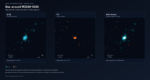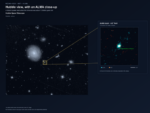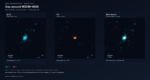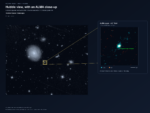
ALMA resolves the gravitational reach of a black hole in the early universe
Gas moving near the center of a galaxy whose light has traveled for more than 12 billion years reveals a black hole about 6.5 billion times more massive than the Sun
Astronomers using the Atacama Large Millimeter/submillimeter Array (ALMA) measured the mass of a supermassive black hole in WISE J224607.56−052634.9, also known as W2246-0526. Its light has been stretched by the expansion of the universe to about 5.6 times its original wavelength. This shift, called redshift, tells astronomers that we see the galaxy as it was when the universe was about 1.3 billion years old.
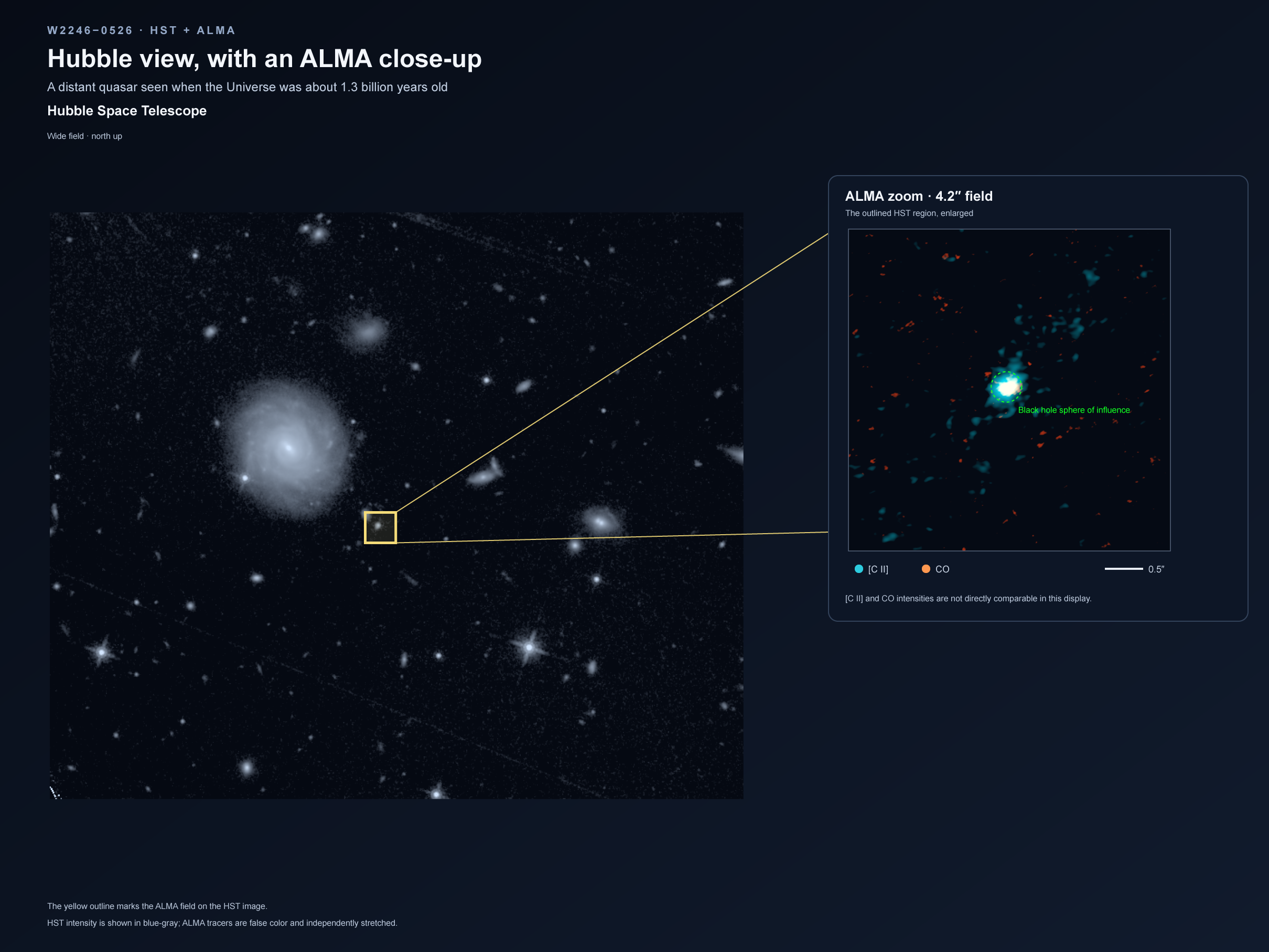
W2246-0526 is a dust-obscured galaxy powered by a bright, active central black hole. This kind of luminous active nucleus is called a quasar. By tracking how gas moves near the galaxy’s center, the team estimated that the black hole has a mass of about 6.5 billion times the Sun’s. The team reports the first dynamical measurement of a black hole’s mass at redshift greater than 2 in an unlensed galaxy—that is, one not significantly magnified by the gravity of a foreground object—with its sphere of influence spatially resolved. The sphere of influence is the region where the black hole’s gravity dominates over that of the surrounding galaxy.
“By resolving the gas motions close to the center, we can see the black hole’s gravity imprinted on its surroundings,” said lead author Mai Liao, affiliated with the National Astronomical Observatories of the Chinese Academy of Sciences and Universidad Diego Portales in Chile. “That gives us a dynamical mass measurement from a time when the universe was only about 1.3 billion years old and lets us compare it with estimates based on the quasar’s light.”
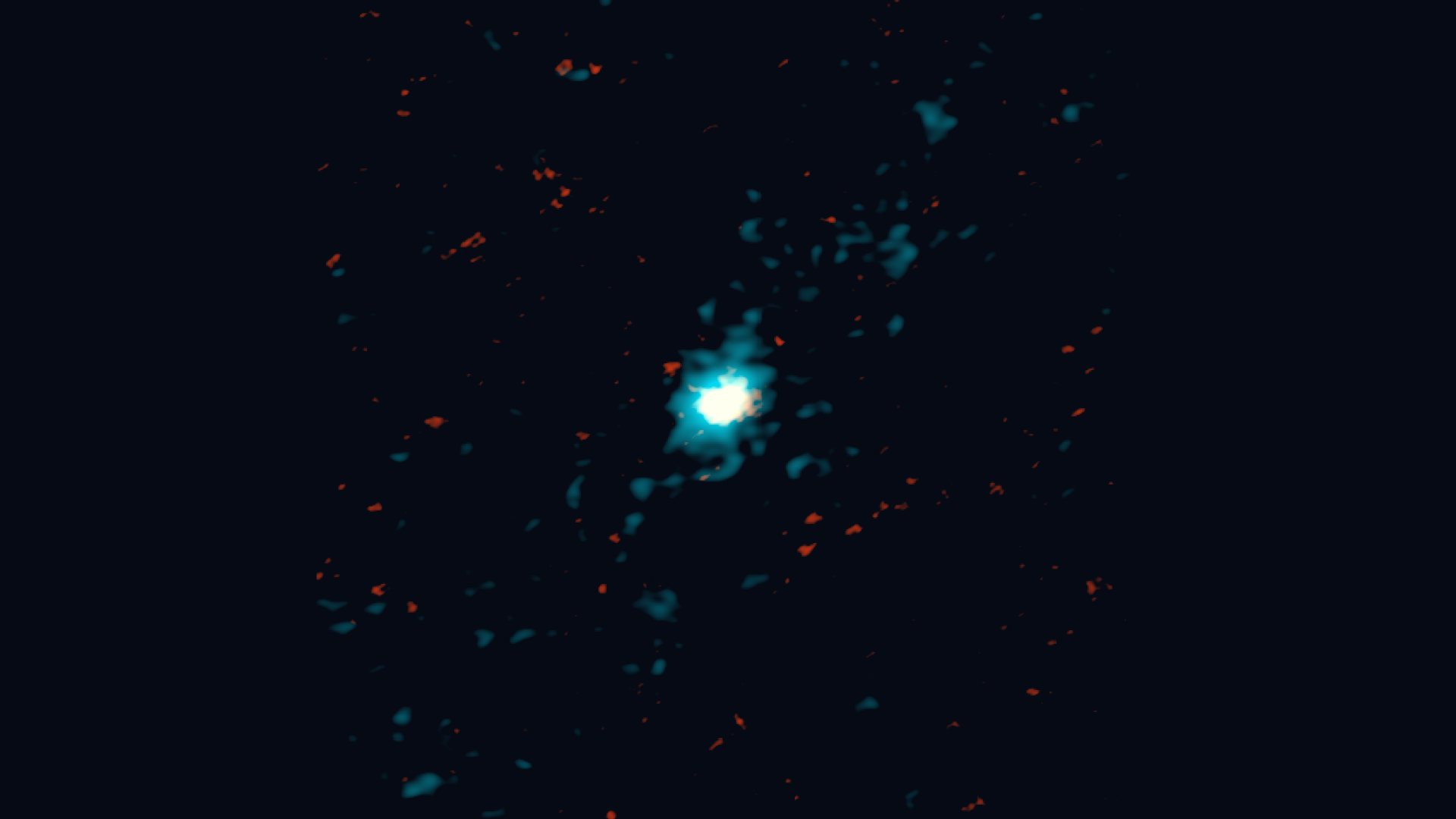
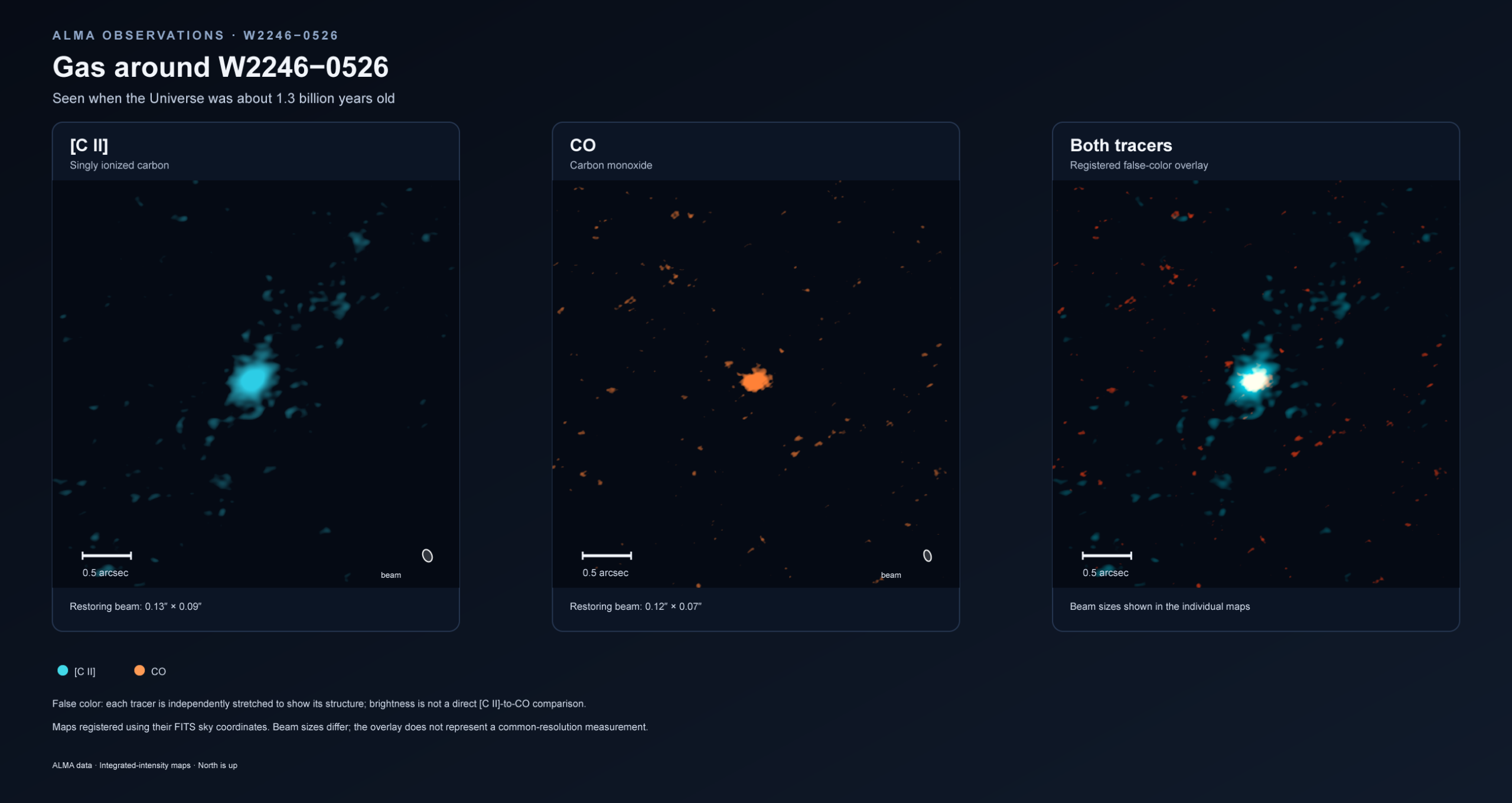
The researchers used ALMA observations of emissions from singly ionized carbon and carbon monoxide in the galaxy. ALMA’s sharpest observations can distinguish features about 700 light-years across at this distance. After accounting for gas flowing outward from the quasar, the team found that the range of gas speeds rises sharply toward the center—a pattern consistent with the black hole’s gravitational pull.
Earlier ALMA studies tried to measure black hole masses in luminous, unobscured quasars at redshifts greater than 6 by tracing emission from singly ionized carbon near their centers, but did not find a clear gravitational signature. One possible explanation is that intense X-ray radiation from the active nucleus further ionizes the carbon, weakening its emission close to the black hole.
The researchers suggest that the thick dust around W2246-0526 shields nearby gas from some of this radiation, allowing carbon and other gas tracers to survive closer to the black hole. This may help explain why ALMA could reveal the black hole’s gravitational influence there. Heavily obscured quasars could therefore be promising targets for building a larger sample of dynamical black hole mass measurements in the early universe.
“ALMA lets us study the gas motions close to the black hole in detail and separate the different dynamical components across the galaxy, including those induced by the black hole’s gravity,” said co-author Roberto J. Assef of Universidad Diego Portales.
Black hole masses in distant quasars are often estimated indirectly, using the width of emission lines and the quasar’s brightness. Those estimates rely on relationships calibrated in the nearby universe. A dynamical measurement offers a way to test how well those relationships work for galaxies in the early universe.
Additional Information
The study, “Resolving the black hole sphere of influence in a hyperluminous obscured quasar at redshift 4.6,” by M. Liao et al has been released in Science Advances.
The Atacama Large Millimeter/submillimeter Array (ALMA), an international astronomy facility, is a partnership of the European Southern Observatory (ESO), the U.S. National Science Foundation (NSF), and the National Institutes of Natural Sciences (NINS) of Japan in cooperation with the Republic of Chile. ALMA is funded by ESO on behalf of its Member States, by NSF in cooperation with the National Research Council of Canada (NRC) and the National Science and Technology Council (NSTC) in Taiwan, and by NINS in cooperation with the Academia Sinica (AS) in Taiwan and the Korea Astronomy and Space Science Institute (KASI).
ALMA construction and operations are led by ESO on behalf of its Member States; by the National Radio Astronomy Observatory (NRAO), managed by Associated Universities, Inc. (AUI), on behalf of North America; and by the National Astronomical Observatory of Japan (NAOJ) on behalf of East Asia. The Joint ALMA Observatory (JAO) provides the unified leadership and management of the construction, commissioning, and operation of ALMA.
Images
Contacts
-
Nicolás Lira
Education and Public Outreach OfficerJoint ALMA Observatory, Santiago - ChilePhone: +56 2 2467 6519Cel: +56 9 9445 7726Email: [email protected] -
Bárbara Ferreira
ESO Media Manager -
Jill Malusky
Public Information Officer -
Seiichiro Naito
NAOJ EPO LeadEmail: [email protected]