ALMA Detects Extremely Abundant Alcohol in Interstellar Comet 3I/ATLAS
Methanol-rich interstellar comet offers a glimpse into planet formation beyond our Solar System
Astronomers using the Atacama Large Millimeter/submillimeter Array (ALMA) have detected an unusually large amount of the organic molecule methanol in the interstellar comet 3I/ATLAS, revealing chemical conditions unlike those found in most comets of our own Solar System.
The observations show that 3I/ATLAS contains significantly more methanol than hydrogen cyanide, unlike nearly all previously studied comets. These findings provide a rare opportunity to study the chemistry of planetary systems beyond our own.
“Observing 3I/ATLAS is like taking a fingerprint from another solar system,” shares Nathan Roth, lead author on this research and a professor with American University. “The details reveal what it’s made of, and it’s bursting with methanol in a way we just don’t usually see in comets in our own solar system.”
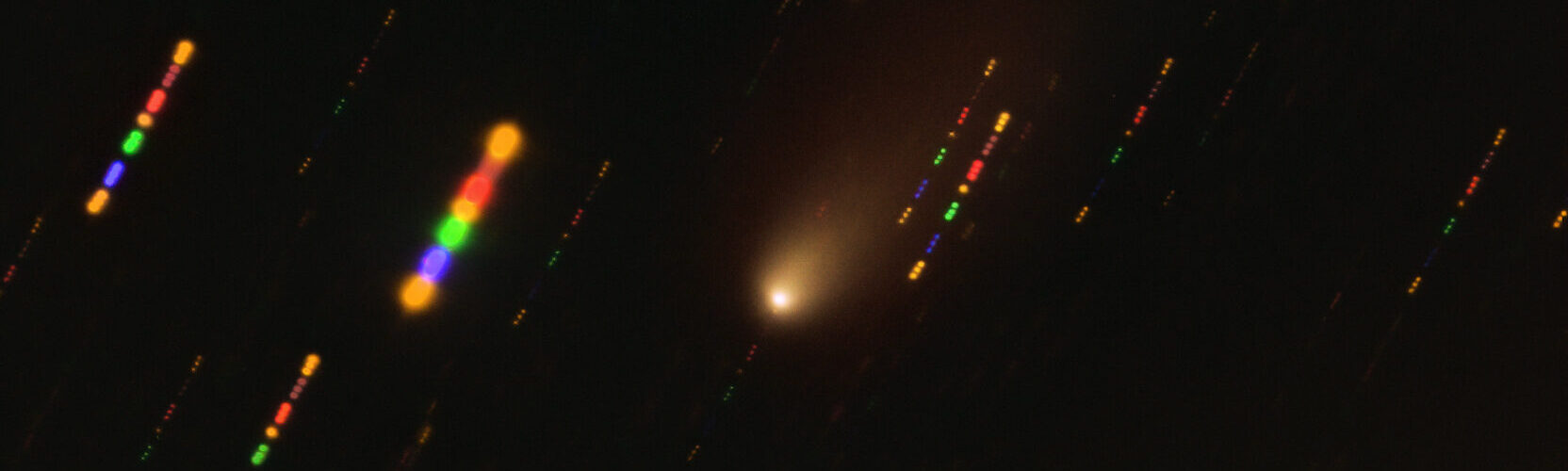
Using ALMA’s Morita Array (Atacama Compact Array - ACA) in Chile, the research team observed 3I/ATLAS on multiple dates in late 2025 as the comet approached the Sun. As sunlight warmed its icy surface, the comet released gas and dust, forming a glowing halo—known as a coma—around its nucleus. By analyzing the composition of this coma, astronomers were able to identify the chemical fingerprints of the material making up the comet and gain insights into the conditions under which it formed.
The team focused on the faint submillimeter signatures of two molecules: methanol (CH₃OH), an alcohol, and hydrogen cyanide (HCN), a nitrogen-bearing organic molecule commonly observed in comets. The ALMA data reveal that 3I/ATLAS is strongly enriched in methanol compared to hydrogen cyanide. On two observing dates, the researchers measured methanol-to-HCN ratios of about 70 and 120, placing 3I/ATLAS among the most methanol-rich comets ever studied.
These measurements suggest that the icy material making up 3I/ATLAS formed—or was processed—under conditions different from those that shaped most comets in our Solar System. Previous observations with the James Webb Space Telescope had already shown that the comet’s coma was dominated by carbon dioxide when it was farther from the Sun. The new ALMA observations add methanol to its unusual chemical inventory as another key component.
ALMA’s high-resolution imaging also allowed astronomers to study how different molecules move away from the comet. Hydrogen cyanide appears to originate mainly from the comet’s nucleus, which is typical for Solar System comets. Methanol, however, appears to be released both from the nucleus and from icy grains in the coma. These tiny particles act like miniature comets: as they are warmed by sunlight, the ice they contain turns into gas and releases methanol into the surrounding coma.
While similar behavior has been observed in some Solar System comets, this is the first time such detailed outgassing processes have been traced in an interstellar object.
Comet 3I/ATLAS is only the third confirmed interstellar visitor detected passing through our Solar System, following 1I/‘Oumuamua and 2I/Borisov. Observations of these rare objects continue to provide valuable clues about how planetary systems form and evolve across the Galaxy.
Additional Information
This research appears in the Astrophysical Journal Letters as "CH3OH and HCN in Interstellar Comet 3I/ATLAS Mapped with the ALMA Atacama Compact Array: Distinct Outgassing Behaviors and a Remarkably High CH3OH/HCN Production Rate Ratio" by N. Roth et al.
The original press release was issued by the National Radio Astronomy Observatory (NRAO) of the U.S., an ALMA partner on behalf of North America.
The Atacama Large Millimeter/submillimeter Array (ALMA), an international astronomy facility, is a partnership of the European Southern Observatory (ESO), the U.S. National Science Foundation (NSF), and the National Institutes of Natural Sciences (NINS) of Japan in cooperation with the Republic of Chile. ALMA is funded by ESO on behalf of its Member States, by NSF in cooperation with the National Research Council of Canada (NRC) and the National Science and Technology Council (NSTC) in Taiwan, and by NINS in cooperation with the Academia Sinica (AS) in Taiwan and the Korea Astronomy and Space Science Institute (KASI).
ALMA construction and operations are led by ESO on behalf of its Member States; by the National Radio Astronomy Observatory (NRAO), managed by Associated Universities, Inc. (AUI), on behalf of North America; and by the National Astronomical Observatory of Japan (NAOJ) on behalf of East Asia. The Joint ALMA Observatory (JAO) provides the unified leadership and management of ALMA's construction, commissioning, and operation.
Image

Contacts
-
Nicolás Lira
Education and Public Outreach OfficerJoint ALMA Observatory, Santiago - ChilePhone: +56 2 2467 6519Cel: +56 9 9445 7726Email: [email protected] -
Jill Malusky
Public Information Officer -
Bárbara Ferreira
ESO Media Manager -
Yuichi Matsuda
Education and Public Outreach OfficerNAOJEmail: [email protected]