A "Cosmic Hamburger" Offers New Clues to Giant Planet Formation
ALMA Studies Supersized Protoplanetary Disk
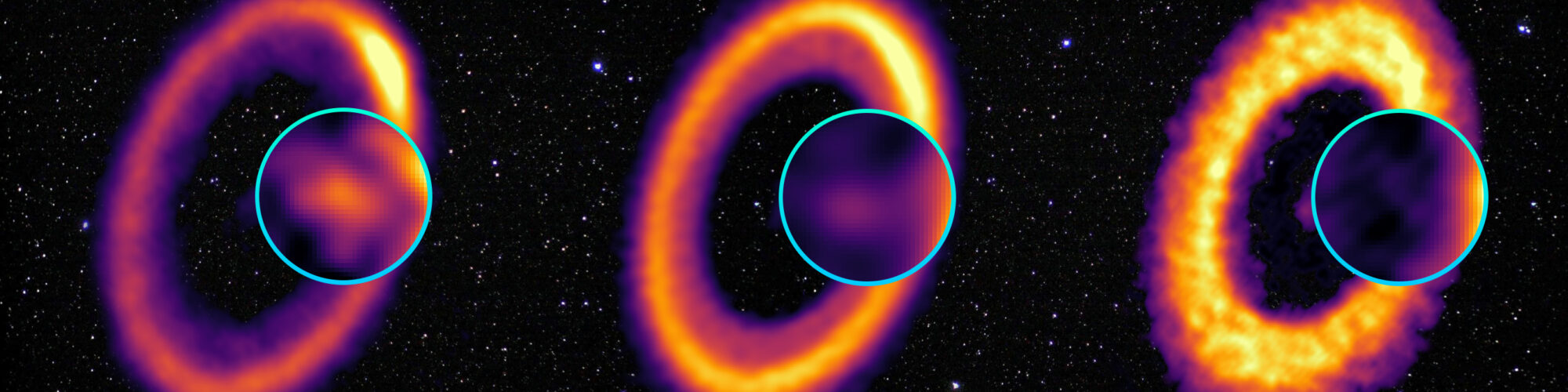
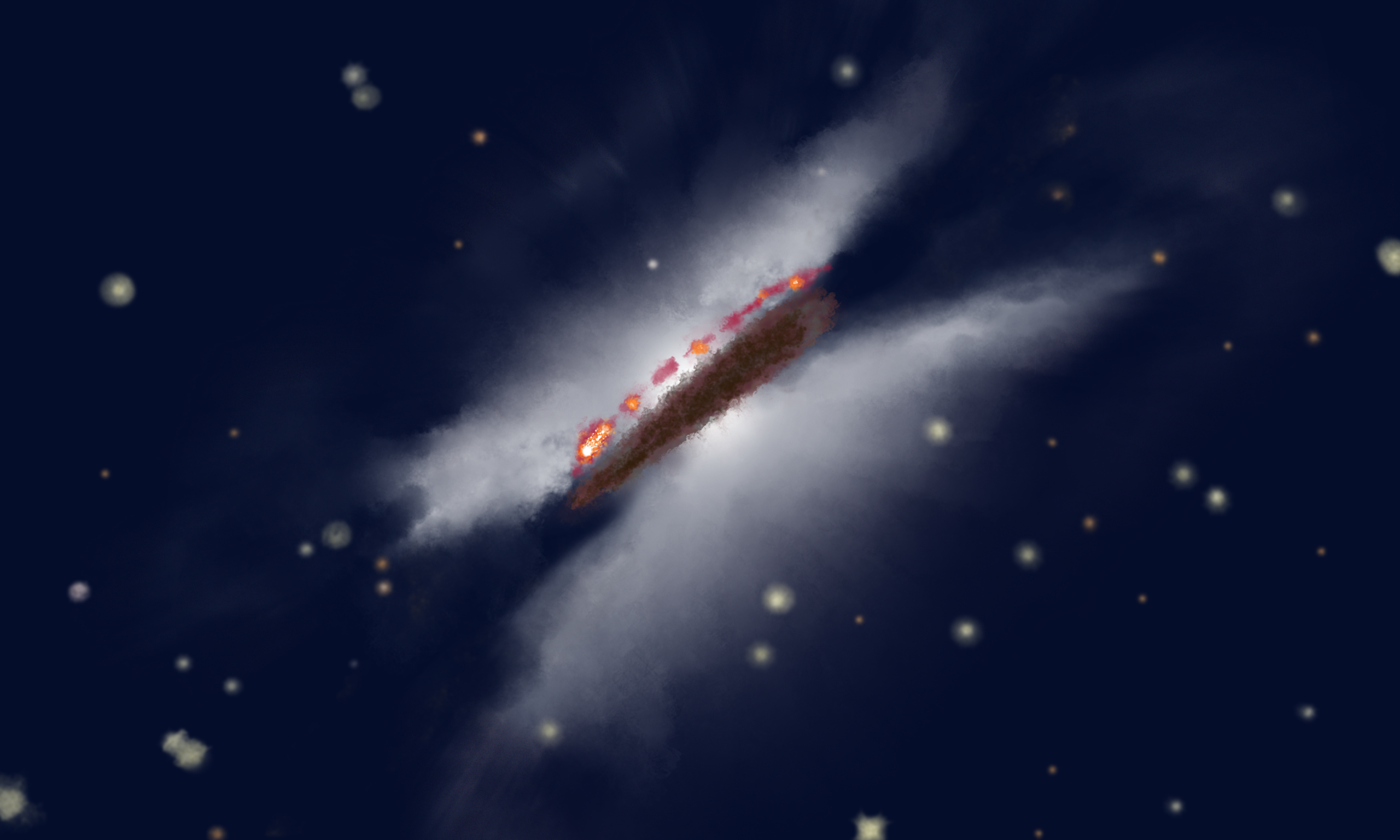
New observations with the Atacama Large Millimeter/submillimeter Array (ALMA) have provided astronomers with an unprecedented view into the structure of a massive protoplanetary disk, nicknamed Gomez's Hamburger ("GoHam"). These results reveal key details about how gas and dust arrange themselves around young stars and raise intriguing possibilities for the early stages of giant planet formation.
Protoplanetary disks are the birthplaces of planets. GoHam stands out for its enormous size and unique orientation: nearly edge-on from Earth, allowing a rare direct view of how materials are stacked vertically and radially within the disk. This detailed perspective is enabled by ALMA's ability to image dust and molecular gas at millimeter wavelengths.
The ALMA observations reveal several distinct layers of gas and dust orbiting the central star: two forms of carbon monoxide (12CO and 13CO) and sulfur-bearing molecules such as CS and SO, each occupying different heights above the disk's midplane. The millimeter-sized dust particles are concentrated in a thin layer near the midplane, while the gaseous components extend much farther above and below it.
GoHam's disk is enormous — the 12CO gas extends to nearly 1000 astronomical units from the star and reaches vertical heights of several hundred astronomical units — making it among the largest known planet-forming disks. The total dust mass is significantly higher than that of typical disks around similar stars, indicating an exceptional capacity to build massive planets and potentially a whole planetary system.
Despite its "hamburger-like" appearance, GoHam is not perfectly symmetrical. One side of the dust layer appears brighter and more extended, likely due to a large-scale disturbance or vortex that could help trap solid particles. This process enhances the growth of planet-building materials. Extended, faint carbon monoxide emissions also suggest a photoevaporative wind, in which starlight gradually blows gas away from the disk's outer regions.
A particularly intriguing discovery is a one-sided arc of sulfur monoxide (SO) emission just outside the brighter dust region. This arc aligns with a previously identified dense clump, GoHam b, interpreted as material collapsing under its own gravity. This feature could represent one of the earliest observable phases of a massive, wide-orbit giant planet forming within the disk.
"GoHam gives us a rare and clear view of the vertical and radial structure of a very large, nearly edge-on disk," said Charles Law, NHFP Sagan Fellow at the University of Virginia and principal investigator of the research. "This makes it a benchmark system for testing detailed models of how disks evolve and form planets."
The combination of the disk's extreme size, asymmetries, winds, and evidence for early planet formation makes GoHam an exceptional laboratory for understanding how giant planets — especially far from their parent stars — can form and influence their surroundings.
Additional Information
The results of this study were presented in a press conference at the American Astronomical Society’s annual meeting this January and are currently under preparation for publication.
This article is based on a press release by the National Radio Astronomy Observatory (NRAO), an ALMA partner on behalf of North America.
The Atacama Large Millimeter/submillimeter Array (ALMA), an international astronomy facility, is a partnership of the European Southern Observatory (ESO), the U.S. National Science Foundation (NSF), and the National Institutes of Natural Sciences (NINS) of Japan in cooperation with the Republic of Chile. ALMA is funded by ESO on behalf of its Member States, by NSF in cooperation with the National Research Council of Canada (NRC) and the National Science and Technology Council (NSTC) in Taiwan, and by NINS in cooperation with the Academia Sinica (AS) in Taiwan and the Korea Astronomy and Space Science Institute (KASI).
ALMA construction and operations are led by ESO on behalf of its Member States; by the National Radio Astronomy Observatory (NRAO), managed by Associated Universities, Inc. (AUI), on behalf of North America; and by the National Astronomical Observatory of Japan (NAOJ) on behalf of East Asia. The Joint ALMA Observatory (JAO) provides the unified leadership and management of ALMA's construction, commissioning, and operation.
Image
Contacts
-
Nicolás Lira
Education and Public Outreach OfficerJoint ALMA Observatory, Santiago - ChilePhone: +56 2 2467 6519Cel: +56 9 9445 7726Email: [email protected] -
Jill Malusky
Public Information Officer -
Yuichi Matsuda
Education and Public Outreach OfficerNAOJEmail: [email protected] -
Bárbara Ferreira
ESO Media Manager