ALMA and the NSF VLA Use a Cosmic Lens to Reveal a Hyperactive Cradle of a Future Galaxy Cluster
ALMA observations, together with NSF VLA, uncover the first strongly lensed protocluster core, revealing an intense burst of galaxy growth in the early universe
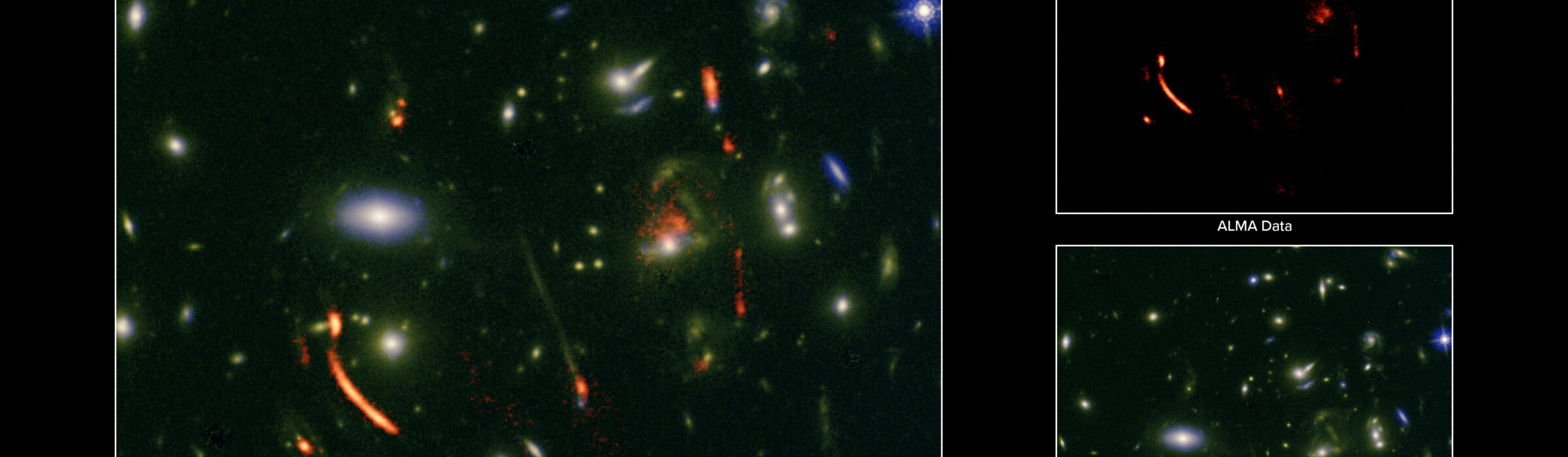
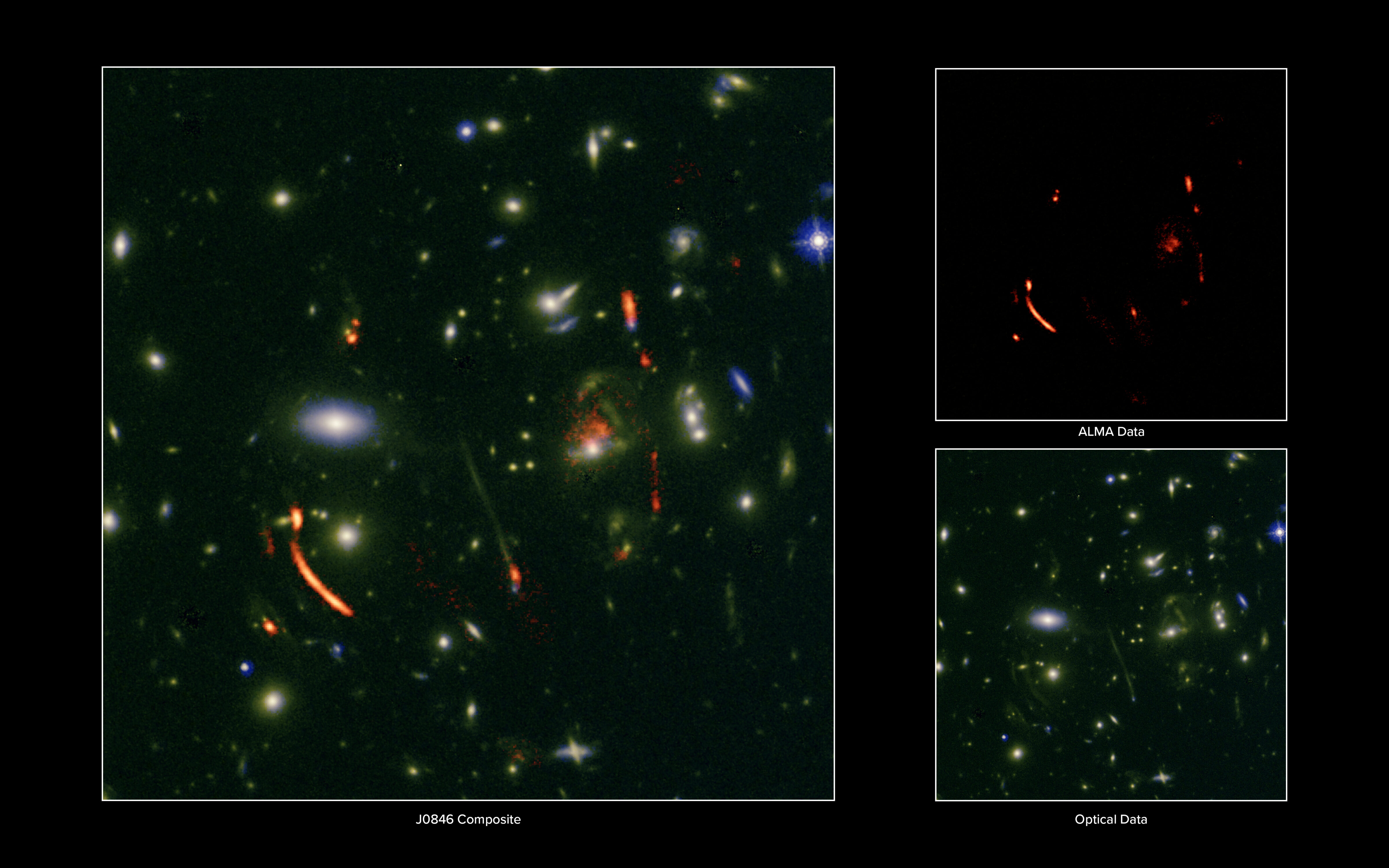
Astronomers using the Atacama Large Millimeter/submillimeter Array (ALMA), together with the U.S. National Science Foundation Very Large Array (NSF VLA), have uncovered a rare, extraordinarily active region of the early universe where a future galaxy cluster is rapidly forming. By exploiting a powerful natural phenomenon known as gravitational lensing, ALMA revealed a compact, dust-enshrouded swarm of young galaxies forming stars at an exceptional rate more than 11 billion years ago.
The discovery marks the first strongly lensed protocluster core ever identified, providing an unprecedented, magnified view of one of the universe’s earliest large-scale structures in formation. Complementary observations with the NSF VLA helped characterize both the distant galaxies and the massive foreground cluster responsible for the lensing effect.
Galaxy clusters are the largest gravitationally bound structures in the universe. Their ancestors, known as protoclusters, are regions where galaxies are still assembling, rapidly converting gas into stars and growing in mass. Studying these systems allows astronomers to trace how today’s massive clusters emerged from much smaller, denser environments in the early cosmos.
ALMA’s high-resolution observations revealed that what initially appeared as a single bright source in all-sky survey data is actually a tightly packed group of at least 11 dusty, star-forming galaxies. These galaxies are confined to a region only a few hundred thousand light-years across — remarkably compact on cosmic scales — and are experiencing intense bursts of star formation.
Because these galaxies are heavily shrouded in dust, most of their visible light is absorbed and re-emitted at millimeter and submillimeter wavelengths. ALMA’s sensitivity to this cold dust and molecular gas allowed astronomers to detect the raw material fueling star formation and to measure the dynamics of the system with exceptional clarity.
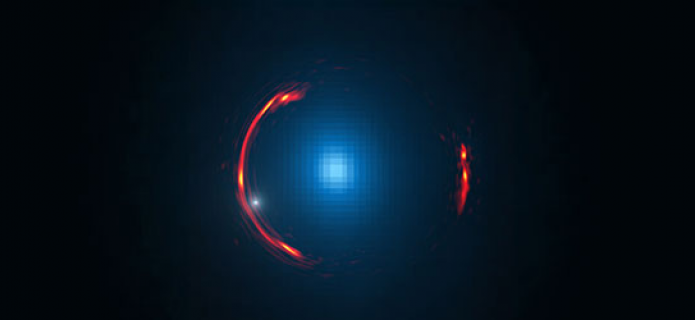
The protocluster lies behind a massive foreground galaxy cluster whose gravity acts as a cosmic magnifying glass, bending and amplifying the light from the more distant system. This gravitational lensing effect dramatically boosts ALMA and the NSF VLA’s ability to resolve individual galaxies and study their properties in detail, effectively turning the universe itself into a telescope.
ALMA detected carbon monoxide (CO) emission, a key tracer of molecular gas, helping confirm that the galaxies share a common distance and form a physically connected structure. These observations show that the protocluster core contains enormous gas reservoirs capable of sustaining vigorous star formation and driving the rapid buildup of stellar mass.
Complementary observations with the NSF VLA provided radio-frequency data that helped map the foreground cluster and identify radio emission associated with both star formation and energetic processes within the system, strengthening the interpretation of the lensing configuration and the nature of the galaxies involved.
“Galaxy clusters are akin to a sprawling modern metropolis that was built upon an ancient civilization from the past. For example, if an archaeologist digs deeper into the ground, then they uncover an earlier civilization. Similarly, when astronomers observe objects farther away, they can look further back in time. In this way, the study of this distant protocluster gives us a glimpse into how one of the earliest ‘settlements’ of galaxies grew and evolved into the mature structures such as that foreground galaxy cluster that we observe today,” said Nicholas Foo, a graduate student at Arizona State University.
Protoclusters like this one represent the earliest construction phases of galaxy clusters seen in the present-day universe. By combining ALMA’s detailed view of cold gas and dust with complementary radio observations from the NSF VLA, astronomers can investigate how galaxies grow, interact, and evolve in the densest environments of the early cosmos.
This rare alignment of a young protocluster and a massive foreground lens provides an exceptional opportunity to test theories of galaxy and cluster formation. Future ALMA observations will further explore how these compact, dust-rich systems evolve and how their extreme environments shape the galaxies that will eventually populate massive clusters billions of years later.
Additional Information
The results of this research appear as "PASSAGES: The Discovery of a Strongly Lensed Protocluster Core Candidate at Cosmic Noon" in the Astrophysical Journal by N. foo et al.
The original press release was published by the National Radio Astronomy Observatory of the United States, an ALMA partner, on behalf of North America.
The Atacama Large Millimeter/submillimeter Array (ALMA), an international astronomy facility, is a partnership of the European Southern Observatory (ESO), the U.S. National Science Foundation (NSF), and the National Institutes of Natural Sciences (NINS) of Japan in cooperation with the Republic of Chile. ALMA is funded by ESO on behalf of its Member States, by NSF in cooperation with the National Research Council of Canada (NRC) and the National Science and Technology Council (NSTC) in Taiwan, and by NINS in cooperation with the Academia Sinica (AS) in Taiwan and the Korea Astronomy and Space Science Institute (KASI).
ALMA construction and operations are led by ESO on behalf of its Member States; by the National Radio Astronomy Observatory (NRAO), managed by Associated Universities, Inc. (AUI), on behalf of North America; and by the National Astronomical Observatory of Japan (NAOJ) on behalf of East Asia. The Joint ALMA Observatory (JAO) provides the unified leadership and management of ALMA's construction, commissioning, and operation.
Image
Contacts
-
Nicolás Lira
Education and Public Outreach OfficerJoint ALMA Observatory, Santiago - ChilePhone: +56 2 2467 6519Cel: +56 9 9445 7726Email: [email protected] -
Jill Malusky
Public Information Officer -
Bárbara Ferreira
ESO Media Manager -
Yuichi Matsuda
Education and Public Outreach OfficerNAOJEmail: [email protected]