WSU Program
Status as of October 2025
The Wideband Sensitivity Upgrade (WSU) is well underway, with key subsystems under development, including new receivers, digitizers, other parts of the wideband IF processor, a data transmission system, and a correlator and a spectrometer. Construction onsite has already started, with the civil works needed for the new OSF Correlator Room and other preparations for implementation. At the system level, the observatory has developed detailed plans for implementation onsite, considering the interdependencies of the different projects, based on a careful project management and systems engineering approach. The substantial improvements in the observing efficiency enabled by the WSU will further enhance ALMA as the world-leading facility for millimeter/submillimeter astronomy.
Definition of the WSU System and Program Plan
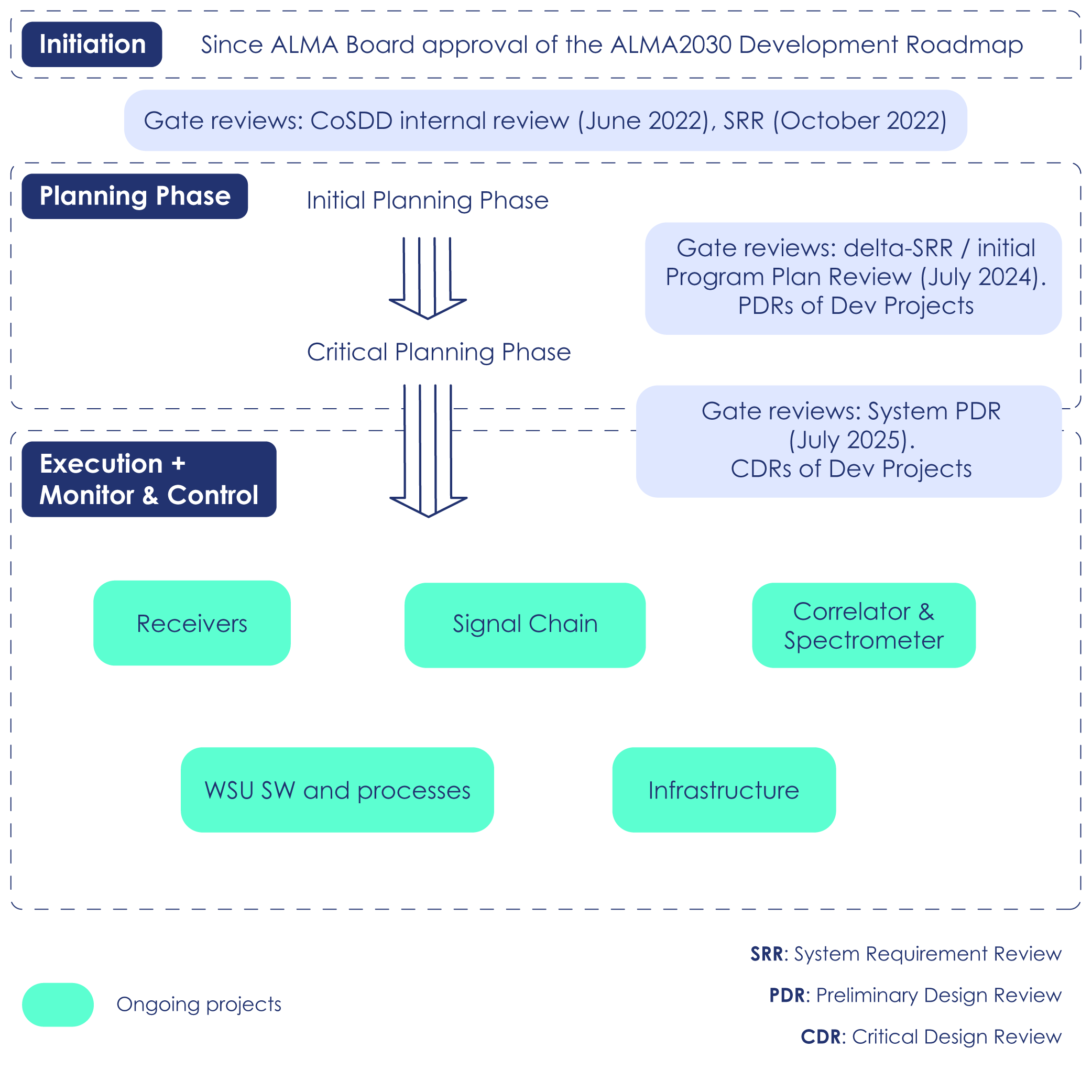
The WSU program began with an initiation phase (2019-2022), during which the observatory and the community evaluated enabling technologies and established top-level goals based on the achievements of previous scientific and technical research. This phase concluded with an initial Conceptual System Design Description (CoSDD), which focused on hardware and updates of the ALMA System Technical Requirements (STR). These efforts laid the groundwork for subsystem development.
From 2022 to 2024, in parallel with hardware development, efforts focused on assessing the WSU's impact on software, computing infrastructure, and science operations. An updated design was proposed, incorporating these elements to provide the first integrated description of the full WSU system. This update also includes a deployment strategy designed to minimize disruptions to scientific observations. These efforts led to further refinement of the ALMA system-level requirements and the creation of an Initial Program Plan, which was positively reviewed by an external panel in July 2024.
The work continued with the preparation of a WSU System Design Description (SDD) and a WSU Program Plan with supporting documentation. Plans for implementation such as the Preliminary Assembly, Integration, Verification, and Commissioning (AIVC) plan, the transition plan to WSU operations and the plan for the data processing transition were prepared. This WSU technical and programmatic baseline was successfully reviewed at the System Preliminary Design Review (PDR) held in July 2025.
Current work focuses on the final tasks to close the planning phase and the preparation towards the start of implementation of the new system.
A staged approach
The Primary Goals of the WSU Program are to:
- Upgrade the signal chain, software and science operations processes for a 4x system bandwidth;
- Upgrades of bands 6, 7 and 8 to wideband 2SB configurations, in addition to band 2 being installed currently; and
- Offer at least the observing modes offered currently.
The WSU System will offer improvements even during the deployment phase following a staged rollout of capabilities. The goal is to offer initial WSU scientific observations with 2x system bandwidth early next decade with continued implementation efforts until the capabilities to meet the WSU goals are in place as early as possible in the 2030s.
The initial WSU user release will be based on initial scientific priorities, implementing high-priority observing modes with the 12m array as soon as at least 36 antennas have been upgraded. This number of retrofitted antennas will provide the same point-source sensitivity as the current array with 43 antennas given the WSU digital efficiency improvement. At that time, the system bandwidth will be 2x and band 2 will be the only wideband receiver available. The initial deployment will be followed by the completion of the upgrade of all ALMA antennas and the commissioning of all currently offered ALMA Observing Modes.
Afterwards, efforts will focus on meeting the WSU top-scientific priorities with new receivers, the bandwidth increase to 4x and a new data processing system. More details about these plans will be shared with the scientific community as they become available.
Progress toward implementation
WSU Signal Chain and related infrastructure
Most ALMA Development Projects for the various parts of the WSU signal chain, which connect the receivers with the Advanced Technology ALMA Correlator (ATAC) and the new Total Power GPU Spectrometer (TPGS), are advancing through the design process.
- Wideband IF Processor (WIFP): The WIFP includes the new IF switch, other IF components, digitizers, and the digital signal processing / optical transmission (DSP/OT) subsystem. The design is closing out the preliminary design phase.
- Data Transmission System (DTS): This subsystem transmits data from each antenna to the new OSF Correlator Room. The design has passed its Preliminary Design Review and is proceeding toward the Critical Design Phase.
- Fiber Optic System (FOS): The project has completed its design phase successfully and plans to proceed with construction in the coming months.
- OSF Correlator Room (OCRO): The project has completed its design phase successfully and construction started at the ALMA OSF in August 2025.
- Advanced Technology ALMA Correlator (ATAC): The 2nd Generation Correlator design has passed its Preliminary Design Review and is now in the Critical Design Phase.
- Total Power GPU Spectrometer (TPGS): The design of the 2nd Generation Spectrometer for the ALMA Total Power array will hold its Preliminary Design Review at the end of January 2026.
Receivers
- Band 2 (67-116 GHz): The first wideband receiver (2-18 GHz) is currently under construction phase, and the first receivers are being integrated into the telescope.
- Band 6 version 2 (209-281 GHz): The receiver design is proceeding towards PDR in 2026.
- Band 7 version 2 (275-373 GHz TBD): in study phase
- Band 8 version 2 (385-500 GHz): The receiver design is proceeding towards PDR in 2026.