ALMA Reveals Long-Lived Hotspots on Betelgeuse’s Bubbling Surface
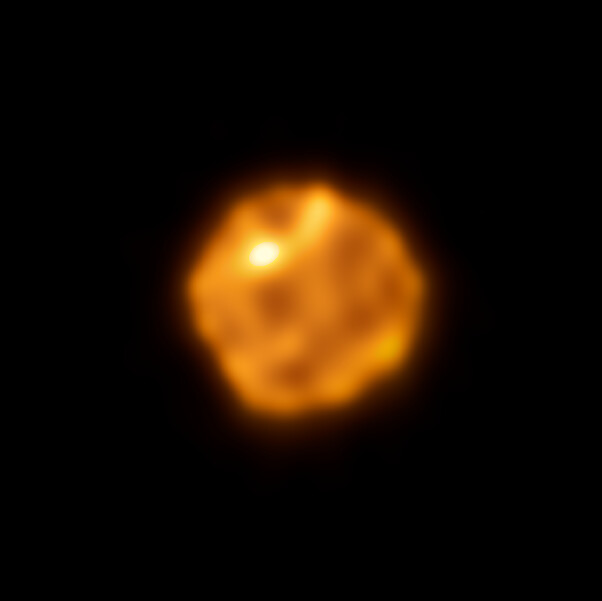
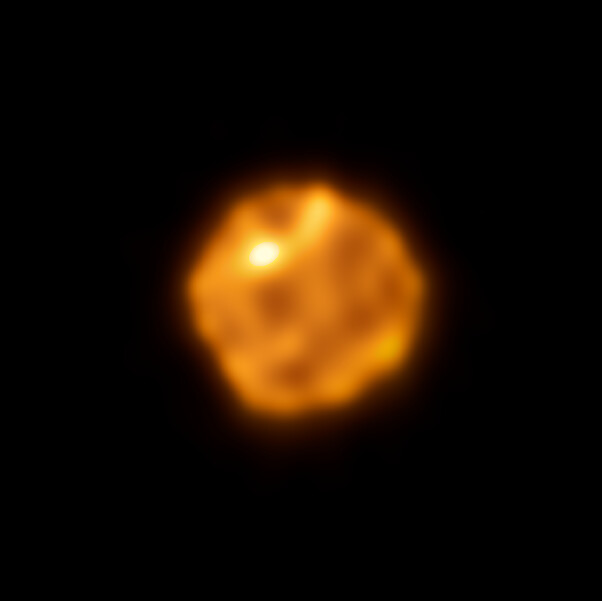
A remarkably detailed image obtained with the Atacama Large Millimeter/submillimeter Array (ALMA) reveals the uneven surface of Betelgeuse, the famous red supergiant in the constellation Orion. The observations show bright hotspots and an irregular, corrugated outline shaped by the enormous motions taking place within the star.
Located roughly 600 light-years from Earth, Betelgeuse is one of the closest red supergiants and has a radius about 800 times that of the Sun. Its immense size makes it possible for ALMA to resolve structures across its atmosphere that would remain hidden in most other stars.
The new observations were obtained in 2023 using ALMA in its longest-baseline configuration, achieving a resolution as fine as about seven milliarcseconds. They reveal an atmosphere with an average temperature of around 2300 K and at least two hotter regions, to the northeast and southwest of the stellar disk. The brightest hotspot is up to about 800 K hotter than the surrounding gas.
These structures are thought to be linked to enormous convective motions inside Betelgeuse. Hot gas rising from deeper layers can generate shocks as it reaches the star’s outer atmosphere, producing the bright and uneven features detected by ALMA.
One finding particularly surprised the researchers. When they compared the 2023 observations with similar ALMA data obtained in 2015, the prominent northeastern hotspot appeared in almost the same location and with a similar intensity. This suggests that the feature has persisted for at least seven years — considerably longer than the lifetimes of large convective structures predicted by current models.
The surface itself is also far from spherical. ALMA measured variations of up to about six percent in its apparent radius, while fainter emission extends several stellar radii into Betelgeuse’s atmosphere. Observations of molecules including silicon monoxide (SiO) and carbon monoxide (CO) reveal an even more irregular and clumpy environment surrounding the star.
The orientation of the long-lived hotspots is also intriguing in light of recent evidence for a close companion to Betelgeuse, although the observations do not establish a direct connection. Continued high-resolution observations with ALMA could reveal whether the hotspots remain fixed and how they relate to convection, mass loss, and the structure of the star’s extended atmosphere.
Betelgeuse is approaching the final stages of its evolution and will eventually explode as a supernova. “Its eventual fate as a supernova makes it fascinating to know what it actually looks like now,” says lead author Bill Dent, an astronomer at ESO.
Additional Information
This post is based on the original published by the European Southern Observatory (ESO), an ALMA partner on behalf of Europe.
The Atacama Large Millimeter/submillimeter Array (ALMA), an international astronomy facility, is a partnership of the European Southern Observatory (ESO), the U.S. National Science Foundation (NSF), and the National Institutes of Natural Sciences (NINS) of Japan in cooperation with the Republic of Chile. ALMA is funded by ESO on behalf of its Member States, by NSF in cooperation with the National Research Council of Canada (NRC) and the National Science and Technology Council (NSTC) in Taiwan, and by NINS in cooperation with the Academia Sinica (AS) in Taiwan and the Korea Astronomy and Space Science Institute (KASI).
ALMA construction and operations are led by ESO on behalf of its Member States; by the National Radio Astronomy Observatory (NRAO), managed by Associated Universities, Inc. (AUI), on behalf of North America; and by the National Astronomical Observatory of Japan (NAOJ) on behalf of East Asia. The Joint ALMA Observatory (JAO) provides the unified leadership and management of ALMA's construction, commissioning, and operation.
Image
Contacts
-
Nicolás Lira
Education and Public Outreach OfficerJoint ALMA Observatory, Santiago - ChilePhone: +56 2 2467 6519Cel: +56 9 9445 7726Email: [email protected] -
Bárbara Ferreira
ESO Media Manager