ALMA traces vaporized minerals around a young massive star
Titanium monoxide gas points to high-temperature processing near the base of a disk wind in Orion Source I
An international research team has detected titanium monoxide (TiO) around Orion Source I, a young massive protostar about 1,350 light-years from Earth. The observations, made with the Atacama Large Millimeter/submillimeter Array (ALMA), mark the first detection of TiO in a star-forming region.
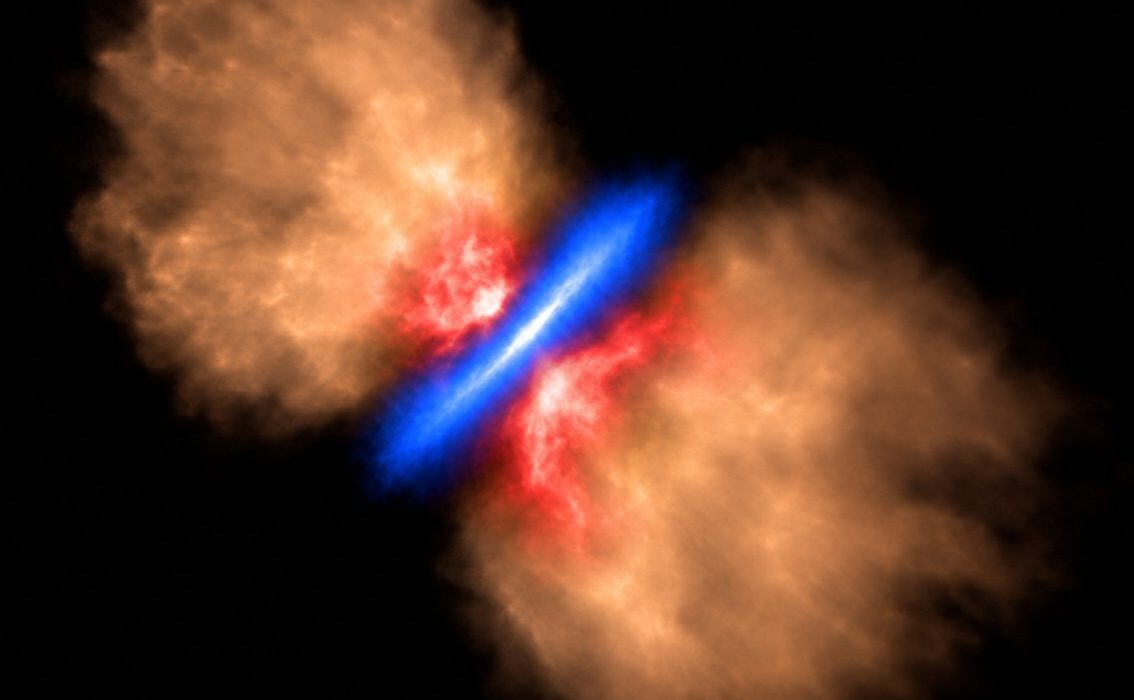
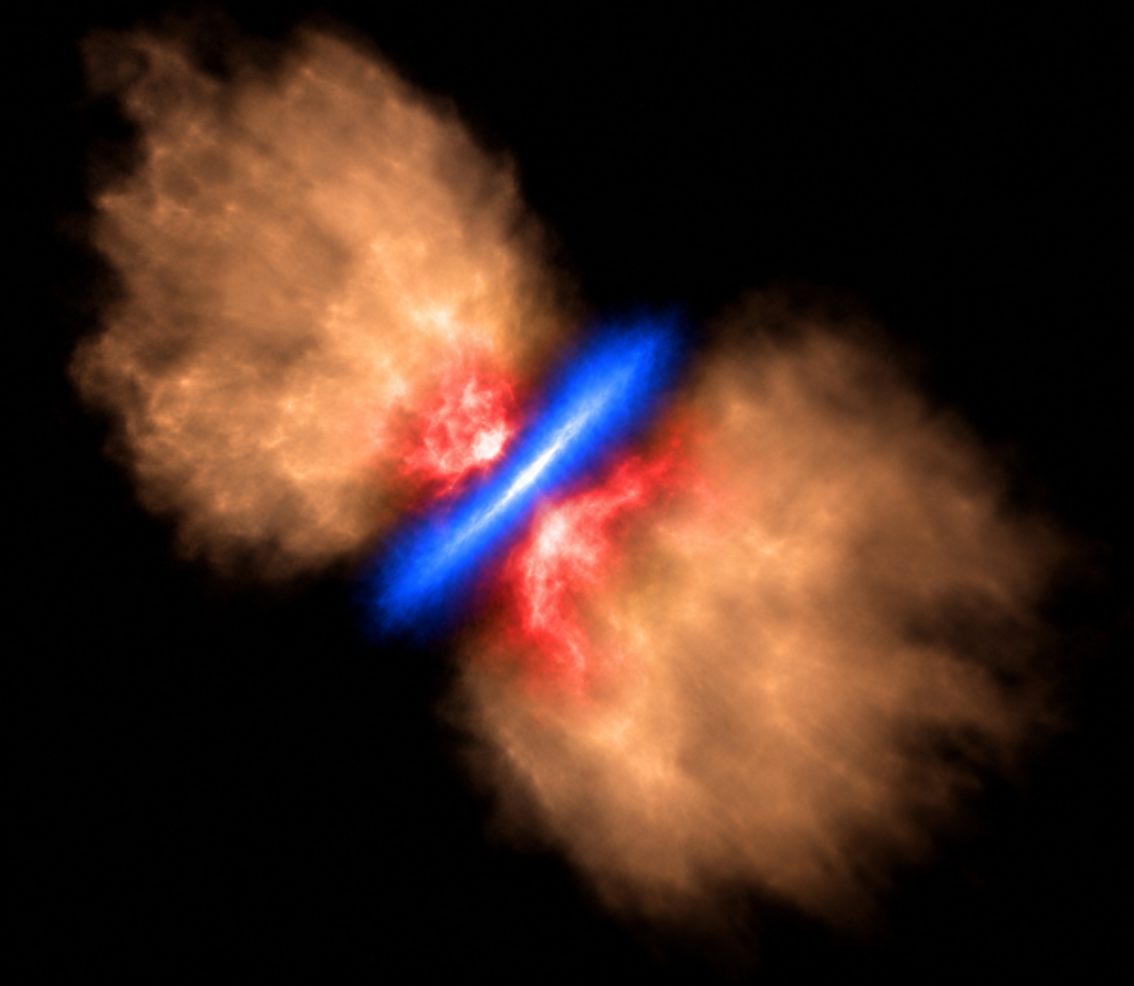
Led by Ziwei E. Zhang and Nami Sakai of the RIKEN Pioneering Research Institute, the researchers identified three rotational emission lines of TiO. The emission is concentrated near the base of a rotating disk wind and closely resembles the distribution of aluminum monoxide (AlO), previously detected in the same region.
Minerals heated near a forming star
Titanium is a refractory element. In the cold conditions of interstellar space, it is generally locked inside solid dust grains. The team interprets the detected TiO as evidence that intense heat near the protostar can release titanium from minerals into the gas. The result offers a way to study how solid material is processed at high temperatures around forming stars, including processes that may be relevant to the formation of calcium-aluminum-rich inclusions (CAIs), the oldest known solid materials in the Solar System.
ALMA resolved the TiO emission in a region about 50 astronomical units across—roughly 50 times the average distance between Earth and the Sun. The team estimates that an imaginary column of gas with a one-square-centimetre cross-section, extending along the line of sight toward the protostar, contains about 3 quadrillion TiO molecules. Astronomers call this a “column density”: it counts molecules along the full path from the source to us.
The team also compared the amount of TiO with silicon monoxide (SiO). Their estimate is about 1.3 TiO molecules for every 100 SiO molecules. This is only an approximate upper limit: the SiO observations combine light from a larger patch of sky than the TiO observations, and local gas conditions also affect the estimate. The detection supports the interpretation that heat near the protostar releases titanium from dust grains into the surrounding gas.
Additional Information
The findings were published as “Dust-seeding Molecules in a Massive Protostar — Detection of TiO in Orion Source I,” by Ziwei E. Zhang et al. in The Astrophysical Journal Letters.
This publication is based on the original press release by the National Astronomical Observatory (NAOJ), an ALMA partner on behalf of East Asia.
The Atacama Large Millimeter/submillimeter Array (ALMA), an international astronomy facility, is a partnership of the European Southern Observatory (ESO), the U.S. National Science Foundation (NSF), and the National Institutes of Natural Sciences (NINS) of Japan in cooperation with the Republic of Chile. ALMA is funded by ESO on behalf of its Member States, by NSF in cooperation with the National Research Council of Canada (NRC) and the National Science and Technology Council (NSTC) in Taiwan, and by NINS in cooperation with the Academia Sinica (AS) in Taiwan and the Korea Astronomy and Space Science Institute (KASI).
ALMA construction and operations are led by ESO on behalf of its Member States; by the National Radio Astronomy Observatory (NRAO), managed by Associated Universities, Inc. (AUI), on behalf of North America; and by the National Astronomical Observatory of Japan (NAOJ) on behalf of East Asia. The Joint ALMA Observatory (JAO) provides the unified leadership and management of the construction, commissioning, and operation of ALMA.
Images
Contacts
-
Nicolás Lira Turpaud
Education and Public Outreach OfficerJoint ALMA Observatory, Santiago - ChilePhone: +56 2 2467 6519Cel: +56 9 9445 7726Email: [email protected] -
Seiichiro Naito
NAOJ EPO LeadEmail: [email protected] -
Jill Malusky
Public Information Officer -
Bárbara Ferreira
ESO Media Manager