Mira lives up to its name
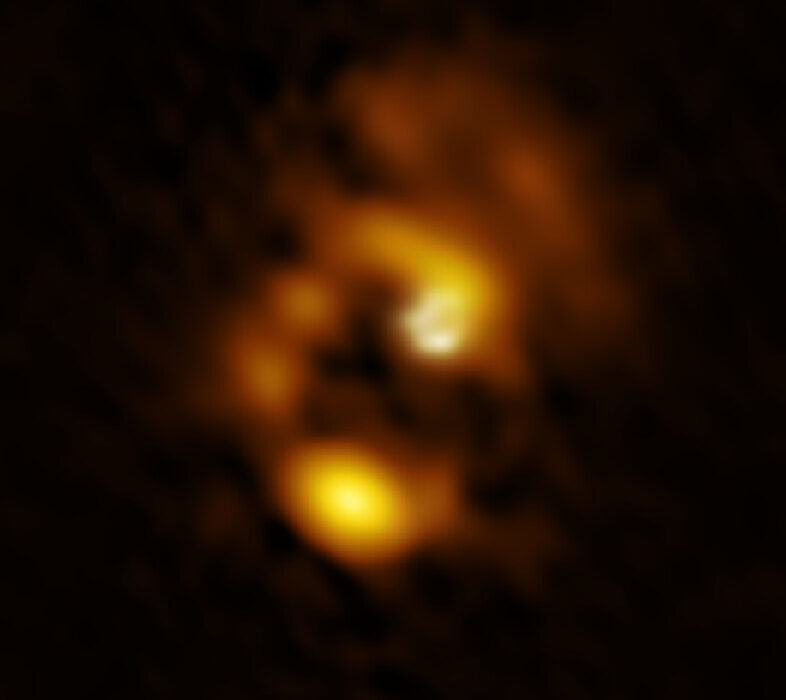
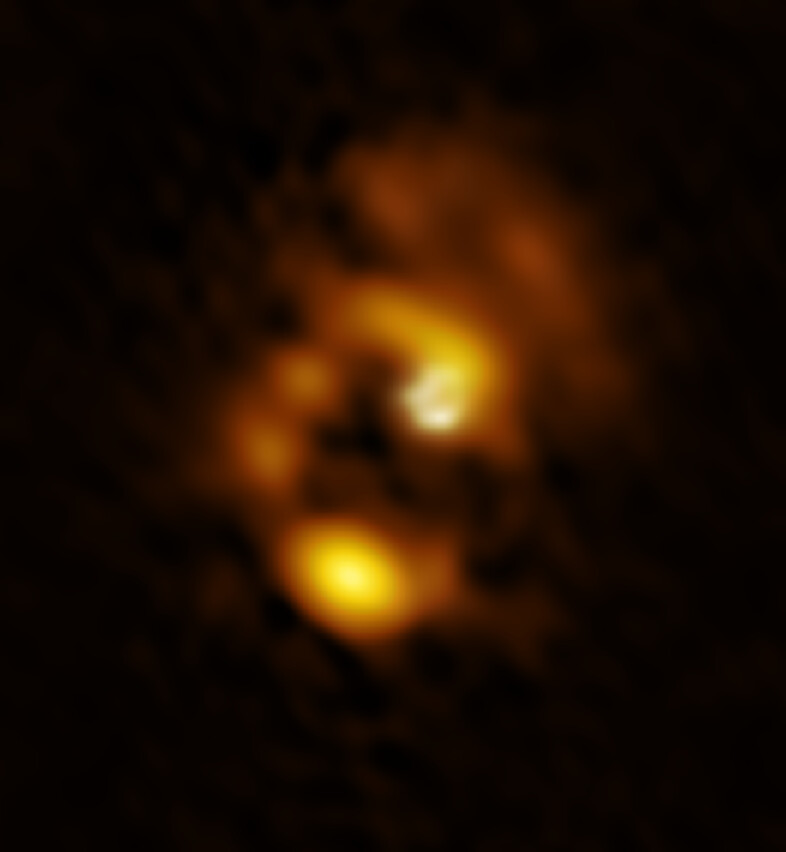
The lumpy, glowing patch at the center of this picture is the surface of Mira A, a red giant star about 330 light-years away in the constellation Cetus. Captured by the Atacama Large Millimeter/submillimeter Array (ALMA), the image also shows a giant loop of material ejected far away from the star. But what caused this?
Mira A is nearing the end of its life, and like other stars of its kind, it is steadily shedding its outer layers into space. What ALMA caught here is one violent example of that process: a loop of material flung off the star and now reaching up to 10 astronomical units away from its surface. This is roughly the distance from the Sun to Saturn. It looks much like a coronal mass ejection from our own Sun, only far larger, carrying more energy than the strongest stellar flares on record. Eruptions like this are expected on other stars too, but stars are so distant that all we usually catch is a brief flicker of brightness. In the case of Mira A, the shape of one can be made out directly.
For decades, astronomers have described the winds of these stars as continuous and gentle: starlight pushing outward on grains of dust, easing them away from the star little by little. But the new ALMA results on Mira, presented in two papers by W. Vlemmings and M. Andriantsaralaza from Chalmers University, Sweden, challenge this picture. An eruption this strong cannot be driven by gentle stellar winds. A more powerful process must be at play, such as the star's magnetic field, which the team confirmed thanks to ALMA’s ability to study polarised light. Moreover, the loop can be traced back to a bright hot spot seen on Mira A's surface two years earlier. Such hot spots come and go repeatedly, suggesting that magnetic outbursts drive most of the mass loss this star undergoes.
Astronomers in the 1600s named this star Mira, Latin for "the wonderful one". Now that we can look at Mira even closer, this is truer than ever.
Additonal information
The results are published in two articles in the scientific journal Astronomy & Astrophysics:
- A giant magnetic eruption from the asymptotic-giant-branch star Mira A by W. Vlemmings, M. Andriantsaralaza, B. Bojnordi Arbab, T. Khouri, B. Lankhaar, L. Planquart, E. De Beck, S. Del Palacio, E. Humphreys, D. Jadlovsky, M. Maercker, H. Olofsson, M. Saberi, M. Siebert, R. Unnikrishnan, S. Wedemeyer, M. Wittkowski.
- Periodic activity on the (sub)millimetre surface of the asymptotic giant branch star Mira A by M. Andriantsaralaza, B. Bojnordi Arbab, W. Vlemmings, T. Khouri, L. Planquart, K. T. Wong, J. Alcolea, E. Humphreys, S. del Palacio, M. Wittkowski.
This science blog post is based on the Picture of the Week released by the European Southern Obsertavory (ESO), an ALMA partner on behalf of Europe.
The Atacama Large Millimeter/submillimeter Array (ALMA), an international astronomy facility, is a partnership of the European Southern Observatory (ESO), the U.S. National Science Foundation (NSF), and the National Institutes of Natural Sciences (NINS) of Japan in cooperation with the Republic of Chile. ALMA is funded by ESO on behalf of its Member States, by NSF in cooperation with the National Research Council of Canada (NRC) and the National Science and Technology Council (NSTC) in Taiwan, and by NINS in cooperation with the Academia Sinica (AS) in Taiwan and the Korea Astronomy and Space Science Institute (KASI).
ALMA construction and operations are led by ESO on behalf of its Member States; by the National Radio Astronomy Observatory (NRAO), managed by Associated Universities, Inc. (AUI), on behalf of North America; and by the National Astronomical Observatory of Japan (NAOJ) on behalf of East Asia. The Joint ALMA Observatory (JAO) provides the unified leadership and management of the construction, commissioning, and operation of ALMA.
Image
Contacts
-
Nicolás Lira
Education and Public Outreach OfficerJoint ALMA Observatory, Santiago - ChilePhone: +56 2 2467 6519Cel: +56 9 9445 7726Email: [email protected]