ALMA Captures a Trillion-Mile Stream Feeding the Triple-Star System GW Orionis
ALMA has mapped a roughly one-trillion-mile gas streamer feeding GW Orionis, linking late-stage infall from the surrounding cloud to the triple-star system’s strikingly misaligned planet-forming rings.
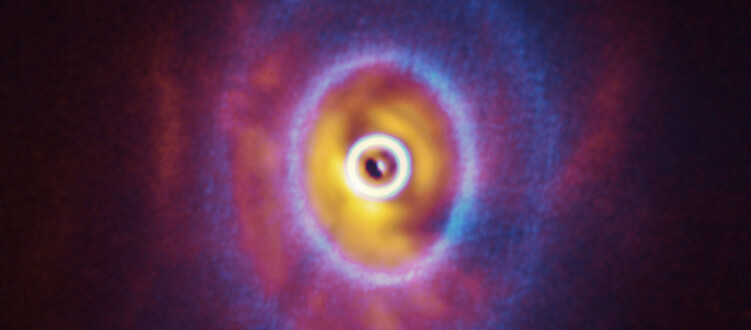
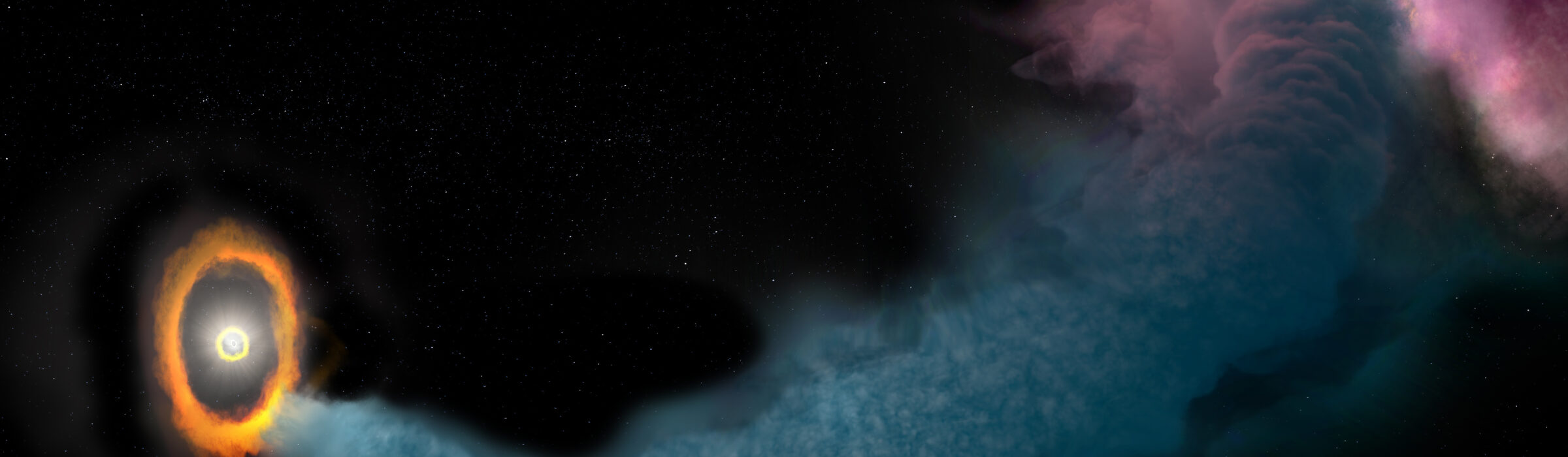
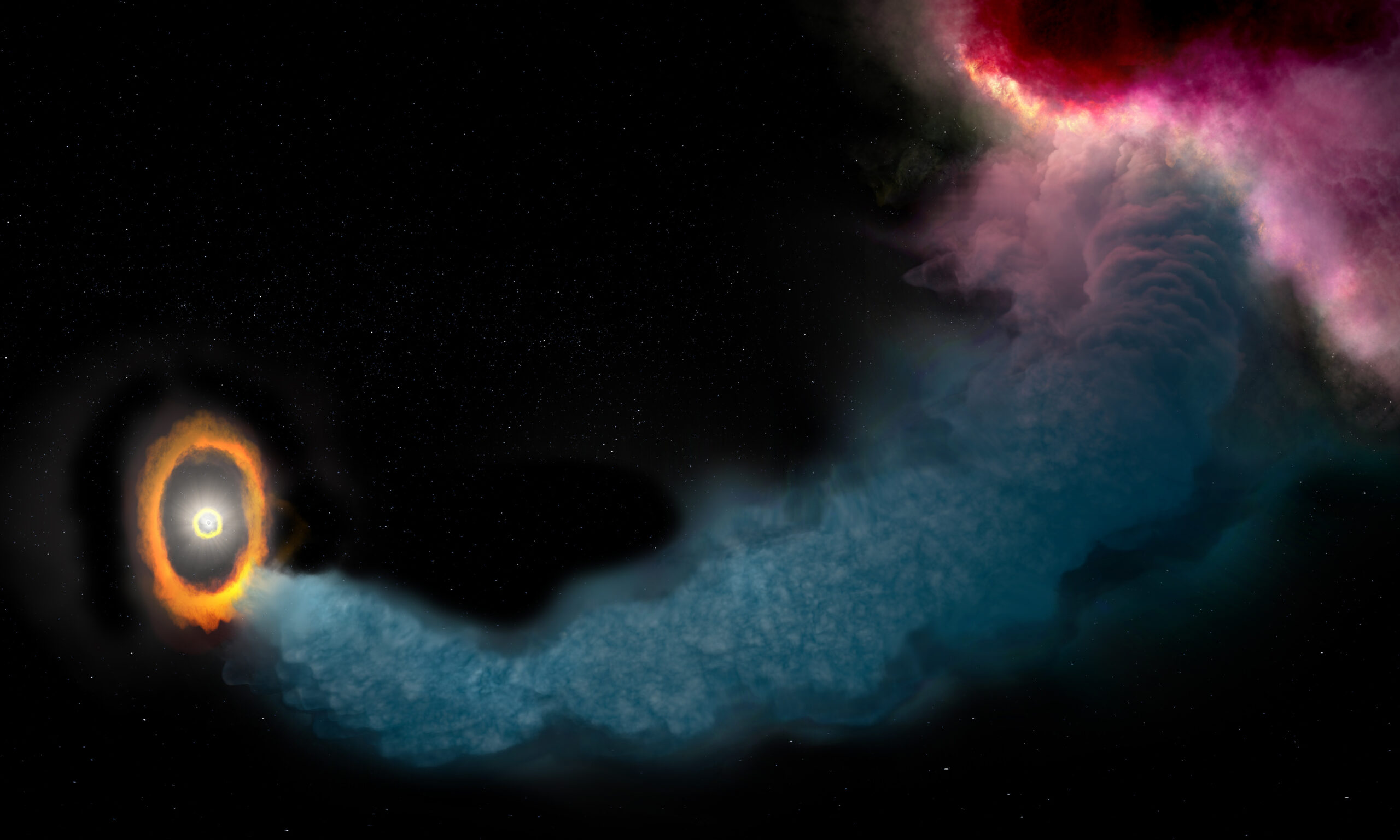
Using the Atacama Large Millimeter/submillimeter Array (ALMA), astronomers have mapped a vast streamer of gas feeding GW Orionis, a young triple-star system surrounded by three misaligned rings of planet-forming material. The observations provide the clearest evidence yet that late infall from a system’s natal cloud can help tilt and reshape a protoplanetary disk.
The streamer extends approximately 12,000 astronomical units—about 0.2 light-years, or roughly one trillion miles—from the disk. By tracing its motion in carbon monoxide, the team found that the incoming gas meets the disk at its outermost dust ring and carries angular momentum closely aligned with that ring, while remaining strongly misaligned with the innermost ring.
A dynamic environment for planet formation
GW Orionis lies about 1,300 light-years away in the Orion constellation. Its three young stars are encircled by a massive disk whose three dust rings are tilted at different angles instead of sharing a single plane. This unusual geometry has made the system an important laboratory for studying how complex stellar environments influence the disks where planets form.
The research was led by Maria Galloway-Sprietsma, a PhD candidate at the University of Florida. The team fitted the streamer’s shape and velocity to reconstruct its trajectory. Their best-fit model places the streamer’s angular-momentum vector within about 3 degrees of the outer ring, compared with a misalignment of about 32 degrees relative to the inner ring. This close correspondence suggests that the infalling material is the likely driver of the outer disk’s tilted structure.
The result supports a more dynamic picture of planet formation than the familiar model of an isolated, orderly disk. Material from a surrounding molecular cloud can continue to fall onto an evolved young system in clumpy streams, changing a disk’s mass and angular momentum and potentially influencing the orbital architecture of planets that form there.
All three ALMA arrays reveal the full streamer
The study combines new and archival ALMA observations. High-resolution data from the 12-m Array resolve the dust rings close to the stars, while observations with the Atacama Compact Array’s 7-m antennas and ALMA’s Total Power antennas recover the much broader molecular emission extending into the surrounding cloud. Together, the three components of ALMA connect the fine structure of the planet-forming disk to its large-scale environment.
“Previous studies of GW Orionis revealed that the system’s inner, middle and outer rings are misaligned, with each ring tilted at a different angle. When our team modeled the infall of this streamer, we found that the angle at which it impacts the disk is closely aligned with the outer ring,” explains Galloway-Sprietsma.
ALMA detected the streamer in the molecular lines of ¹²CO and ¹³CO, allowing the researchers to study both its morphology and its kinematics. “Because ALMA is such a sensitive instrument, we were able to study the kinematics of the streamer with the molecular line data,” Galloway-Sprietsma said.
From the ¹³CO emission, the team estimated that the streamer contains about 1.6 Jupiter masses of gas. They derived an infall timescale of approximately 40,000 years and a current mass-infall rate of 3.6 × 10⁻⁸ solar masses per year—about an order of magnitude below the rate at which the stars are accreting material.
The streamer’s total angular momentum is also lower than that of the disk. Taken together, these measurements indicate that ALMA is probably witnessing the late stages of the infall event: the streamer may have carried more angular momentum in the past, when it could have produced the disk’s present misalignment, but is now unlikely to tilt the disk substantially further.
Still connected to its natal cloud
ALMA’s Total Power observations reveal bright emission linking the streamer to the surrounding star-forming region. The paper concludes that the projected separation is well within the system’s Bondi–Hoyle radius, consistent with the possibility that GW Orionis captured the material while moving through its natal cloud. This offers an observational connection between late-stage accretion and the structure of a planet-forming disk.
Future ALMA observations will search for shock-tracing molecules, including sulfur-bearing species, to locate where the streamer strikes the disk and determine how the impact changes the material available for planet formation. Surveys of additional young systems will help establish how common these streamers are and whether they can explain other strongly tilted planetary architectures.
Additional information
The research is presented in “A Streamer Driving Misalignment in the Circumtriple Disk of GW Ori” by Maria Galloway-Sprietsma et al., published in The Astronomical Journal.
This article is based on a press release by the National Radio Astronomy Observatory (NRAO), an ALMA partner on behalf of North America.
The Atacama Large Millimeter/submillimeter Array (ALMA), an international astronomy facility, is a partnership of the European Southern Observatory (ESO), the U.S. National Science Foundation (NSF), and the National Institutes of Natural Sciences (NINS) of Japan in cooperation with the Republic of Chile. ALMA is funded by ESO on behalf of its Member States, by NSF in cooperation with the National Research Council of Canada (NRC) and the National Science and Technology Council (NSTC) in Taiwan, and by NINS in cooperation with the Academia Sinica (AS) in Taiwan and the Korea Astronomy and Space Science Institute (KASI).
ALMA construction and operations are led by ESO on behalf of its Member States; by the National Radio Astronomy Observatory (NRAO), managed by Associated Universities, Inc. (AUI), on behalf of North America; and by the National Astronomical Observatory of Japan (NAOJ) on behalf of East Asia. The Joint ALMA Observatory (JAO) provides the unified leadership and management of the construction, commissioning, and operation of ALMA.
Images
Contacts
-
Nicolás Lira
Education and Public Outreach OfficerJoint ALMA Observatory, Santiago - ChilePhone: +56 2 2467 6519Cel: +56 9 9445 7726Email: [email protected] -
Jill Malusky
Public Information Officer -
Bárbara Ferreira
ESO Media Manager -
Seiichiro Naito
NAOJ EPO LeadEmail: [email protected]