ALMA Discovers Chemically Rich Stellar Cradles Inside a Supernova Remnant
The first detection of hot molecular cores in a supernova remnant suggests that newborn stars can preserve complex organic molecules even in the harsh aftermath of a stellar explosion
Highlights
- ALMA has detected hot molecular cores inside a supernova remnant for the first time.
- The discovery was made in RX J1713.7−3946, the remnant of a massive star that exploded about 1,600 years ago.
- The two hot cores are warm, dense cocoons of molecular gas surrounding newborn stars.
- Both hot cores contain a wide variety of organic molecules.
- The chemical composition of one core is remarkably similar to that of hot cores in ordinary star-forming regions.
- The result suggests that newborn stars can remain protected within their natal cocoons, preserving molecular complexity even in the face of intense supernova feedback.
Using the Atacama Large Millimeter/submillimeter Array (ALMA), astronomers have discovered warm, dense stellar cocoons rich in organic molecules inside a supernova remnant. The finding marks the first detection of hot molecular cores in such an extreme environment and suggests that the chemical ingredients associated with star and planet formation can survive even in the aftermath of a nearby stellar explosion.
The research team, led by Takashi Shimonishi of Niigata University, used ALMA to observe RX J1713.7−3946, the remnant of a massive star that exploded about 1,600 years ago. Supernovae are among the most energetic events in the universe. They forge heavy elements, accelerate cosmic rays, generate powerful shock waves, and can reshape nearby clouds of gas and dust. Yet their impact on the chemistry of the material from which new stars and planets form has remained uncertain.
Hot molecular cores are compact regions of warm, dense molecular gas surrounding newborn stars. They are important laboratories for astrochemistry because they contain molecules that can form on the surfaces of cold dust grains and later evaporate into gas when heated by a young star. Some of these molecules are complex organic molecules, considered important tracers of the chemical richness available during the formation of stars and planets.
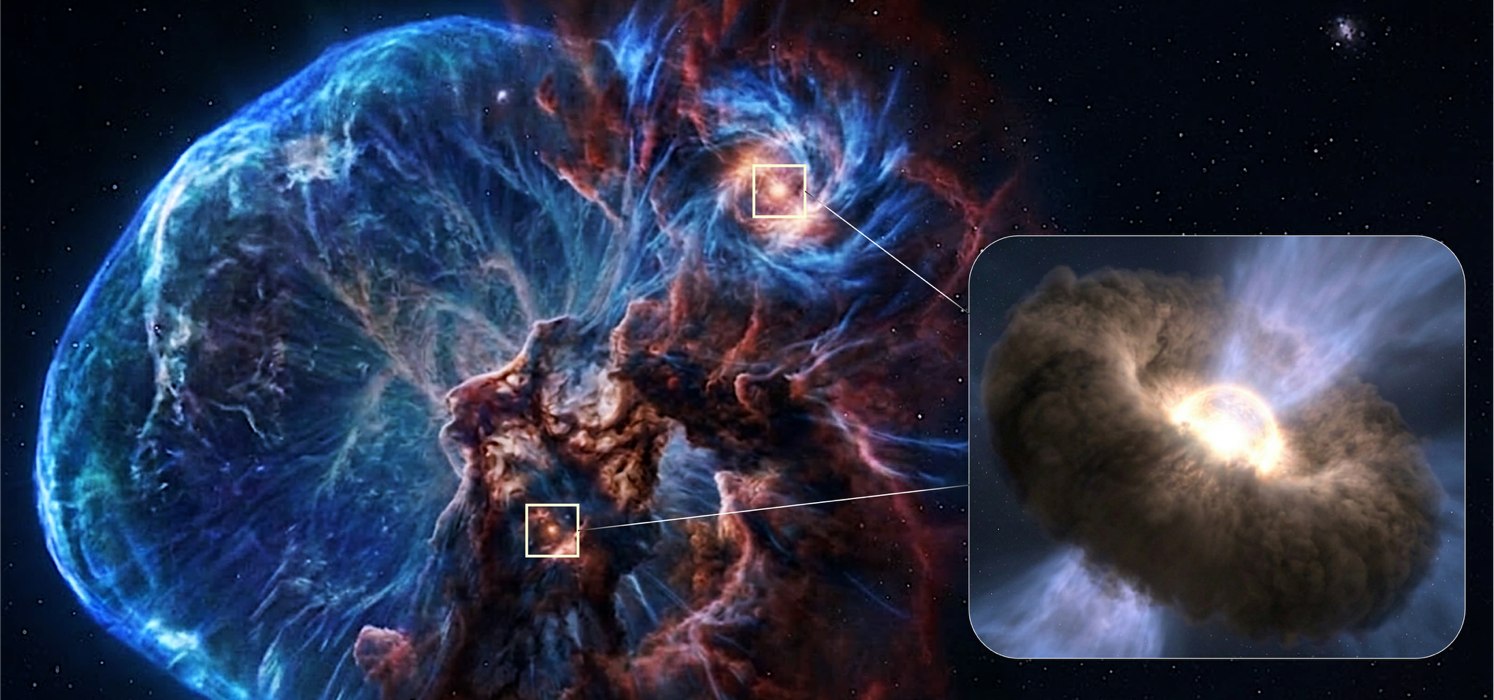
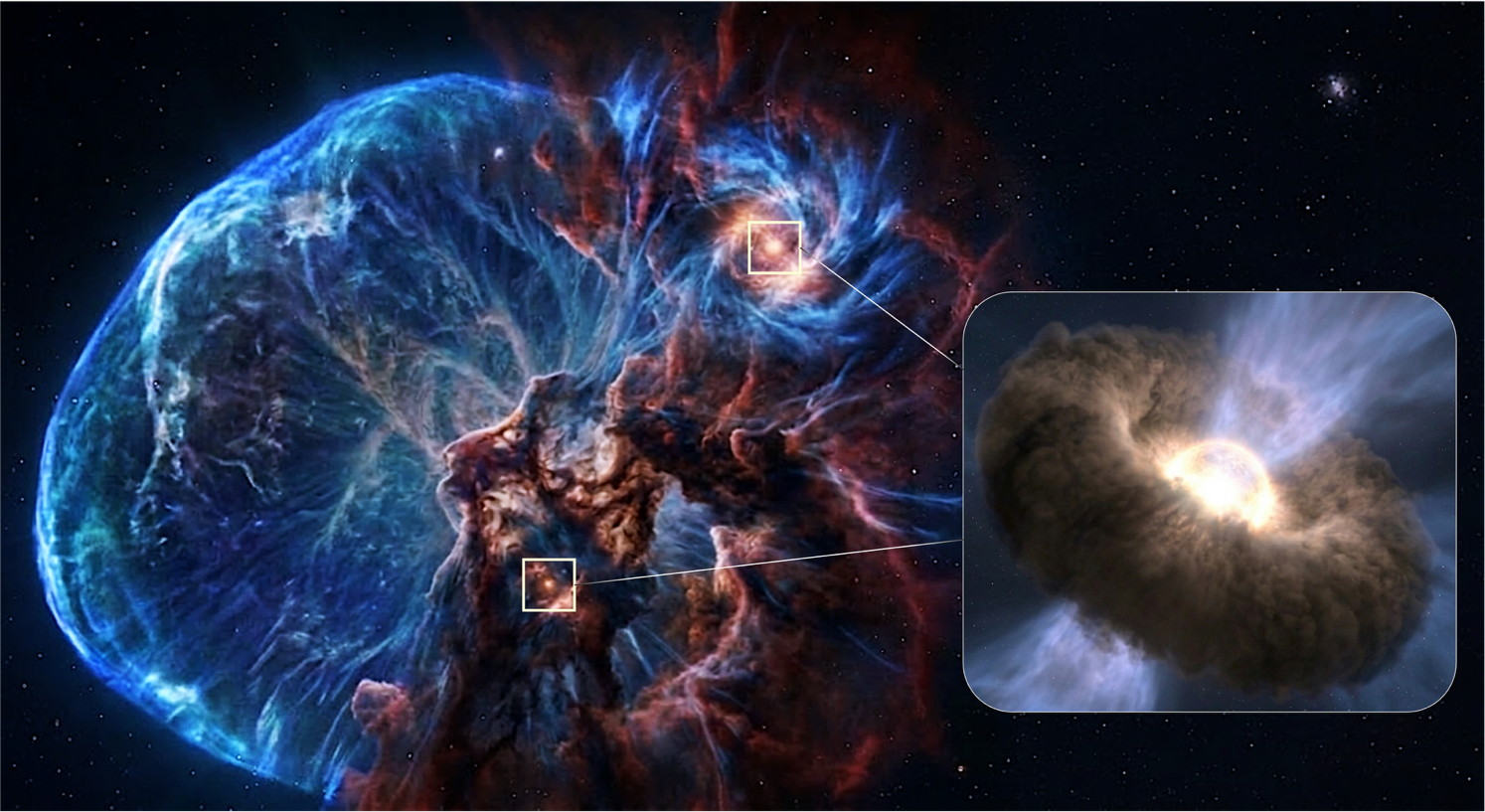
ALMA’s sensitivity and high angular resolution allowed the team to identify two hot cores within the supernova remnant. Both objects show rich molecular emission, including a wide variety of organic molecules. A detailed analysis of one of the hot cores revealed that the relative abundances of its complex organic molecules are remarkably similar to those found in hot cores in ordinary star-forming regions that have not experienced nearby supernova explosions.
“These observations indicate that even in the harsh environment of a supernova remnant, newborn stars can remain well protected within their natal cocoons, preserving their rich molecular composition,” says Takashi Shimonishi, an astronomer at Niigata University, Japan, and the paper’s lead author. “The environments capable of harboring complex organic molecules—potential building blocks of prebiotic chemistry—may be more diverse than previously recognized,” Shimonishi adds.
The result suggests that the molecules in these hot cores have not been significantly destroyed, despite their location in a region affected by supernova feedback. The researchers propose several possible explanations. One is that the hot cores may have only recently begun to experience the effects of the supernova, leaving too little time for energetic particles to significantly alter their chemistry. Another possibility is that strong magnetic fields amplified by the supernova shock may help shield the dense molecular gas by suppressing the penetration of cosmic rays.
The discovery may also help astronomers investigate the early environment of our own Solar System. Analyses of primitive Solar System materials suggest that the Sun and planets may have formed in a region influenced by a nearby supernova explosion. The chemically rich hot cores found in RX J1713.7−3946 may therefore provide a valuable analogy for studying how supernova feedback affects the raw materials of future stars and planets.
Although the newly discovered hot cores have retained their molecular richness, it remains unclear whether this is a common outcome in regions affected by supernovae. Future observations with radio and infrared telescopes will help reveal the physical and chemical properties of stellar cradles and protoplanetary disks shaped by supernova feedback, and may provide new insights into whether the environment in which the Solar System formed was typical or exceptional.
Additional Information
This research was presented in “Survival of Molecular Complexity under Recent Supernova Feedback: Detection of Hot Cores in RX J1713.7−3946,” by Takashi Shimonishi, Hidetoshi Sano, Kenji Furuya, and Yoko Oya, published in The Astrophysical Journal. DOI: 10.3847/1538-4357/ae6fba.
This article is based on a press release by the National Astronomical Observatory of Japan (NAOJ), an ALMA partner on behalf of East Asia.
The Atacama Large Millimeter/submillimeter Array (ALMA), an international astronomy facility, is a partnership of the European Southern Observatory (ESO), the U.S. National Science Foundation (NSF) and the National Institutes of Natural Sciences (NINS) of Japan in cooperation with the Republic of Chile. ALMA is funded by ESO on behalf of its Member States, by NSF in cooperation with the National Research Council of Canada (NRC) and the National Science and Technology Council (NSTC) in Taiwan and by NINS in cooperation with the Academia Sinica (AS) in Taiwan and the Korea Astronomy and Space Science Institute (KASI).
ALMA construction and operations are led by ESO on behalf of its Member States; by the National Radio Astronomy Observatory (NRAO), managed by Associated Universities, Inc. (AUI), on behalf of North America; and by the National Astronomical Observatory of Japan (NAOJ) on behalf of East Asia. The Joint ALMA Observatory (JAO) provides the unified leadership and management of the construction, commissioning and operation of ALMA.
Image
Contacts
-
Nicolás Lira
Education and Public Outreach OfficerJoint ALMA Observatory, Santiago - ChilePhone: +56 2 2467 6519Cel: +56 9 9445 7726Email: [email protected] -
Seiichiro Naito
NAOJ EPO LeadEmail: [email protected] -
Jill Malusky
Public Information Officer -
Bárbara Ferreira
ESO Media Manager