ALMA Lifts the Veil on Hidden Nurseries of Massive Star Clusters in Nearby Galaxies
ALMA and the NSF VLA reveal circumnuclear “ring factories” where massive star clusters form and evolve in nearby galaxies
Highlights
- ALMA revealed a population of young massive cluster candidates hidden within dense star-forming rings surrounding the centers of two nearby spiral galaxies.
- By tracing both cold dust and ionized gas, ALMA helped astronomers distinguish cluster candidates at different stages of their early evolution.
- The study provides one of the most detailed radio views to date of massive cluster formation in circumnuclear rings.
- Nearby galaxies such as NGC 3351 and NGC 1097 offer a unique opportunity to study star formation processes similar to those common in galaxies billions of years ago.
Astronomers have used the Atacama Large Millimeter/submillimeter Array (ALMA) and the U.S. National Science Foundation Karl G. Jansky Very Large Array (VLA) to peer through thick curtains of cosmic dust and build one of the clearest pictures yet of how massive star clusters are born in the hearts of nearby galaxies. Focusing on two barred spiral galaxies, NGC 3351 and NGC 1097, the team identified young massive cluster candidates at different stages of their early evolution, from deeply embedded, dust-shrouded objects to systems that have already begun clearing their surroundings — revealing objects that optical telescopes, and even many infrared observations, cannot see at all.
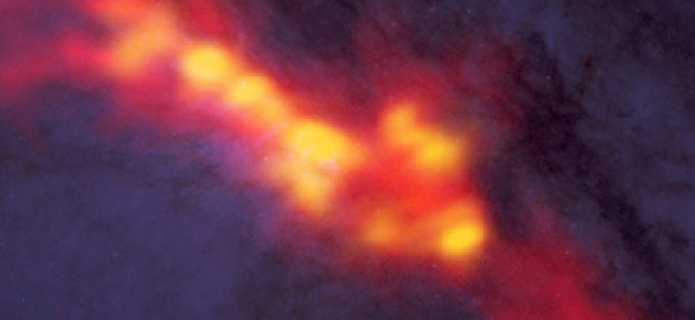
In many spiral galaxies, gas flowing inward along a central bar piles up in a dense, star-forming ring a few hundred to a thousand light-years from the galactic core, acting like a cosmic factory for massive star clusters. In NGC 3351 and NGC 1097, these circumnuclear rings pack gas into compact, high-pressure clumps and ignite bursts of star formation at rates and densities similar to those seen in typical galaxies when the Universe was only a few billion years old — making them nearby stand-ins for the early cosmos. By combining ALMA’s sensitivity to cold dust and embedded star formation with complementary VLA observations, the team observed the ring of NGC 3351 at several frequencies between 93 and 350 gigahertz and with the VLA at 33 gigahertz, and the larger, more active ring of NGC 1097 with ALMA alone across three complementary frequency bands. The team identified dozens of compact hot spots associated with the formation of star clusters.
Different kinds of radio emission reveal different parts of a cluster's story. Signals from ionized hydrogen gas trace the energetic glow surrounding the hottest young stars. Other radio signals come from high-energy particles launched by supernova explosions. Still others track the cold dust within the cluster's birth cloud. By carefully measuring how each compact source brightens or fades across the radio spectrum — and by requiring that real sources appear simultaneously in more than one radio band at the same position on the sky — the researchers detected fainter objects than previous surveys while still filtering out noise. Across both galaxies, the compact radio sources line up along the rings in bright knots, span sizes from a few to a few dozen light-years, and show the energy output of anywhere from a handful to more than a thousand of the most massive stars known, identifying a population that includes numerous young massive cluster candidates.
Because the radio data allow astronomers to separate these different emission types, the team can assign each source to a stage in a young cluster's early life. Dust-bright, radio-faint clumps mark the earliest observed stages of cluster formation. Clusters combining strong ionized-gas and dust emission but little supernova-related signal appear extremely young and still buried in their natal material. Sources with strong ionized-gas emission but weak dust likely host clusters that have blown away most of their birth cloud. And sources dominated by supernova-related radio emission indicate clusters where the most massive stars have already exploded. All four stages coexist within the same ring in both galaxies, confirming that massive cluster formation is a continuous, ongoing process rather than a single synchronized burst.
The team also compared their radio-selected sources to high-resolution images from the NASA/ESA/CSA James Webb Space Telescope, confirming that the compact radio sources genuinely correspond to star clusters and their immediate surroundings. The most luminous source in the entire sample, located in the NGC 1097 ring, is equivalent in ionizing power to roughly 1,200 of the hottest, most massive stars known, and ranks among the most powerful compact star-forming regions identified outside a starburst galaxy nucleus.
The conditions in these rings — thick gas, strong turbulence, and intense crowded star formation — closely resemble those in typical massive galaxies at the peak of cosmic star formation history. By using ALMA and the VLA together across a wide range of radio frequencies, astronomers can now study young massive cluster candidates representing different stages of early evolution within the same galactic ring, providing crucial tests for theories of how quickly clusters assemble, how efficiently they convert gas into stars, and how stellar feedback shapes the densest star-forming environments in galaxies near and far.
Additional Informaion
This research is presented in “A Multi-Band Radio Continuum Search for Young Massive Clusters in the Circumnuclear Rings of NGC 3351 and NGC 1097,” by Sajia Shahrin Neha and Jiayi Sun, accepted for publication in the Monthly Notices of the Royal Astronomical Society.
This news is featured in a press conference at the American Astronomical Society's 248th meeting on Wednesday, June 17th at 10:15am PDT. Find a recording from this presentation on the AAS Press Office YouTube channel.
This article is based on the original press release by the United States of America National Radio Astronomy Observatory (NRAO), an ALMA partner on behalf of North America.
The Atacama Large Millimeter/submillimeter Array (ALMA), an international astronomy facility, is a partnership of the European Southern Observatory (ESO), the U.S. National Science Foundation (NSF) and the National Institutes of Natural Sciences (NINS) of Japan in cooperation with the Republic of Chile. ALMA is funded by ESO on behalf of its Member States, by NSF in cooperation with the National Research Council of Canada (NRC) and the National Science and Technology Council (NSTC) in Taiwan and by NINS in cooperation with the Academia Sinica (AS) in Taiwan and the Korea Astronomy and Space Science Institute (KASI).
ALMA construction and operations are led by ESO on behalf of its Member States; by the National Radio Astronomy Observatory (NRAO), managed by Associated Universities, Inc. (AUI), on behalf of North America; and by the National Astronomical Observatory of Japan (NAOJ) on behalf of East Asia. The Joint ALMA Observatory (JAO) provides the unified leadership and management of the construction, commissioning and operation of ALMA.
Image
Contacts
-
Nicolás Lira
Education and Public Outreach OfficerJoint ALMA Observatory, Santiago - ChilePhone: +56 2 2467 6519Cel: +56 9 9445 7726Email: [email protected] -
Jill Malusky
Public Information Officer -
Bárbara Ferreira
ESO Media Manager -
Seiichiro Naito
NAOJ EPO LeadEmail: [email protected]