ALMA Reveals a Hidden Starburst Galaxy Linked to a High-Energy Neutrino
Gravitational lensing allowed astronomers to study a compact, dust-obscured galaxy from 11 billion years ago that is the most plausible counterpart candidate to an IceCube neutrino event
Highlights
- ALMA resolved a distant, dust-obscured galaxy into four gravitationally lensed images and revealed an extremely compact region of intense star formation.
- The galaxy, nicknamed "Shadow Blaster," lies within the localization region of the high-energy neutrino event IC 210922A.
- Its position, rarity, and dense, gas-rich core make it the most plausible electromagnetic counterpart candidate identified within the neutrino's localization region, although a chance alignment cannot be ruled out.
- The findings suggest that populations of compact starburst galaxies during "Cosmic Noon" may make a meaningful but subdominant contribution to the high-energy neutrino background.
Astronomers using the Atacama Large Millimeter/submillimeter Array (ALMA) have revealed the hidden structure of an intensely star-forming galaxy as it appeared nearly 11 billion years ago. Located in the same patch of sky as a high-energy neutrino detected by the IceCube Neutrino Observatory, the galaxy is the most plausible electromagnetic counterpart yet identified for that event.
Officially designated JCMT0402−0424 and nicknamed "Shadow Blaster," the galaxy is so deeply obscured by dust that it is nearly invisible at optical wavelengths. ALMA observations showed that its light has been magnified and distorted by the gravity of a massive foreground galaxy, splitting it into four separate images. By combining ALMA's high-resolution data with gravitational-lens modeling, the research team reconstructed the galaxy's true structure and probed the dense gas fueling its starburst.
A cosmic messenger with an uncertain origin
Neutrinos are electrically neutral elementary particles that interact only weakly with matter. They can travel through gas, dust, and magnetic fields almost unaltered, carrying information directly from some of the most energetic environments in the universe.
On September 22, 2021, IceCube — embedded deep in the Antarctic ice — detected a high-energy neutrino event designated IC 210922A, with an estimated energy of roughly 750 teraelectronvolts, far beyond what most known astronomical processes can produce. Telescopes around the world searched the neutrino's localization region across the spectrum but found no convincing gamma-ray, X-ray, or optical transient to explain it.
Follow-up observations with the James Clerk Maxwell Telescope turned up an exceptionally bright submillimeter source within the region. The Submillimeter Array refined its position, and ALMA then provided the resolution and spectral detail needed to determine its physical nature. The team estimates the chance of finding such an unusually bright submillimeter galaxy at random within the IceCube localization region at roughly 1% or lower. That doesn't establish a definitive physical link, but the positional coincidence — combined with the absence of any equally plausible alternative — makes Shadow Blaster the leading candidate counterpart in the field.
ALMA uncovers four images of one hidden galaxy
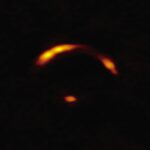
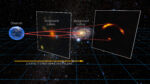
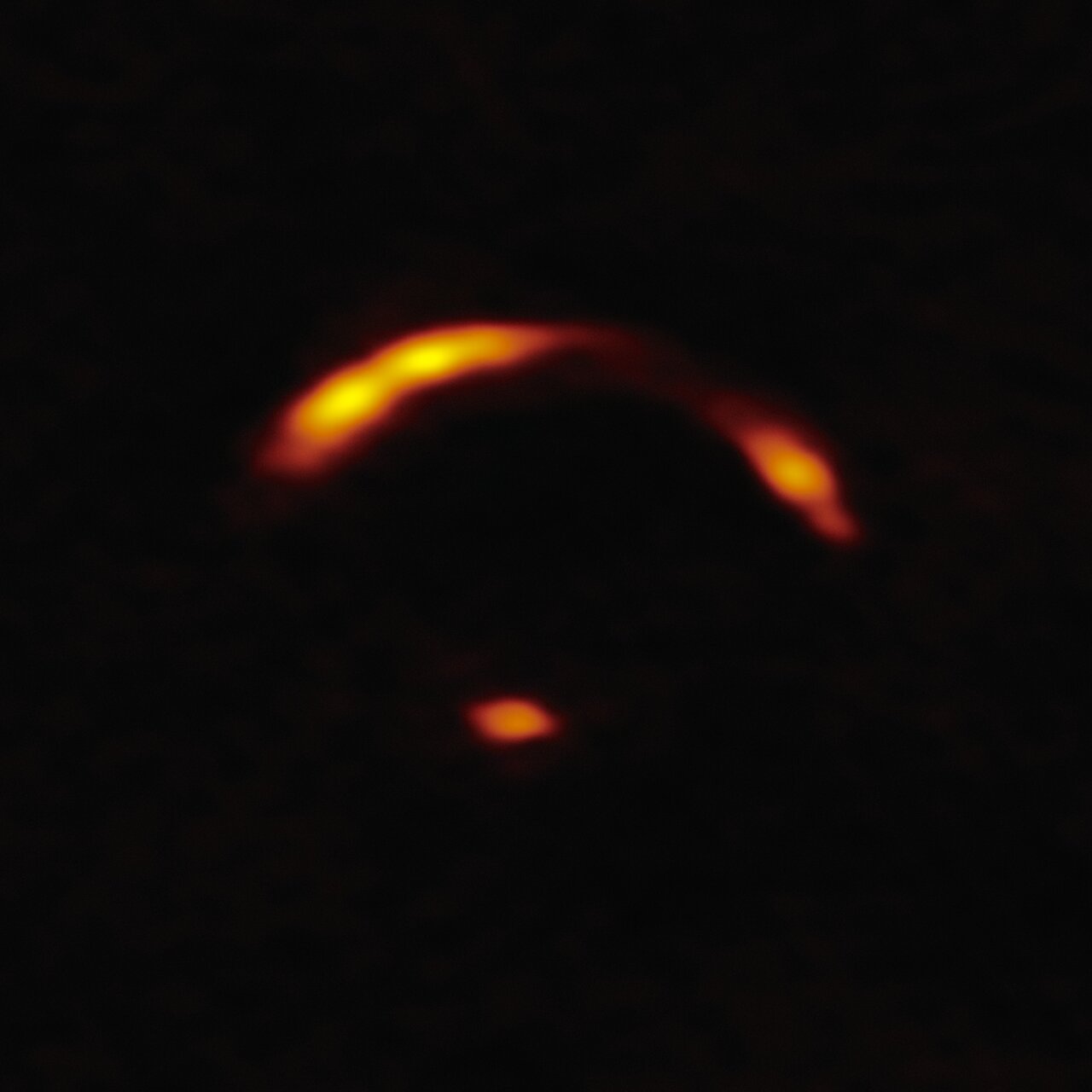
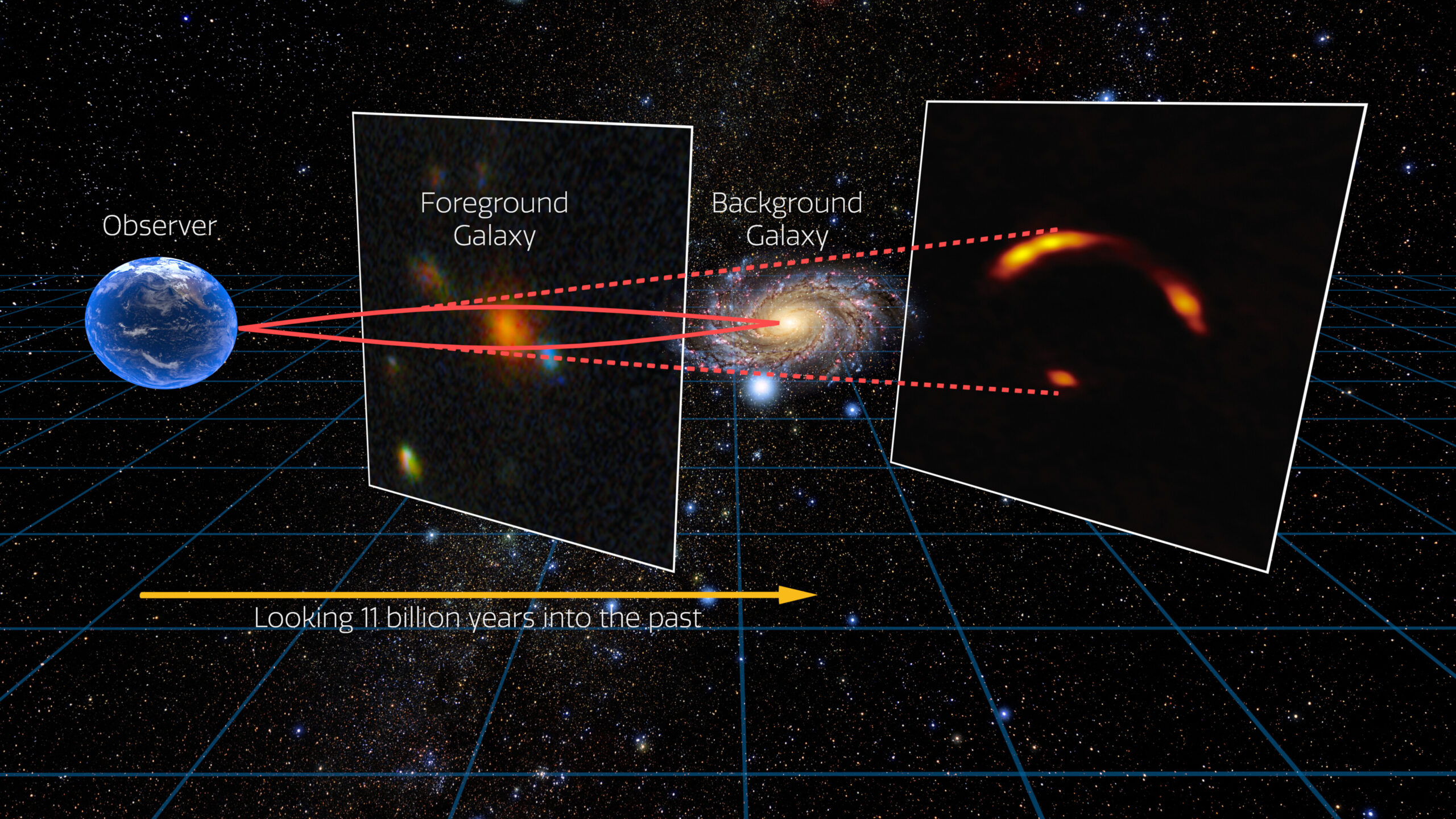
ALMA observed Shadow Blaster in Bands 3, 4, and 5. Its highest-resolution continuum data resolved the source into four distinct images arranged around a foreground elliptical galaxy — the signature of strong gravitational lensing, in which the foreground galaxy's gravity bends and magnifies light from the much more distant background source, acting as a natural cosmic telescope.
Using the four lensed images together with optical and infrared data on the foreground galaxy, the team modeled the lensing effect and reconstructed Shadow Blaster's intrinsic appearance. The reconstruction revealed an extended star-forming region roughly 1,700 light-years across, alongside an even more compact, unresolved component. The magnification from lensing let ALMA resolve spatial scales that would otherwise have been extremely difficult to study at this distance.
A compact and gas-rich starburst
ALMA detected several emission lines from carbon monoxide and neutral atomic carbon, establishing a precise redshift of 2.988 — meaning the light began its journey when the universe was only a few billion years old, during the era known as "Cosmic Noon," when galaxies formed stars at the highest rates in cosmic history.
These molecular-line measurements let the astronomers examine the excitation and motion of the gas inside the galaxy. The data show no clear sign that a powerful active galactic nucleus dominates its energy output; instead, the gas properties point to an intense, compact episode of star formation. After correcting for gravitational magnification, the team estimates the galaxy is forming hundreds of solar masses of stars per year, with large quantities of gas and dust packed into a compact central region.
That density matters for the neutrino question: it creates conditions where energetic cosmic rays can repeatedly collide with surrounding matter, producing short-lived particles that decay into gamma rays and neutrinos. Dense, dusty starbursts may act as cosmic-ray "calorimeters" — trapping energetic particles long enough for much of their energy to be converted into these secondary particles.
A possible population of hidden neutrino sources
The expected neutrino output of any single dusty star-forming galaxy is modest, and the study does not claim Shadow Blaster has been conclusively identified as the source of IC 210922A. But the galaxy's location, rarity, compact structure, and gas-rich core together strengthen the case for a possible association — and suggest that similar galaxies could contribute collectively to the diffuse background of high-energy neutrinos observed across the sky.
Population modeling in the study indicates that compact-core dusty starburst galaxies could account for roughly 15%, and at most around 20% in the models considered, of the diffuse astrophysical neutrino flux between tens of teraelectronvolts and petaelectronvolt energies. That would be a meaningful but subdominant contribution — implying that several different classes of astronomical objects are likely responsible for the neutrinos IceCube and other observatories detect.
The result is a clear demonstration of multi-messenger astronomy at work: combining a particle signal with observations across the electromagnetic spectrum. It also underscores ALMA's unique ability to reveal the dense gas, dust, and compact structures hidden inside galaxies that visible light alone cannot penetrate.
Additional information
This research is presented in the paper "Compact dusty starbursts at cosmic noon linked to high-energy neutrinos," by Y. Urata et al., published in Nature Astronomy.
This article is based on the original press release by the National Astronomical Observatory of Japan (NAOJ), an ALMA partner on behalf of East Asia.
The Atacama Large Millimeter/submillimeter Array (ALMA), an international astronomy facility, is a partnership of the European Southern Observatory (ESO), the U.S. National Science Foundation (NSF) and the National Institutes of Natural Sciences (NINS) of Japan in cooperation with the Republic of Chile. ALMA is funded by ESO on behalf of its Member States, by NSF in cooperation with the National Research Council of Canada (NRC) and the National Science and Technology Council (NSTC) in Taiwan and by NINS in cooperation with the Academia Sinica (AS) in Taiwan and the Korea Astronomy and Space Science Institute (KASI).
ALMA construction and operations are led by ESO on behalf of its Member States; by the National Radio Astronomy Observatory (NRAO), managed by Associated Universities, Inc. (AUI), on behalf of North America; and by the National Astronomical Observatory of Japan (NAOJ) on behalf of East Asia. The Joint ALMA Observatory (JAO) provides the unified leadership and management of the construction, commissioning and operation of ALMA.
Images
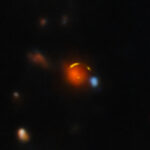
Gravitational lensing occurs when a very massive foreground galaxy bends spacetime, acting as a cosmic magnifying glass that enlarges and distorts the image of a more distant galaxy behind it. In this case, a foreground galaxy, which is not visible in this image, is bending the light of the more distant Shadow Blaster galaxy, creating multiple distorted images of it that appear here as yellow arcs. Credit: NOIRLab/NSF/AURA/ALMA (ESO/NAOJ/NRAO)
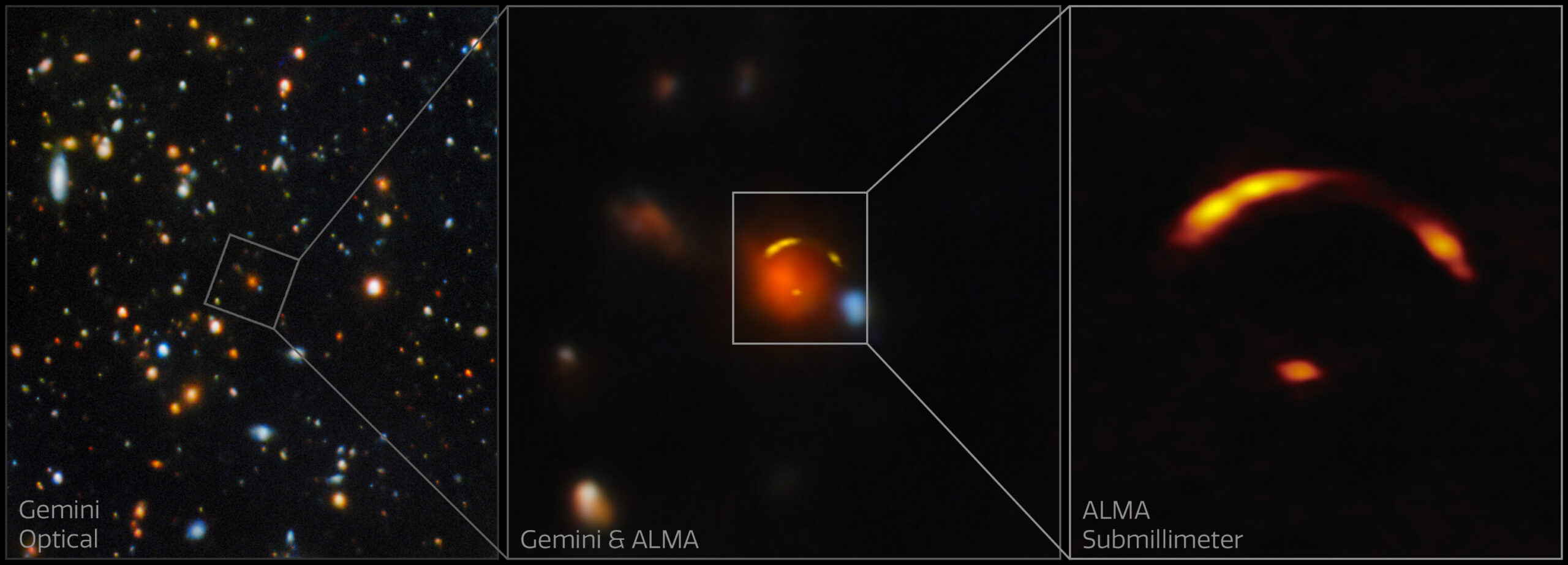
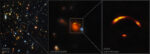
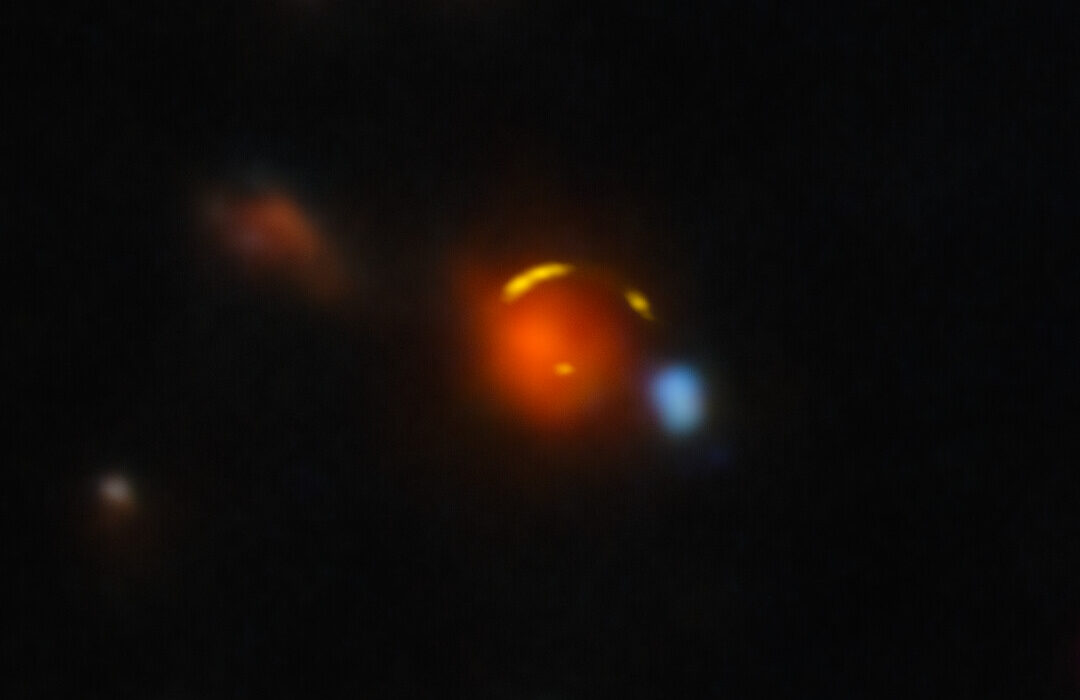
Center: a close-up of the gravitational lens in which the red foreground galaxy is causing the light from the more distant Shadow Blaster galaxy to bend around it, creating multiple distorted images of the galaxy that appear as yellow arcs.
Right: a close-up of the gravitationally lensed Shadow Blaster galaxy.
These images were captured with the Atacama Large Millimeter/submillimeter Array (ALMA) and the Gemini North telescope, one half of the International Gemini Observatory, partly funded by the U.S. National Science Foundation and operated by NSF NOIRLab. Credit: International Gemini Observatory/NOIRLab/NSF/AURA/ALMA (ESO/NAOJ/NRAO)
Image Processing: T.A. Rector (University of Alaska Anchorage/NSF NOIRLab), D. de Martin & M. Zamani (NSF NOIRLab)
Acknowledgment: PI: Yuji Urata (MITOS Science Co., LTD.)
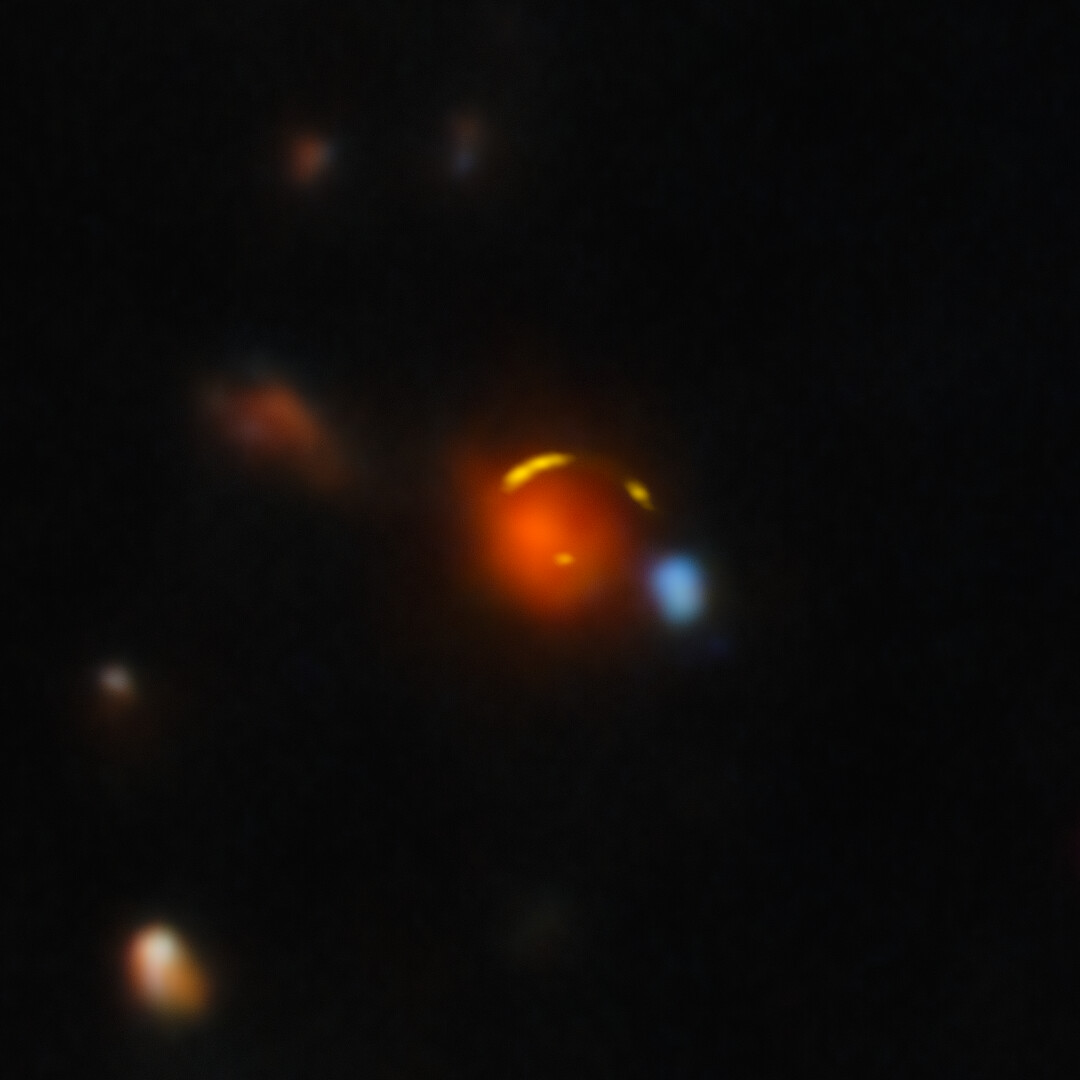
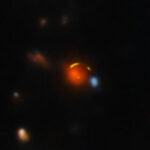
Gravitational lensing occurs when a very massive foreground galaxy bends space-time, acting as a cosmic magnifying glass that enlarges and distorts the image of a more distant galaxy behind it. In this case, the red foreground galaxy is bending the light of the more distant Shadow Blaster galaxy, creating multiple distorted images of it that appear here as yellow arcs.
This composite image was created using data from the Atacama Large Millimeter/submillimeter Array (ALMA) and the Gemini North telescope, one half of the International Gemini Observatory, partly funded by the U.S. National Science Foundation and operated by NSF NOIRLab. Credit: International Gemini Observatory/NOIRLab/NSF/AURA/ALMA (ESO/NAOJ/NRAO)
Image Processing: T.A. Rector (University of Alaska Anchorage/NSF NOIRLab), D. de Martin & M. Zamani (NSF NOIRLab)
Acknowledgment: PI: Yuji Urata (MITOS Science Co., LTD.)
Image Processing: T.A. Rector (University of Alaska Anchorage/NSF NOIRLab), D. de Martin & M. Zamani (NSF NOIRLab)
Motion Graphics: N. Bartmann
Contacts
-
Nicolás Lira
Education and Public Outreach OfficerJoint ALMA Observatory, Santiago - ChilePhone: +56 2 2467 6519Cel: +56 9 9445 7726Email: [email protected] -
Seiichiro Naito
NAOJ EPO LeadEmail: [email protected] -
Jill Malusky
Public Information Officer -
Bárbara Ferreira
ESO Media Manager