ALMA Cycle 13 Set to Begin
Record Demand and a New Window on the Universe
The Atacama Large Millimeter/submillimeter Array (ALMA) is preparing to begin Cycle 13 science observations on 1 October 2026, launching a new year of exploration with record demand from the international astronomical community and a major expansion of the observatory’s scientific capabilities. For the first time in a general observing cycle, astronomers will be able to use ALMA’s new Band 2 receivers, opening new opportunities to study the cold Universe at longer millimeter wavelengths. Cycle 13 will run until 30 September 2027.
Interest in ALMA reached an all-time high for Cycle 13. The observatory received 1,839 proposals, requesting 37,471 hours of observing time on the 12-meter Array — the highest number of proposals and the largest amount of requested 12-meter Array time in any ALMA cycle to date. With 4,300 hours originally offered, demand exceeded the available time by a factor of 8.7. A total of 229 proposals received the highest-priority Grades A or B, representing an overall acceptance rate of about 12%.
“The record demand for ALMA reflects the wide range of science that astronomers want to pursue with the observatory,” said John Carpenter, ALMA Observatory Scientist. “With Band 2 available in Cycle 13, we can explore new aspects of how stars, planets, and galaxies form and evolve. We look forward to seeing what these ambitious programs reveal.”
The new observing program spans the full breadth of ALMA science, from some of the earliest galaxies in the Universe to the processes that form stars, planets and complex chemical environments much closer to home. The 229 Grade A and B projects were allocated 4,257 hours on the 12-meter Array, 2,089 hours on the 7-meter Array, and 1,739 hours on the Total Power Array. The 12-meter allocation is slightly below the nominal 4,300 hours because some unfinished Grade A observations from Cycle 12 are expected to carry over into Cycle 13.
One of Cycle 13’s most significant advances is the introduction of Band 2 for science observations with the 12-meter Array. Covering frequencies from approximately 67 to 116 GHz, Band 2 is the last of ALMA’s ten planned receiver bands to become available, completing the observatory’s originally envisioned receiver coverage across the millimeter and submillimeter spectrum. The astronomical community responded strongly to the new capability: 210 proposals requested Band 2, making it the fourth most requested receiver band for observing time.
Cycle 13 will also include four new Large Programs, ambitious projects designed to address scientific questions that require substantial observing campaigns. They will investigate the complex environments surrounding aging stars; conduct a deep survey to build a census of star formation in a distant extragalactic field; connect the earliest embedded stages of planet-forming disks with their later evolution; and study how solid material evolves in the environments where planetary systems assemble.
“These Large Programs will help us to study important stages in the evolution of stars and planetary systems, while also building a more comprehensive view of star formation in the distant Universe,” said Carpenter. “By studying large samples in detail, we can begin to distinguish what is common from what is exceptional—and better understand the processes shaping what we see.”
These projects are part of a diverse observing program covering all five of ALMA’s major science areas. The most submitted proposals focused on the interstellar medium, star formation, and astrochemistry, while strong demand was seen across cosmology, galaxies, circumstellar disks and planetary systems, and stellar evolution. Bands 6 and 7 continued to attract the largest amount of requested observing time, alongside the strong debut of Band 2.
Selecting the Cycle 13 program relied on extensive participation from the astronomical community. The ALMA Proposal Review Committee, consisting of 20 members and a chair, evaluated the 47 submitted Large Program proposals, supported by 80 external Science Assessors. The remaining proposals were assessed through ALMA’s distributed peer-review system, in which 1,216 astronomers submitted nearly 17,900 reviews. The resulting scientific ranking, together with factors such as weather, receiver availability, array configuration and the location of targets in the sky, was used to construct the observing program.
Cycle 13 also continues ALMA’s growing coordination with other major observatories. A record 91 Joint Proposals were submitted for observations combining ALMA with the NASA/ESA/CSA James Webb Space Telescope, the U.S. National Science Foundation Very Large Array, or ESO’s Very Large Telescope. Public information on the highest-priority Cycle 13 projects, including titles, abstracts, and investigator teams, is available through the ALMA Science Portal.
ALMA thanks the members of the ALMA Proposal Review Committee, the external Science Assessors and the more than one thousand astronomers who contributed their time and expertise to the distributed peer-review process. Their participation is essential to building a scientific program that makes the most effective use of one of the world’s most powerful astronomical observatories.
With observations beginning on 1 October, Cycle 13 brings together unprecedented community demand, a broad new scientific program and the arrival of Band 2 — extending ALMA’s ability to investigate the cold Universe and setting the stage for another year of discoveries from the Chajnantor Plateau.
Additional Information
ALMA is a partnership of ESO (representing its member states), NSF (USA), and NINS (Japan), together with NRC (Canada), NSTC and ASIAA (Taiwan), and KASI (Republic of Korea), in cooperation with the Republic of Chile. The Joint ALMA Observatory is operated by ESO, AUI/NRAO, and NAOJ.
Images
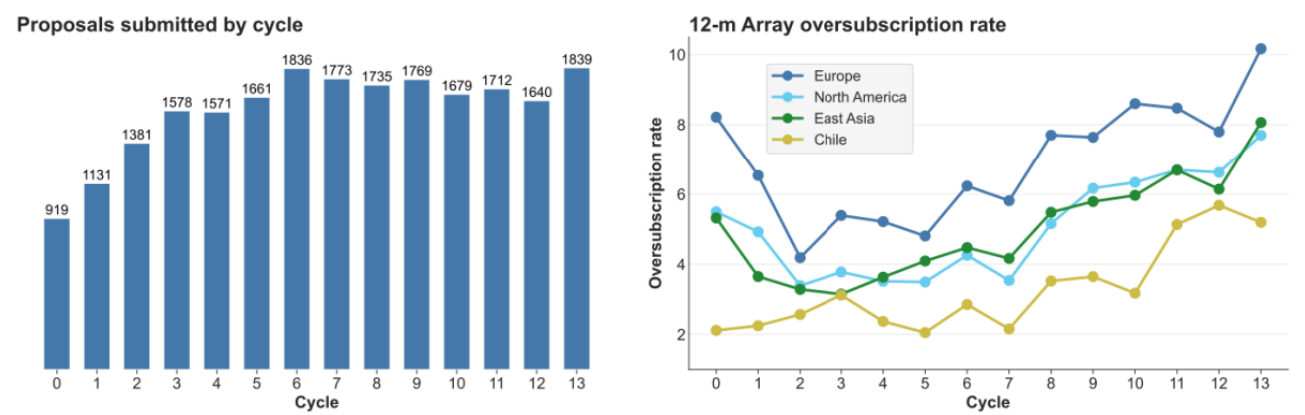
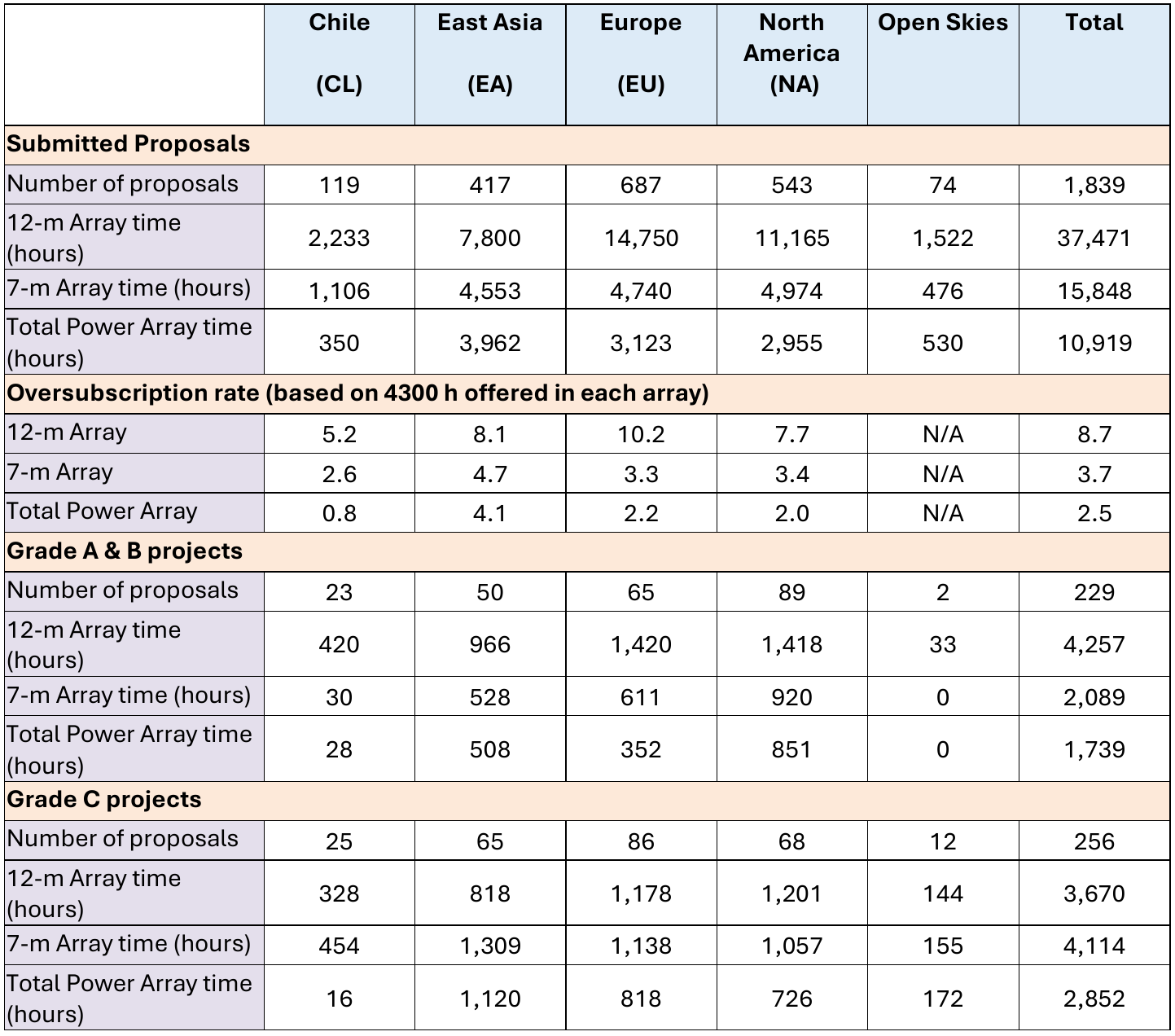
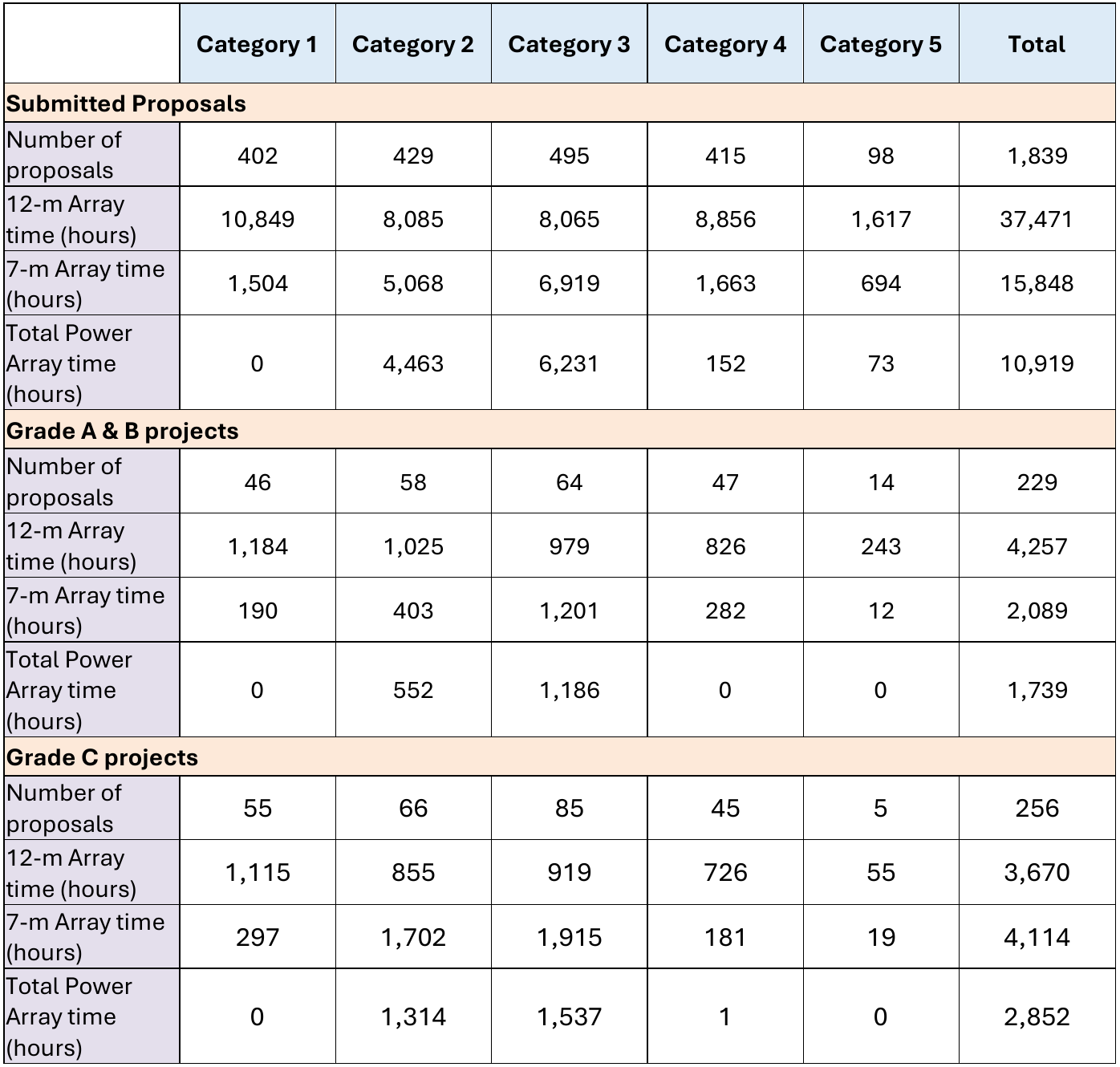
* The five ALMA science categories are (1) Cosmology and the high redshift universe, (2) Galaxies and galactic nuclei, (3) ISM, star formation and astrochemistry, (4) Circumstellar disks, exoplanets and the solar system, and (5) Stellar evolution and the Sun.
Contacts
-
Nicolás Lira
Education and Public Outreach OfficerJoint ALMA Observatory, Santiago - ChilePhone: +56 2 2467 6519Cel: +56 9 9445 7726Email: [email protected]