ALMA and VLA Reveal a Vast Reservoir of Star-Forming Fuel in a Galaxy Near Cosmic Dawn
Highlights
- Astronomers used ALMA and the NSF Very Large Array (VLA) to detect molecular gas in REBELS-25, a massive star-forming galaxy observed just 700 million years after the Big Bang.
- The observations reveal a reservoir of roughly 100 billion solar masses of cool gas — the raw fuel for star formation — in one of the earliest and most distant galaxies ever studied in this way.
- The VLA achieved the most distant detection to date of a key molecular gas tracer, while ALMA provided a detailed picture of the galaxy’s star-forming environment.
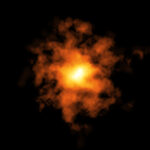
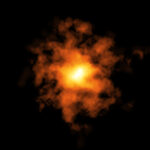
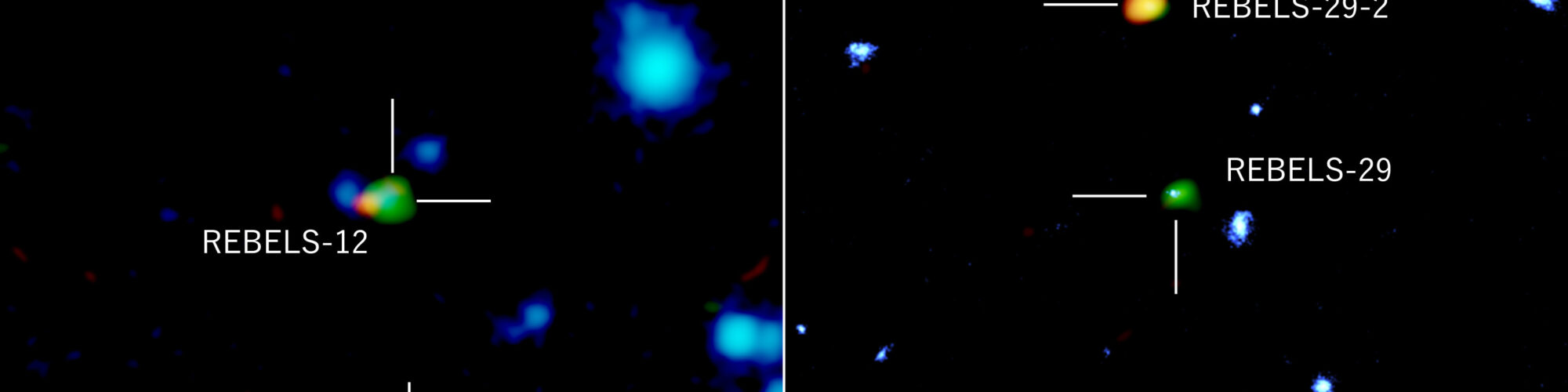
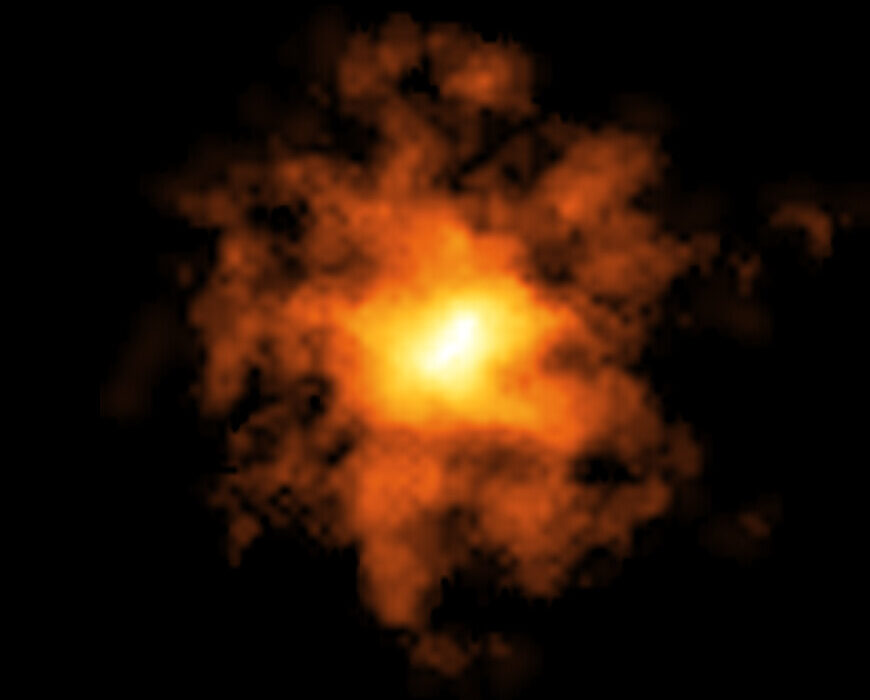
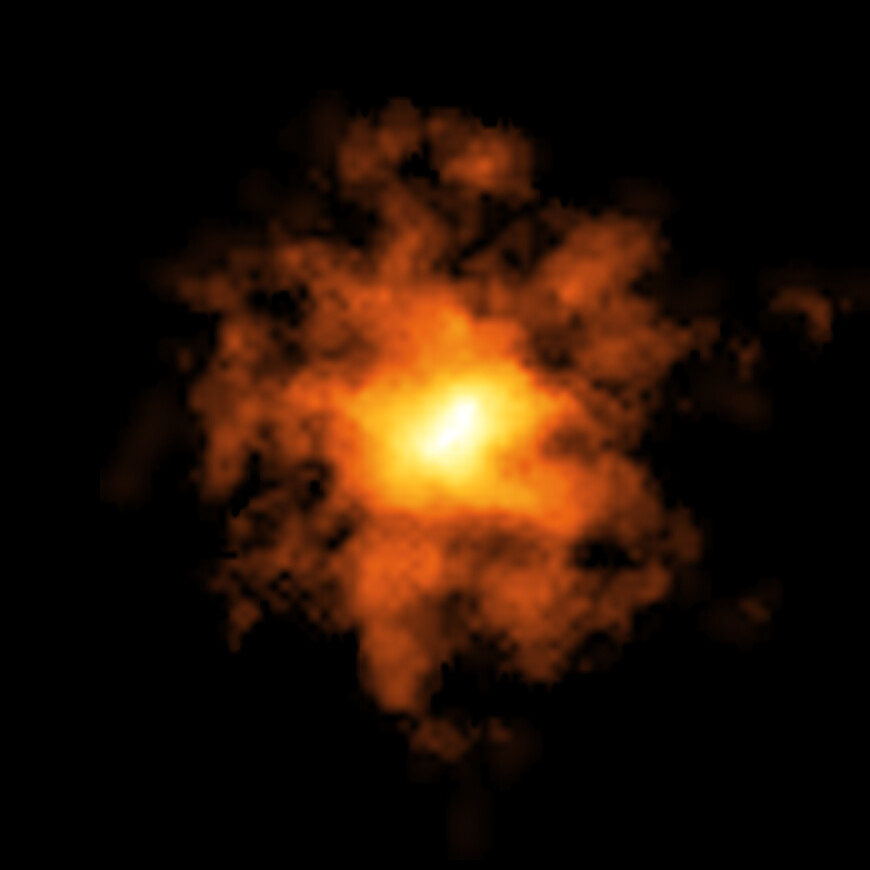
Astronomers have directly detected a vast reservoir of cool molecular gas in REBELS-25, a massive star-forming galaxy seen just 700 million years after the Big Bang. The discovery, made using the NSF Very Large Array (VLA) and the Atacama Large Millimeter/submillimeter Array (ALMA), provides a rare direct measurement of the star-forming fuel available to a galaxy in the early universe.
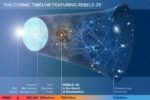
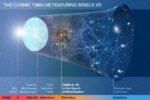
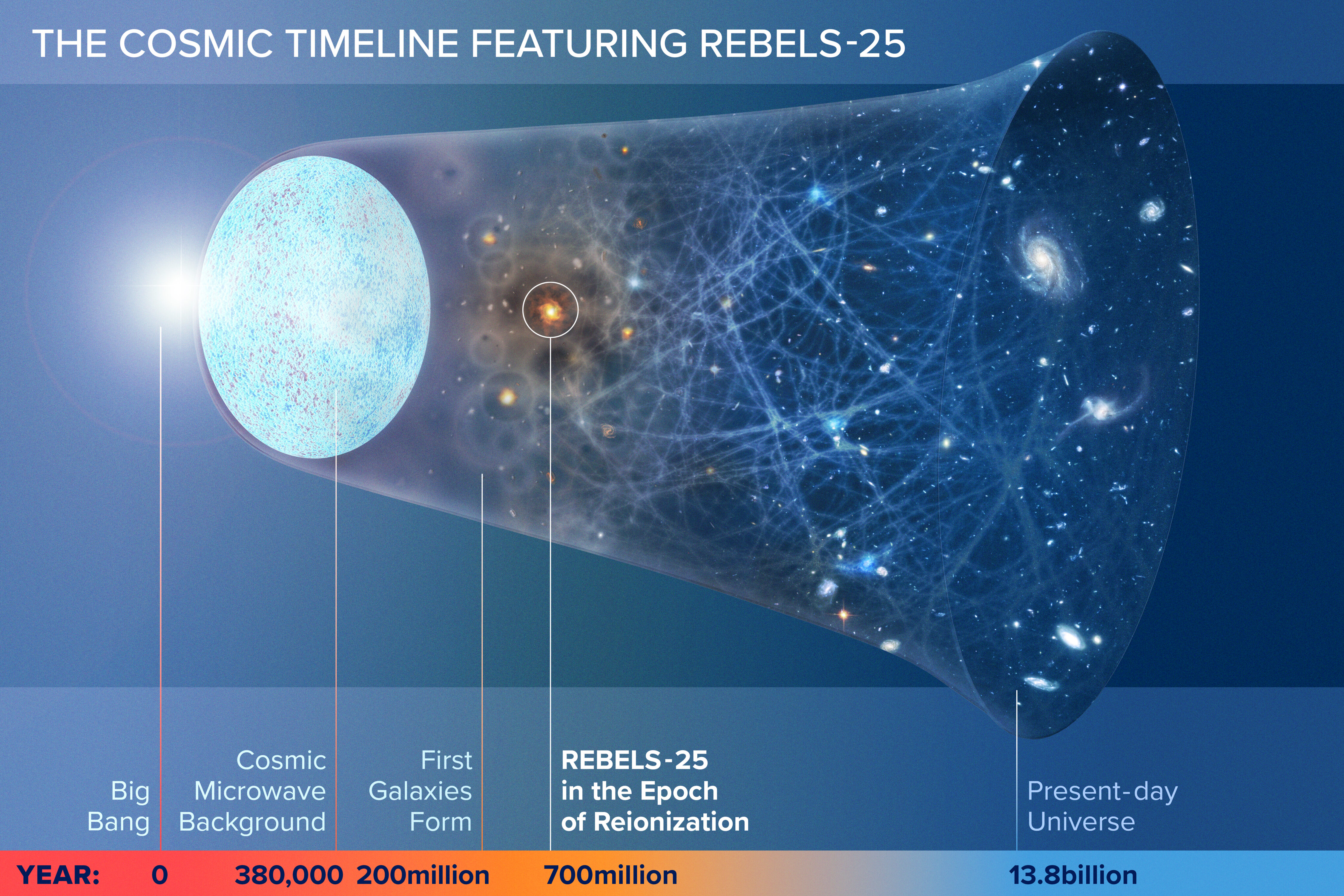
REBELS-25 is observed at a cosmic distance so vast that its light has been stretched – or redshifted – by the expansion of the universe to a redshift of z = 7.31. Astronomers see the galaxy as it was roughly 13 billion years ago, during the Epoch of Reionization — the period when the first stars and galaxies were transforming the young universe, just 5% of its current age.
Galaxies grow by turning gas into stars, and molecular gas is the primary raw material for that process. Until now, astronomers had strong indirect evidence that some early, massive galaxies contained large gas supplies, but directly detecting this material at such early cosmic times has been extremely difficult.
The team, led by Karin Cescon of Leiden University, used deep VLA observations to search for faint radio emission from carbon monoxide, or CO, a molecule commonly used to trace molecular gas. The VLA detected a low-energy CO transition that traces relatively cool gas – the most distant detection of this kind ever reported, and the first in a star-forming galaxy this early in cosmic history.
“Our results show galaxies just 700 million years after the Big Bang already contained large reservoirs of cold gas available for star formation,” said Karin Cescon, PhD student at Leiden University and lead author. “With these deep NSF VLA observations, we were able to overcome the observational challenges posed by the cosmic microwave background.”
That background – the ancient glow of radiation left over from the early universe – makes these observations especially challenging. At high redshift, it is warmer and brighter than it is today, like trying to spot a faint light against an increasingly bright sky. By accounting for this effect, the team derived a molecular gas mass of roughly 100 billion solar masses, a figure independently supported by modeling of both the CO and dust emission.
ALMA played a crucial role in completing the picture. Its observations detected higher-energy carbon monoxide emission and provided measurements of dust and ionized carbon, together revealing the gas’s physical conditions and confirming that the CO emission lines up spatially with other star-formation tracers. The results confirm that REBELS-25 is strongly gas-dominated, with a reservoir large enough to sustain vigorous star formation. They also suggest that ionized carbon emission, one of ALMA’s most powerful tools for studying early galaxies, remains a viable – if imperfect – tracer of molecular gas at these distances.
“This NSF VLA detection is an exciting sneak peek of what’s to come with the ngVLA,” noted Karin’s PhD advisor, Professor Jacqueline Hodge. “The ngVLA will allow us to find and study cool gas in many more young galaxies, including those at even earlier times. This will be crucial for understanding how the first galaxies formed and grew.”
The discovery helps explain how some early galaxies grew so large, so fast. The direct confirmation of such a massive gas reservoir – assembled when the universe was still in its infancy – places REBELS-25 among the most informative laboratories for studying how galaxies built up their ordinary matter, formed stars, and enriched the chemical content of their interstellar medium during the first billion years of cosmic history.}
Together, ALMA and current and future radio facilities are opening a new window onto the fuel supply of the earliest galaxies. Expanding the sample of galaxies with these kinds of measurements at z>7 will be essential for understanding how efficiently the first galaxies formed stars – and ultimately, how the universe came to look the way it does today.
Additional Information
This research is presented in “Direct detection of cool molecular gas in a star-forming galaxy at z = 7.31,” by K. Cescon et al., published in Monthly Notices of the Royal Astronomical Society.
The Atacama Large Millimeter/submillimeter Array (ALMA) data used in this study include observations from project 2021.1.01495.S. The VLA observations are available under project 21A-335.
This article is based on the original press release by the U.S. National Science Foundation National Radio Astronomy Observatory (NRAO), an ALMA partner on behalf of North America.
The Atacama Large Millimeter/submillimeter Array (ALMA), an international astronomy facility, is a partnership of the European Southern Observatory (ESO), the U.S. National Science Foundation (NSF) and the National Institutes of Natural Sciences (NINS) of Japan in cooperation with the Republic of Chile. ALMA is funded by ESO on behalf of its Member States, by NSF in cooperation with the National Research Council of Canada (NRC) and the National Science and Technology Council (NSTC) in Taiwan and by NINS in cooperation with the Academia Sinica (AS) in Taiwan and the Korea Astronomy and Space Science Institute (KASI).
ALMA construction and operations are led by ESO on behalf of its Member States; by the National Radio Astronomy Observatory (NRAO), managed by Associated Universities, Inc. (AUI), on behalf of North America; and by the National Astronomical Observatory of Japan (NAOJ) on behalf of East Asia. The Joint ALMA Observatory (JAO) provides the unified leadership and management of the construction, commissioning and operation of ALMA.
Images
Credit: ALMA (ESO/NAOJ/NRAO)/L. Rowland et al.
Contacts
-
Nicolás Lira
Education and Public Outreach OfficerJoint ALMA Observatory, Santiago - ChilePhone: +56 2 2467 6519Cel: +56 9 9445 7726Email: [email protected] -
Jill Malusky
Public Information Officer -
Bárbara Ferreira
ESO Media Manager -
Seiichiro Naito
NAOJ EPO LeadEmail: [email protected]