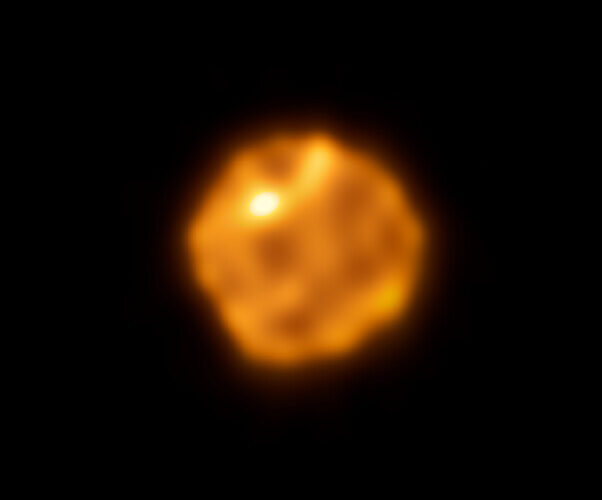
ALMA and VLA Reveal Signs of a Companion Stirring Betelgeuse’s Atmosphere
Radio observations trace changes in the red supergiant’s shape and reveal a cool layer close to its surface.
Astronomers using the Atacama Large Millimeter/submillimeter Array (ALMA) and the U.S. National Science Foundation’s Karl G. Jansky Very Large Array (NSF VLA) have found evidence that a nearby companion is disturbing Betelgeuse’s extended atmosphere. The observations also show how the red supergiant’s atmospheric temperatures have changed since its dramatic dimming in late 2019 and early 2020.
Led by Lynn D. Matthews of MIT Haystack Observatory, the team combined measurements taken between 2021 and 2026 at seven frequencies, from 22 to 485 gigahertz. Different radio frequencies reveal different atmospheric depths, allowing astronomers to examine this enormous star layer by layer.
“This companion is orbiting so close to the star that it actually passes through its extended atmosphere,” Matthews said.
A changing outline
The companion, known as Siwarha, is too faint to appear directly in these radio observations. Instead, the researchers examined changes in Betelgeuse’s outline. Its atmosphere appears more elongated when the companion is expected to lie farther from the star in our view, and rounder when it should pass in front of or behind it. This pattern supports the idea that the companion disturbs the surrounding gas as it orbits. Observations covering more of the orbit are needed to test that interpretation.
ALMA probes a cool atmospheric layer
The measurements reveal an atmosphere with a complex temperature structure. At the highest frequency observed, ALMA probes closer to the visible surface, where the team measured a brightness temperature of about 2,200 kelvin. Brightness temperature describes the temperature corresponding to the radiation detected by the telescope. The result confirms a cool region between the visible surface and the chromosphere above it.
Farther out, at approximately 2.7 times the star’s radius, the brightness temperature reaches about 3,500 kelvin. At the VLA frequencies, it has risen from the unusually low values measured in 2019, before the Great Dimming. Together, these measurements help astronomers follow changes across the atmosphere of an evolved star and investigate the influence of a close companion.
Additional Information
The study by L. D. Matthews, A. K. Dupree, A. M. S. Richards and W. R. F. Dent is titled New Spatially Resolved Observations of Betelgeuse from the VLA and ALMA: Evidence for Atmospheric Perturbations from a Close Companion. NRAO reports its publication in The Astronomical Journal. The preprint is available on arXiv.
This article is based on the original press release by the National Radio Astronomy Observatory (NRAO) of the United States, an ALMA partner on behalf of North America.
The Atacama Large Millimeter/submillimeter Array (ALMA), an international astronomy facility, is a partnership of the European Southern Observatory (ESO), the U.S. National Science Foundation (NSF), and the National Institutes of Natural Sciences (NINS) of Japan in cooperation with the Republic of Chile. ALMA is funded by ESO on behalf of its Member States, by NSF in cooperation with the National Research Council of Canada (NRC) and the National Science and Technology Council (NSTC) in Taiwan, and by NINS in cooperation with the Academia Sinica (AS) in Taiwan and the Korea Astronomy and Space Science Institute (KASI).
ALMA construction and operations are led by ESO on behalf of its Member States; by the National Radio Astronomy Observatory (NRAO), managed by Associated Universities, Inc. (AUI), on behalf of North America; and by the National Astronomical Observatory of Japan (NAOJ) on behalf of East Asia. The Joint ALMA Observatory (JAO) provides the unified leadership and management of the construction, commissioning, and operation of ALMA.
Image

Contacts
-
Nicolás Lira
Education and Public Outreach OfficerJoint ALMA Observatory, Santiago - ChilePhone: +56 2 2467 6519Cel: +56 9 9445 7726Email: [email protected] -
Cyprus Van Inwegen
Public Information OfficerNRAOEmail: [email protected] -
Bárbara Ferreira
ESO Media Manager -
Seiichiro Naito
NAOJ EPO LeadEmail: [email protected]